Get Full Government Meeting Transcripts, Videos, & Alerts Forever!
Get email alerts on the Budget Process topic
No spam. Unsubscribe anytime.
Ways and Means subcommittee holds primer on budget process, ORBITS tracking and posting rules
Summary
Subcommittee staff briefed members on how primary appropriation bills are numbered and structured, how the ORBITS tracking system is used, and procedural rules including a 4‑hour posting requirement for amendments and the subcommittee's limited power to table measures.
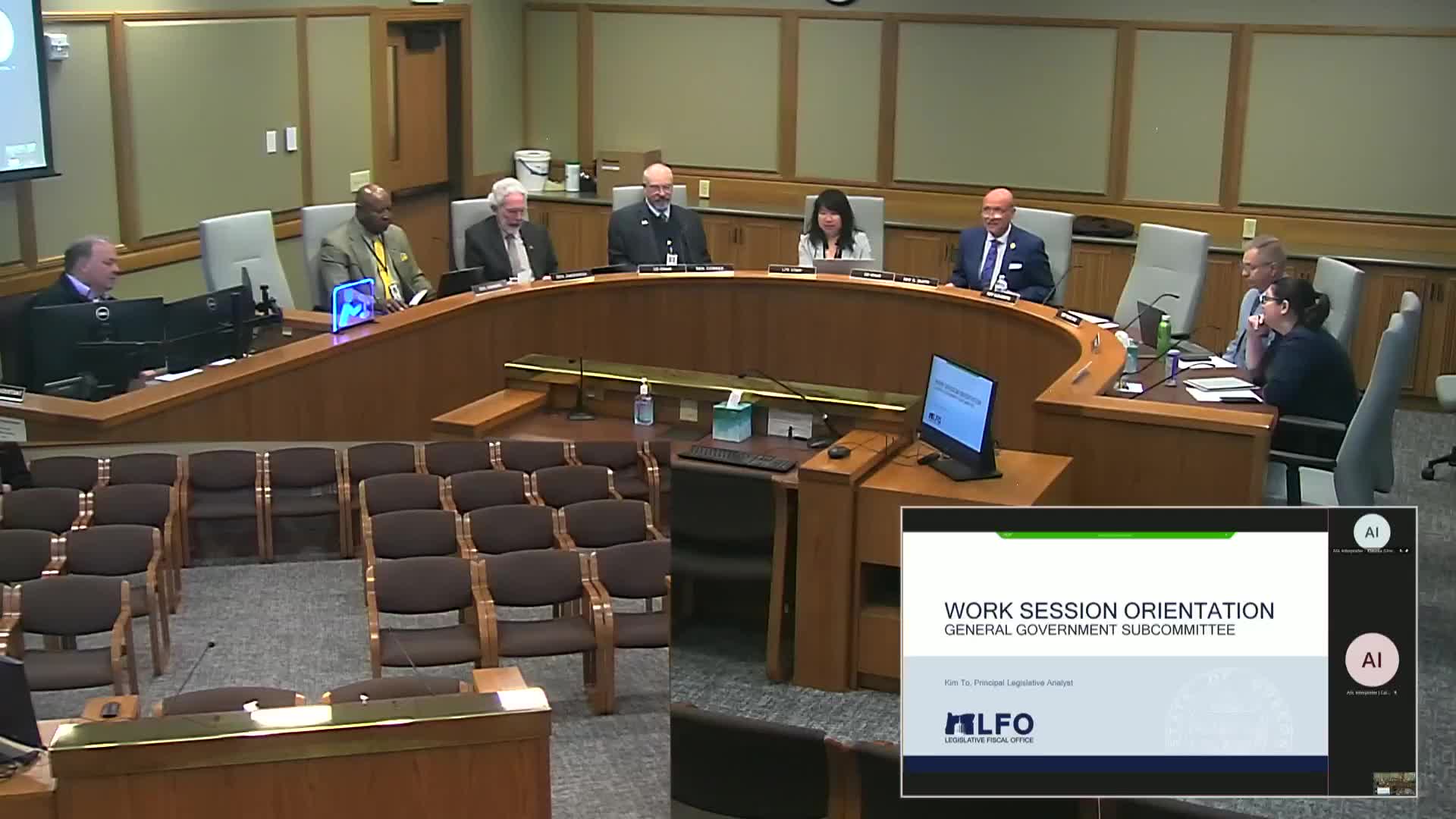
The Joint Committee on Ways and Means Subcommittee on General Government opened April 15 with an informational primer on how the Legislature’s budget process works and how subcommittee work sessions will proceed.
Kim, a legislative fiscal analyst, told co‑chairs and members that the subcommittee will hold 15 work sessions on 15 budget bills and walked through how primary budget measures are numbered and structured. “The budget bill or the primary appropriation bill, are in the 5 — you always know that there — it's a budget bill because it's in the 5,000 series,” Kim said. She noted Senate and House numbering conventions (5,500 vs. 5,000 series) can shift between sessions.
The memo and presentation emphasized that most appropriation bills include an emergency clause and become effective on passage but generally are not operative until the start of the biennium (July 1). For the current cycle the biennium ends June 30, 2027. Kim said budgets are organized by fund type—general fund, other funds and federal funds—and larger agencies may be organized by program or division for more granular control.
Why it matters: the subcommittee’s primer outlined the documents and systems members will use to examine budgets and make decisions. Kim repeatedly pointed members to supporting materials posted on OLIS (the Legislature’s online information system) and to the ORBITS (Oregon Budget Information Tracking System) report, which LFO uses to show how policy packages and budget adjustments flow into an agency’s current service level and proposed budgets.
Most important procedural points in the session included:
- No public or agency testimony during these work sessions unless the chair allows it; agencies and the Department of Administrative Services (DAS) CFO typically attend but do not speak without invitation. “There'll be no agency or public testimony,” Kim told the subcommittee.
- Amendments must be posted on OLIS at least four hours in advance of a work session before the committee can take action on them.
- The subcommittee needs an affirmative majority of appointed members from each chamber to advance a measure, and the subcommittee does not have the authority to table or hold legislation; it must report measures back to the full committee. Kim explained there are logistical options if a subcommittee cannot reach quorum, including bringing leadership into the room or asking for a courtesy vote from co‑chairs.
- LFO recommendations start from the current service level and are supported by numbered policy packages (e.g., 70 for revenue shortfalls, 800 for interim changes, 090 for CFO/governor recommendations). Certain assessments (DAS and Department of Justice assessments) are typically allocated in an end‑of‑session omnibus or reconciliation and are not always reflected in subcommittee LFO recommendations.
Kim described other supporting documents members will see: the LFO recommendation memo, a budget report (which combines a staff measure summary and fiscal impact statement), key performance measures (KPMs) and budget notes (administrative directives that do not carry the force of law and typically expire at the end of the biennium).
During the exchange, several members asked procedural questions about how measures are assigned, how policy bills are handled when referred to Ways and Means, and how KPMs are reviewed. Representative Brushman asked whether budget numbering retains the same last two digits across House and Senate versions; Kim said it often does but cautioned that Legislative Counsel and changes can alter numbering. Representative Gomberg and others asked about whether a subcommittee can send a measure to the full committee without recommendation; Kim said she would verify the rules for the record.
The primer closed with a reminder that the subcommittee will receive the full set of LFO materials, ORBITS output and KPM attachments on OLIS for each agency work session and that some accompanying policy or fee bills will appear alongside primary appropriation measures.