Get Full Government Meeting Transcripts, Videos, & Alerts Forever!
Get email alerts on the Victim Services topic
No spam. Unsubscribe anytime.
Oregon DOJ requests $18.5 million backfill after 42% VOCA cut, warns victim services at risk
Summary
The Department of Justice's Crime Victim and Survivor Services Division told lawmakers a 42% drop in federal VOCA funding in 2024 threatens statewide victim services and asked the committee to approve an $18.5 million backfill to avoid program cuts.
The Oregon Department of Justice asked the legislature to backfill $18,500,000 in federal Victims of Crime Act (VOCA) funding that the division says dropped 42% in 2024, threatening victim services across the state.
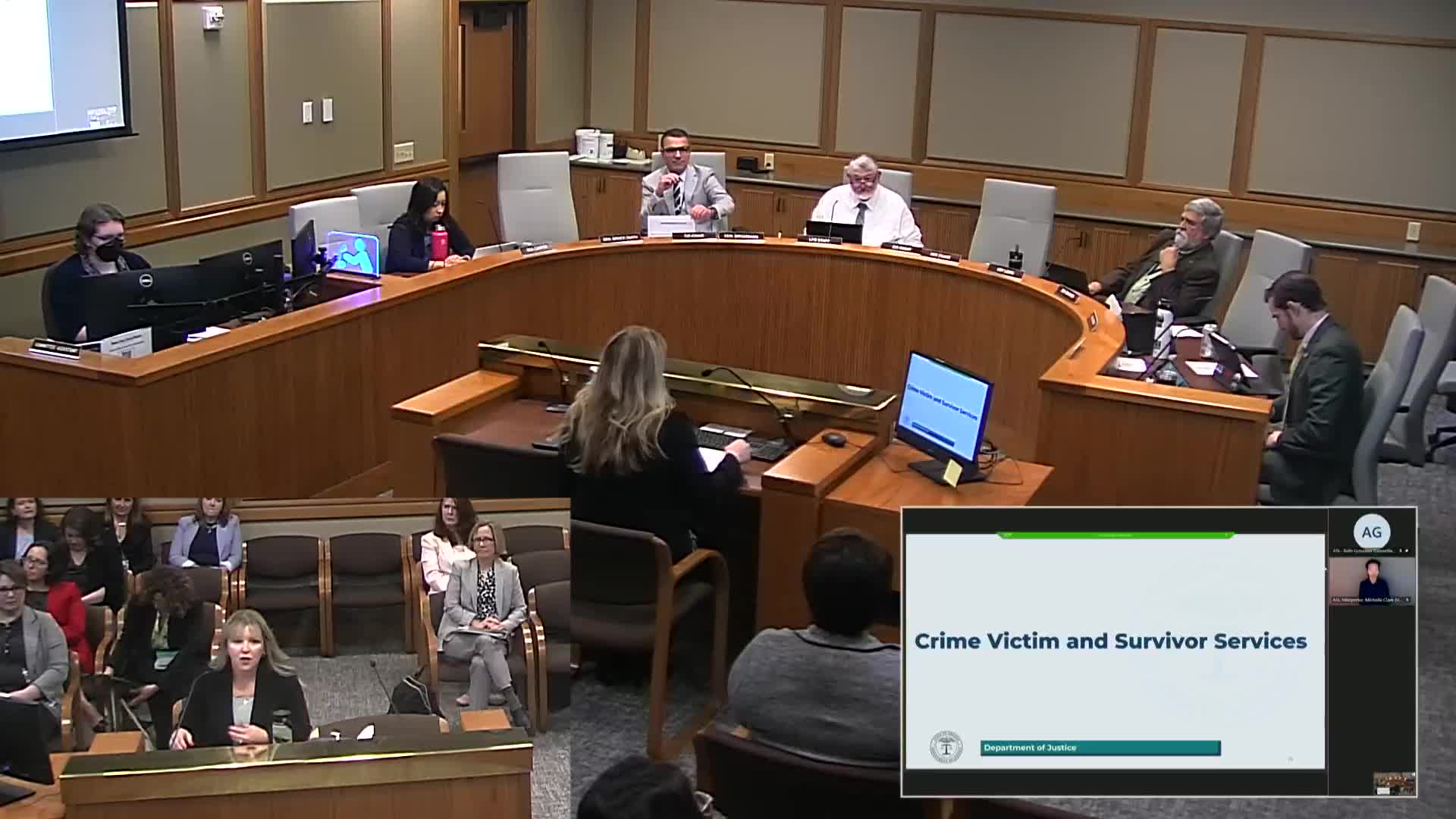
Shannon Savelle, director of the Crime Victim and Survivor Services Division (CVSSD), told the Public Safety subcommittee on April 15 during the House Bill 5014 informational hearing that VOCA has been Oregon's primary federal funding source for victim services and that the sudden drop would destabilize more than 40 different victim service programs supported by VOCA. "We're requesting the 18,500,000.0 to keep victim and survivor service providers at their current service level of funding and prevent cuts that would destabilize these programs," Savelle said.
Why it matters: VOCA funding supports children's advocacy centers, campus sexual-assault programs, culturally specific and tribal victim services, district attorney victim assistance programs, nonprofit domestic-violence providers, and human-trafficking programs. Savelle said the funds pay for on-scene crisis intervention, shelter, transitional housing, forensic medical exams and mental-health services. Oregon's VOCA receipts have averaged about $22 million a year over the last decade, she said.
Program details: Savelle described CVSSD's portfolio and the scope of services the $18.5 million would preserve. CVSSD manages 10 ongoing state grant funds and five ongoing federal grants and provides services including the bias-response and sanctuary promise hotlines, crime victims compensation (CBC), the trafficking response and intervention program (TRIP), and appellate advocacy. She said the sanctuary promise hotline "has received over a 1000% increase in calls since the first of the year," and that TRIP has trained thousands of providers and law enforcement; the program contributed a virtual training required under Senate Bill 1052, completed by roughly 1,300 state employees since January.
Savelle framed the $18.5 million ask as a backfill to maintain current services rather than a program expansion. CVSSD estimated VOCA funds support more than 90 grants and more than 40 types of victim service programs statewide. She warned that losing funds would return service capacity to levels of more than a decade ago.
Other funding items: Savelle also reviewed one-time general fund grants CVSSD manages, including the community violence intervention grant (initially $15 million in 2022 and an additional $10 million in 2023) and survivor housing grants (a $3 million grant started in 2019). She said the community violence intervention grant currently funds 30 organizations in 16 counties.
Questions from lawmakers focused on whether the VOCA reduction was a policy choice or a funding-availability issue; Savelle told the committee it was a combination of both, including past settlements that had temporarily bolstered the VOCA account and more recent legislative changes at the federal level.
Ending: Savelle asked the committee to consider the backfill to avoid cutting front-line services and to maintain CVSSD's administrative capacity to manage grants statewide.