Get Full Government Meeting Transcripts, Videos, & Alerts Forever!
Get email alerts on the Middle School Restructuring topic
No spam. Unsubscribe anytime.
Pittsfield School Committee accepts middle-school restructuring timeline, schedules public hearings
Summary
The committee approved a year-long timeline to reorganize middle grades, accepted a working plan that sets deadlines for curriculum, transportation and facilities decisions, and directed public hearings and community engagement ahead of final votes.
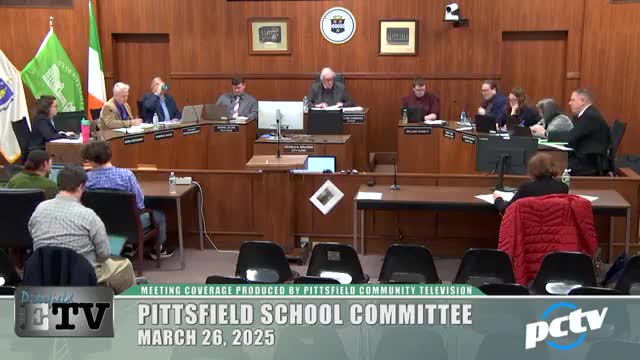
At its March 26 meeting the Pittsfield School Committee voted to accept a proposed timeline for restructuring middle grades and set a schedule of public hearings and outreach to guide decisions on grade spans, transportation and instructional models.
Superintendent Curtis presented a draft timeline that maps tasks from April 2025 through September 2026, organized by curriculum and instructional model, scheduling, staffing, transportation, facilities and community engagement. The document includes committee suggestions, marked in blue, and proposes that the district move quickly so decisions can be implemented for the 2026–27 school year.
The restructuring committee recommended a focus on instructional models and suggested that school committee members consider serving on a working group. Some committee members pressed for hiring an outside consultant or project manager to ensure timely completion; others said a locally driven committee could handle the work if members can commit sufficient time. The chair and superintendent said the decision whether to hire an external firm or proceed locally could be revisited as the committee develops a public engagement plan.
The timeline calls for the school committee to memorialize proposed grade spans — for example creating an intermediate school for grades 5–6 and a middle school for grades 7–8 — and to hold at least one public hearing at each middle school. Committee members asked for translation services at hearings, suggested offering opportunities for residents to submit questions in advance, and discussed the need to coordinate bargaining-unit requirements, start/end times and transportation options (two‑ or three‑tier systems).
The committee accepted the timeline as a working document, noting it may be revised as the process unfolds. The administration was instructed to schedule public hearings in April and May at the middle schools, provide an FAQ and coordinate translation services. The vote to accept the timeline carried by voice vote.
Ending: The timeline establishes a compressed schedule for curricular decisions, professional development and community hearings; committee members signaled willingness to revisit consultant staffing and to prioritize public engagement as the plan proceeds.