Get Full Government Meeting Transcripts, Videos, & Alerts Forever!
Get email alerts on the Budget topic
No spam. Unsubscribe anytime.
Rochester Community Schools previews 2025-26 budget amid enrollment, revenue uncertainty
Summary
Superintendent Mr. Russo and staff outlined budget priorities for fiscal 2025-26, saying the governor's proposal raises the foundation allowance but much funding is restricted; administrators warned of enrollment uncertainty, rising health and retirement costs, and contract increases that could pressure the district's fund balance.
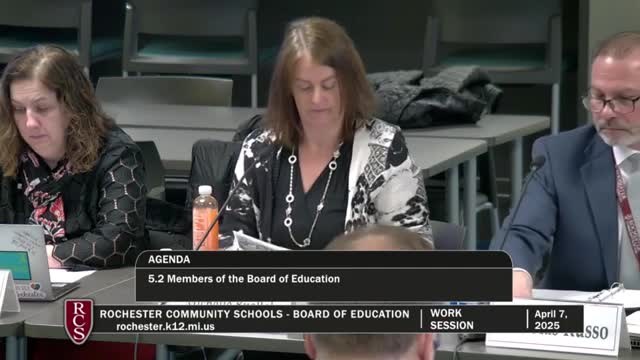
Superintendent Mr. Russo and district finance staff on Monday outlined priorities and a range of budget scenarios for Rochester Community Schools' 2025-26 fiscal year, stressing uncertainty in state and federal funding and projected enrollment declines that could affect the district's fund balance.
The district is using the governor's budget as a working baseline, but administration warned that much of the governor's proposed increase is restricted and that final dollar amounts will depend on the House, Senate and a future conference committee. "We want to prioritize teaching and learning ... people and students, and protecting the classroom as much as possible," Mr. Russo said as he reviewed planning priorities.
Why it matters: The board must adopt a budget by June 30 even though the state often finalizes its budget later. That timing mismatch, combined with uncertain federal grants and local cost increases, could force the district to use more fund balance or make programmatic adjustments if promised revenues do not materialize.
Details from the presentation: - Governor's proposal: Mr. McDaniel told the board the governor proposes to raise the per-pupil foundation allowance to $10,000. "The governor increases the per pupil foundation allowance for school districts to $10,000 per student," he said, but he and other administrators stressed that many increases in the governor's plan are for restricted programs (for example, 31a at-risk funding, early literacy, career and technical education) that cannot be used for general operations. - Unrestricted revenue estimate: Administration estimated the district might see roughly $3.2 million in additional unrestricted revenue under current proposals, well below an earlier $5.8 million expectation. Mr. McDaniel said, in effect, that retirement cost savings built into last year's state actions will be smaller for Rochester than anticipated, reducing an earlier projected benefit. - Cost pressures: The presentation listed known and estimated cost increases including recent collective-bargaining settlements (teachers estimated at about $4.6 million, secretaries about $700,000), potential increases in health insurance (the district's share of claims is roughly $21 million annually; a 10% change would be about $2.1 million), and contract increases for services such as transportation and custodial contractors. Administrators noted a 19% requested increase for school police liaisons and potential higher district share of that cost. - Enrollment projections: Two commonly used projections diverged. PowerSchool predictive analytics estimated a decline of about 140 full-time-equivalent general-education students; Plant Moran / RealPoint projected about a 177 decline. Administration said it planned to budget using a conservative midpoint (about 150 fewer students) to hedge against variation. Board members raised concerns that enrollment inputs used for per-pupil calculations in state agency documents were based on current-year flat counts rather than local forecasts. - Special education and federal funds: Administration noted uncertainty at the federal level and a state special-education reimbursement that is often a year behind; they flagged roughly $3.2–$3.3 million in federal IDEA funding as the district's largest federal revenue source and said loss of such funds would likely have to be backfilled from the general fund.
Board reaction and priorities: Trustees repeatedly said their top priorities are to protect classroom staffing and direct student resources. "My priority in a budget year would be to preserve the classrooms ... nothing that would increase class sizes," Trustee Blake said. Several trustees urged that strategic-plan goals guide budgeting decisions and asked administration for more frequent updates to the board as state budgets evolve.
Next steps: Administration will monitor House and Senate proposals, present a comparison if and when those plans are released, and deliver a proposed district budget to the State Budget Oversight Committee in May and to the full board in June for final adoption. Mr. Russo said the district would keep trustees updated as new state or federal information becomes available.
Ending: Trustees signaled broad agreement on high-level priorities — protect classrooms, align spending to the strategic plan, and minimize long‑term use of fund balance — while acknowledging major line‑item numbers remain provisional until the state process concludes.