Get Full Government Meeting Transcripts, Videos, & Alerts Forever!
Get email alerts on the Municipal Budget topic
No spam. Unsubscribe anytime.
New Shoreham Council adopts FY2026 budget for submission; sets mini-grant pot and conditions early-learning support
Summary
The New Shoreham Town Council approved the FY2026 budget for submission to the Financial Town Meeting, agreeing to a series of adjustments including a $19,000 mini-grant line, a benefits-eligible 20-hour clerk position option, and funding for the Early Learning Center conditioned on a written agreement and third‑party review.
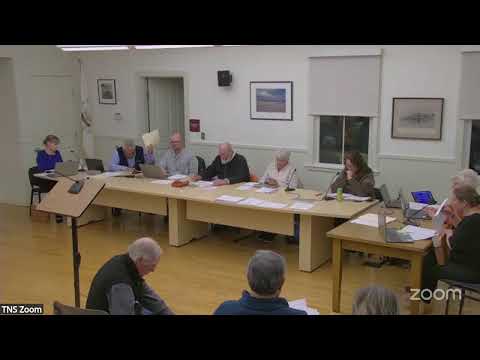
The New Shoreham Town Council approved the town’s FY2026 budget for submission to the Financial Town Meeting on Wednesday, April 9, following several staff-led adjustments and a package of small cuts to close a remaining gap.
Town Manager Amy (town manager) and budget staff presented a revised draft that showed an overall variance of $17,534 after changes, including an insurance-benefit savings and several program corrections, and councilors discussed a set of departmental and community-support items before voting to forward the budget to the town meeting.
The revised draft reflected a $7,516 reduction in benefit costs after staff updated health and dental rates using figures from Rhode Island Trust, and a $24,154 reallocation of the town-clerk wage line to contingency while the clerk position remains in an interim status. Budget staff also moved $5,000 from a police accreditation line to seasonal police wages and corrected a police-housing stipend to add $1,250; the stipend was described as a $5,000-a-year benefit that is partly offset by rent if the chief occupies town-provided housing at the Coast Guard Station.
Mona (staff member), who walked the council through the line-item changes, described the larger personnel question the council debated: expanding an existing 10-hour-per-week clerk position to 20 hours. She told the council that moving the position from 10 to 20 hours would increase payroll and trigger benefits, producing roughly a $21,000 increase in the budget with net benefit costs of about $9,700; an intermediate 15-hour option would add roughly $6,000 and avoid the benefits threshold. Councilors agreed they wanted flexibility to recruit the right candidate rather than locking the role to a single hour total.
Council discussion also noted operating-cost increases in recreation facilities. Staff said maintenance and cleaning at Fred Benson Beach, Ball O’Brien and Heinz Field have grown because service hours and the length of the season have increased; camp expansion tied to a new van will raise both revenue and counselor wages. Mona and Amy flagged that some historical maintenance costs had been underbudgeted and the revised draft corrects those lines.
On community-support spending, the council debated the mini-grants program, which last year totaled $33,000. Staff said the program’s average award was roughly $1,400 and the maximum grant had been $2,500. Councilors agreed to include a line for mini grants in FY2026 but reduced the initial proposal of $20,000 by $1,000 during later balancing votes; the budget approved for submission therefore carries a $19,000 mini-grant allocation.
The council also addressed the town’s annual community-support payment to the Early Learning Center (ELC). Several councilors said they had received multiple parent complaints and asked for outside review. Bill (council member) proposed — and the council approved — a motion to fund the ELC subject to a written agreement pursuant to the town’s nonprofit funding policy and to the ELC’s participation in a third-party review (councilors discussed the Rhode Island United Way as a preferred neutral reviewer). Amy said she would follow up with the ELC leadership and that any costs for a review, if charged, could be deducted from the town payment.
Fire and rescue finances and aging apparatus also drew extended discussion. Beth (fire department representative) reported the department’s cash-on-hand balance at approximately $488,000 and noted two committed items — $50,000 for a repeater system and $50,000 for architectural plans for a building. She said Engine 4 and an aging ladder truck require a longer discussion about long-term replacement and maintenance costs; the council requested a follow-up meeting with the chief and fire leadership to review a multiyear apparatus plan. Beth told the council the temporary tent structure currently housing a ladder cost about $85,000 to install.
To close the remaining shortfall and keep the budget within the town’s cap, the council voted a handful of small cuts and reallocations rather than trimming core services. Those changes included: a $1,500 reduction to the State Police support line, $700 reductions to both the volunteer Fire & Rescue and the medical center community-support checks, and a $1,000 reduction to the mini-grant line (reducing it to $19,000). The council then voted to adopt the FY2026 budget for submission to the Financial Town Meeting.
Votes and formal directions recorded in the meeting minutes matched the council’s voice votes: motions were seconded and carried by voice roll-call of “ayes” with no roll-call tallies provided on the record. Staff said that if bills or invoices arrive above budgeted line items (for example State Police overtime for holiday weekends), the town manager could propose contingency transfers after the financial town meeting as needed.
Why it matters: the FY2026 budget sets property-tax and spending proposals that the town’s voters will consider at the Financial Town Meeting. The council’s conditions on ELC funding and its decisions about clerk hours, mini grants and small community-support reductions reflect priorities for staffing flexibility, oversight of outside nonprofits receiving town funds, and maintenance of island services while staying within the town cap.
The budget will be printed for the Financial Town Meeting and the council’s written-agreement language for the ELC will be drafted before that meeting so voters can see any conditions attached to community-support funding.