Get Full Government Meeting Transcripts, Videos, & Alerts Forever!
Get email alerts on the Development Agreements topic
No spam. Unsubscribe anytime.
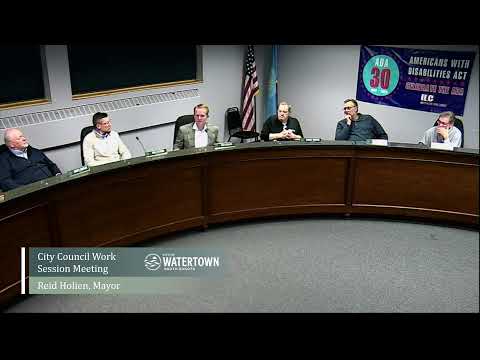
Watertown council discusses overdue development agreements, possible ordinance changes and incentives for builders
Summary
City of Watertown engineering staff told the City Council at a Feb. work session that 14 development agreements are active in the city and 10 have passed their contractual expiration dates, and presented options the city could use to address recurring delays completing public infrastructure.
City of Watertown engineering staff told the City Council at a Feb. work session that 14 development agreements are active in the city and 10 have passed their contractual expiration dates, and presented options for how the city might respond to recurring delays completing public infrastructure.
The city engineer, Justin Peterson, said the agreements normally require developers to complete public infrastructure—drainage, water, sanitary sewer, storm sewer, curb and gutter, paving and ADA ramps—within a two-year time frame. Twenty-five or so minutes into the development agenda item, Peterson said the city’s record shows that "10 of the 14 have surpassed their expiration date" and that the delinquency ranges from roughly four months up to about six and a half years, with an average of about two years overdue.
Why it matters: unfinished public infrastructure can shift maintenance obligations, complicate future construction and affect residents who live on roads not yet accepted by the city. Peterson told the council the city’s options include formally extending expired agreements, requiring developers to post bonds or other surety for future projects, stopping building permits in incomplete subdivisions, completing work with city crews and assessing costs back to properties, strengthening Title 24 language, or doing nothing. He described the current certification process: the developer’s engineer issues a certificate of completion that begins a one-year warranty; if warranty items remain, the city can request repairs and later take a certificate of acceptance transferring maintenance to the city.
Council direction, not a vote: Peterson said staff’s near-term request was to bring the expired development agreements back to council for formal extension—"we'd we'd like to bring those development agreements to council and and formally extend them for for a year." He also sought direction on several possible ordinance changes, including clearer language about required submittals (density tests, as-builts, asphalt testing), fines for missed paperwork or erosion-control failures, and a requirement that future developments post bonds, lines of credit, cashier's checks or escrow as surety. Council members asked staff to return to a public meeting with concrete proposals rather than deciding changes tonight.
Developers push back on fines and surety: Several developers and engineers who addressed the council said added costs would raise lot prices and could discourage building in Watertown. Colin Paulson of J and J Land Sales and Scott Calvert of Austin Engineering urged practical timing for density tests and as-built submissions, noting many tests are run the day before paving in a short construction season. Paulson said Watertown has not historically required bonds and that requiring them now could limit who can develop. He told the council that proposed $500 daily fines—for failing to submit density tests or as-builts—were circulated by email and would be onerous, saying developers already face limited subcontractor availability and thin margins.
Local developer Steve Horning described two properties tied to older agreements and emphasized timing issues with a state-required turning lane on Highway 212: "I didn't think it was required so I hired a firm out of Sioux Falls ... they came out with the recommendation that was required, so I'm gonna do it." Horning said some of his older agreements date to 2008 and 2014 and that the city’s prior standards and timing in those agreements differed from current two-year practice.
Contractor and scheduling constraints cited: Greg Hoffteaser of High Plains Development and other speakers told the council individual small items—missing bolts in a storm sewer, a 12-foot curb fillet—have delayed completion. Hoffteaser estimated bonding costs at roughly 1% of a project and said requiring bonds would add thousands to per‑lot costs. Developers and contractors repeated a common theme: subcontractor scarcity and a short regional construction season make tight two-year deadlines difficult in some cases.
Staff and council responses: Community Development Manager Hinton and engineering staff said they are already tracking agreement deadlines and contact developers through OpenGov. Marcy Luno, identified as part of the engineering team, confirmed the city has a tracker and described existing notice procedures. Interim City Manager Bob Zine told the council staff would prepare options and send proposed ordinance language to the planning commission for review before returning to council. Several council members expressed reluctance to impose new fines without further study and supported exploring alternatives such as tiered timeframes by project size or administrative extensions in some cases.
Ideas raised for incentives and better coordination: Developers and council members asked for better coordination among the city, the Watertown Development Company (WDC) and municipal utilities to help drive sales and lower per‑lot costs. Councilman Peters and others suggested exploring homebuyer incentive programs used in nearby cities, and multiple speakers urged better, earlier communication and annual check‑ins on open agreements so issues are flagged before deadlines lapse.
What was decided: no ordinance was adopted at the work session. Staff said they will prepare a package of options for council consideration, including bringing the expired agreements forward for extension. Council members said they preferred additional information and clearer draft language before considering fines or bonding mandates.
Votes at the work session: The council approved the meeting agenda at the start of the session (motion by Councilman Tupper, seconded by Councilman Peters; outcome: motion carries) and later approved adjournment (motion by Councilman Tupper, seconded by Councilman Bueller; outcome: motion carries). Those procedural votes were the only formal motions recorded in the transcript for this agenda item.
Background: Peterson said the standard two‑year timeframe for completion was adopted after earlier periods that allowed longer agreements; he noted one older agreement—Isabella—was written as a 10‑year agreement under a prior standard. The city’s certification procedure remains: engineer of record signs off, city issues certificate of completion starting a one‑year warranty, and, if warranty items remain, staff and council review an acceptance certificate before the city takes maintenance responsibility.
Next steps: Staff will return to council with draft ordinance language and a list of the expired agreements to consider extensions and with options for procedural changes such as clearer submittal deadlines, a possible tiered timeframe by project size, and communication checklists for developers and staff.