Get Full Government Meeting Transcripts, Videos, & Alerts Forever!
Get email alerts on the Unified Development Code topic
No spam. Unsubscribe anytime.
Bozeman staff outlines Unified Development Code revisions focusing on traffic, parking and bike access
Summary
City planners presented a supplemental engagement report and draft revisions to the Unified Development Code that would change how traffic impacts, level-of-service targets and parking are handled; staff proposed clearer triggers for traffic impact studies and new local-street thresholds, drawing questions about thresholds and community impacts.
Bozeman Community Development staff summarized Phase 1 engagement and a second draft of the city’s Unified Development Code on March 26, outlining proposed changes to how the city measures traffic impacts, manages parking and requires bicycle parking.
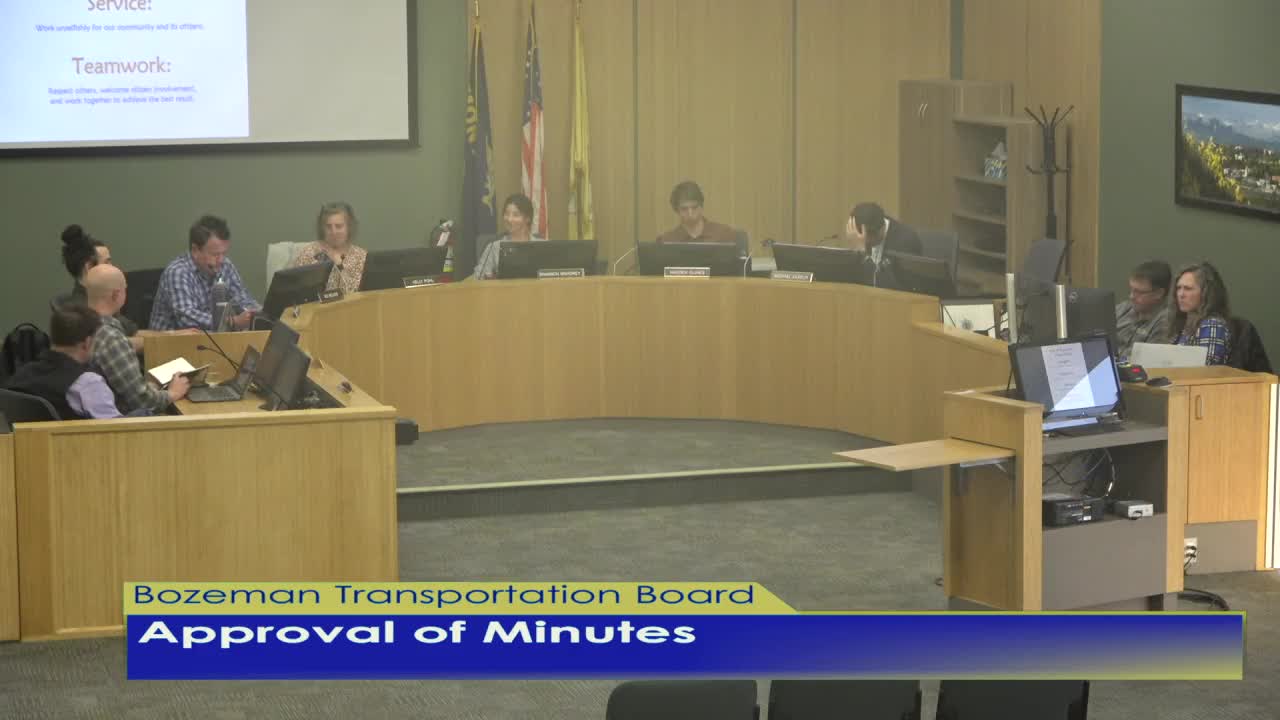
The city’s long-range planning manager, Chris Saunders, told the Transportation Advisory Board the UDC update implements goals adopted in 2020 for land use, climate action and housing and must be completed under state law by May 17, 2026. “That is our hard deadline,” Saunders said.
The revised draft seeks to make regulatory text easier to use and to align zoning with state-required housing actions. Staff said outreach produced widely varied and often contradictory public comment; transportation and parking ranked among residents’ top concerns in the Phase 1 engagement. Saunders pointed board members to the project materials on the Engage Bozeman website for drafts and outreach summaries.
Nick Ross, director of Transportation Engineering, described several substantive changes staff is proposing: (1) clarifying and simplifying nonresidential parking requirements while retaining a maximum standard, (2) elevating bicycle parking to its own section that distinguishes short- and long-term bike storage, (3) adding standards to require traffic analysis for local streets when development would increase volumes above a set threshold, and (4) revising when traffic impact studies (TIS) are required and how far into the future capacity must be modeled. “Level of service is not a metric of safety,” Ross said during the board discussion to help explain why LOS has been controversial in public meetings.
Why it matters: the UDC dictates what developers must submit and what the city can require as mitigation. Changes to TIS triggers, LOS thresholds and parking rules can affect project design, developer costs and neighborhood traffic or safety outcomes. Staff said the draft aims to avoid overbuilding streets while giving clearer, legally defensible standards.
Major proposals and clarifications
- Traffic impact study triggers: Staff proposed clearer, enumerated triggers that flip the current waiver-based approach into a set of objective thresholds (project type, trip generation, location on arterial/collector, access changes, or local-street impacts). Staff said the intent is to reduce unnecessary study work but warned some thresholds may be softened after public input. Staff noted their prior, informal practice used a 100 peak-hour-trip threshold as guidance.
- Local-street threshold: The draft introduces a 1,000 vehicles-per-day threshold on local streets. If a development is expected to increase local-street traffic above that threshold, the city would have authority to require mitigation such as traffic calming beyond the project’s property limits.
- Level of service (LOS): The draft would allow the city to apply standards for city-owned routes and clarify that LOS measures average vehicle delay at intersections during peak hour (staff said LOS C corresponds roughly to a maximum average delay of about 35 seconds and LOS D about 55 seconds). Staff emphasized LOS measures throughput rather than safety or multimodal performance.
- Future-year modeling for TIS: Staff recommended replacing the current 15-year horizon with analysis targeted to an expected project completion year (often a shorter, project-specific build year) to reduce overestimation and the risk of overbuilding streets.
- Parking and bicycle parking: The draft simplifies the nonresidential parking table and retains both minimum and maximum standards in most areas; it elevates bicycle parking into its own clear section addressing short- and long-term bike storage. Staff said bicycle-parking incentives previously codified as exceptions are being consolidated into a simpler standard.
Costs, timing and data concerns
- Typical TIS cost: Staff estimated a traffic impact study generally runs $20,000–$50,000; for small developments the per-unit effect is modest but nonzero. Staff also noted TIS preparation adds time to the application process, which can affect overall project costs.
- Trip-generation data: Staff said the Institute of Transportation Engineers trip-generation references in current use have not been revised since COVID and may not reflect post-pandemic travel patterns.
Board and public reaction
Board members asked for more clarity on numeric thresholds and expressed concern that controversial projects could erode public trust if thresholds allowed review to proceed without a TIS. Several board members supported the idea of softening thresholds slightly to reduce surprises, while still maintaining mechanisms to require studies or mitigation for neighborhood-sensitive projects. Public commenters emphasized mode-share goals and urged the city to design studies and mitigation to support walking and biking.
What staff will do next
Saunders and Ross told the board the draft will be revised based on input from advisory boards and the public, then returned to commission for formal adoption steps. Staff flagged that legislative changes in the current state session could require additional revisions before adoption.
Ending note: The UDC is a broad rewrite that affects zoning, parking, analysis requirements and how the city balances development with multimodal goals. Staff emphasized further public engagement and legal defensibility of standards will guide the final draft.