Get Full Government Meeting Transcripts, Videos, & Alerts Forever!
Get email alerts on the Development Ordinance Amendment topic
No spam. Unsubscribe anytime.
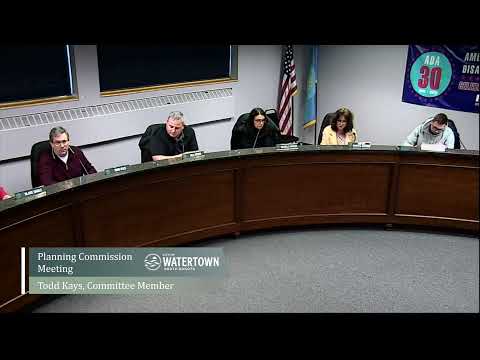
Watertown planning commissioners recommend ordinance 25-03 with mailbox language amended
Summary
The City of Watertown Planning Commission voted to recommend approval of ordinance 25-03 on a voice vote after amending language related to mailbox collection-point approvals.
The City of Watertown Planning Commission voted to recommend approval of ordinance 25-03 on a voice vote after amending language related to mailbox collection-point approvals.
The recommendation, made by Commissioner Case and seconded by Commissioner Dolly, strikes the phrase "as approved by the US Postal Service" from the proposed code provision on mailbox collection-point locations and directs staff to develop policies for implementing mailbox placement and maintenance. The commission voted unanimously with no recorded opposition.
The amendment is part of broader, largely clerical revisions the ordinance would make to the city's development-agreement and engineering-related code. Planning staff said the changes formalize timelines and inspection expectations, align private-road minimum widths with recently adopted engineering design standards, and change the certificate-of-completion authority from the public works director to the city engineer.
"So it's really just creating clarification and then setting a different timeline because we had a lot of outstanding development agreements," said Brandy (planning staff), who presented the item and noted the engineering division had been involved in drafting the edits. Brandy said development agreements are typically tied to a plat and generally allow two years for required improvements, with flexibility to extend to three years in cases that involve substantial right-of-way work and an additional one-year extension available from the city council.
Commissioners asked several technical questions during discussion. One question concerned a change to the minimum width for private roads in the code: the proposed amendment reduces the minimum from 28 feet to 27 feet 4 inches to match the City's engineering design standards. That change was described as a minor cost-saving alignment with the standards.
The commission also debated a new sentence in a sewer-related section (transcript: "240606, section 3 f") that asks that lift-station capacity "shall accommodate adjacent future [development] as indicated by the city engineer." Commissioners and engineering staff discussed who bears the design and construction costs when a new or upsized lift station is needed to serve more than the immediate development. Brandy and engineering staff said oversizing for future service is possible and that, in some cases, the city would contribute to upsizing costs and later recover those costs through a cost-recovery mechanism. Staff also said the city's recent sewer capacity study focused on existing lift stations and did not map future regional lift-station locations.
Concerns from a public commenter, Bill Riefenberger, focused on the proposed mailbox-planning language. "They said, 'Why don't you just take that first lot and make that a mailbox area,' which would involve putting in driveway and parking," Riefenberger said, describing earlier conversations with the post office. He also raised questions about who would maintain cluster or parcel boxes over time and whether a developer should bear perpetual responsibility.
Planning staff responded that the city cannot override United States Postal Service (USPS) standards and that the proposed ordinance language was intended to make mailbox planning visible on concept plans so developers are not surprised later. "We do not have to take responsibility for what they are requiring," Brandy said, adding that the city would engage the local postmaster early in plan review to inform developers of likely USPS preferences.
The motion that passed directs staff to remove the explicit USPS-approval trigger from the code's preliminary-plan approval requirement, instead leaving mailbox collection-point locations as an element shown on concept/preliminary plans with staff coordinating early review with USPS. The motion also requested that staff prepare implementation policies covering how mailbox locations and any future changes are handled, and to change internal references in the code so that certificates of completion refer to the city engineer rather than the public works director.
The changes approved for recommendation are intended to reduce ambiguity in engineering and development review, but the commission asked staff to draft clear policy language on cost-recovery for oversized utilities and on how mailbox collection points will be coordinated with USPS to avoid delays or unforeseen developer costs.
The Planning Commission's recommendation will be forwarded to the City of Watertown city council for final action.