Get Full Government Meeting Transcripts, Videos, & Alerts Forever!
Get email alerts on the Bar Tavern Expansion topic
No spam. Unsubscribe anytime.
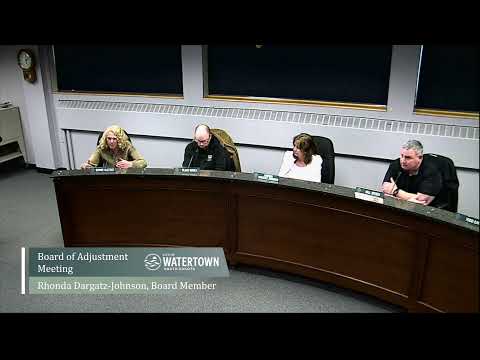
Board rejects RiverCard Casino’s request to convert laundromat into expanded bar/tavern
Summary
The Board of Adjustments denied a conditional-use request to expand a bar/tavern that would convert an existing laundromat into additional gaming/bar space, citing unresolved parking, shared-parking enforcement and neighborhood concerns.
The Watertown Board of Adjustments on Oct. 12 voted to deny a conditional-use request that would have allowed RiverCard Casino to expand into an adjoining laundromat space at 7 Eighth Street SW.
The applicants, Rodney and Shirley Parent, proposed removing the laundromat and expanding the bar, tavern and casino footprint. Shirley Parent, who identified herself to the board as the owner of RiverCard Casino and West Side Laundry, told the board the laundromat was “not worth to to fix anymore.” She also said current hours are about 10 a.m. to 10 p.m. Monday–Thursday and “10 to 02:00 in the morning” on busy Fridays and Saturdays.
Staff told the board the site currently has 10 legal nonconforming parking spaces and that the proposed expanded tavern use would require 24 spaces under the city’s parking calculation. The applicants negotiated a shared-parking lease with an adjacent property owner (packet initially listed 12 spaces; staff clarified 10 existing spaces) to provide 14 additional spaces. The lease is for $100 a month, automatically renews annually unless terminated, and restricts use of the leased spaces to peak evening hours (staff described the timing roughly as 5 p.m. to 8 a.m.). Brandy, a city planning staff member, recommended that if the board were to approve the conditional use, the shared-parking agreement should be tied to the tavern use so that loss of the lease would affect the expanded use.
Several nearby residents spoke in opposition, citing noise, safety and property-value concerns and the presence of a daycare nearby. Ruth Swenson, who said she has lived across the street for 58 years, told the board the neighborhood has been “a nice quiet area” and that she objects to the expansion. Lauren Blauer, representing a family property nearby, said she was “opposed to the expansion of the casino taking over the laundromat” and questioned the long-term reliability of a one-year, auto-renewing lease as a means to meet long-term parking requirements.
Board members raised legal and policy concerns about the proposed shared-parking arrangement and enforcement. Commissioners noted the city amended its parking ordinance in 2022 to allow shared parking agreements, but several members said the provision was intended mainly for coordinated, longer-term shared-use arrangements, not short-term leases across a public street. One board member said the ordinance change was “after” previous denials and that the shared-parking mechanism is not typically used for a short-term, across-the-street lease. Another member warned about pedestrian safety where patrons would cross a city street to reach leased parking.
On a roll call the motion to approve failed; the board recorded the vote as: Aleksy — no; Dali — no; Dargus (Darrius) Johnson — no; Speier — no; Kays — no; Kaczek — no. The motion was defeated and the expansion request denied.
Why it matters: The decision preserves the existing mixed residential/commercial character of the block and highlights enforcement and precedent questions about shared-parking agreements used to meet off-street parking requirements.
What’s next: The applicant may revise the proposal (reduce floor area or reconfigure use) or seek a different parking strategy; any future application would return to the board for review and a new public hearing.