Get Full Government Meeting Transcripts, Videos, & Alerts Forever!
Get email alerts on the Capital Projects Prioritization topic
No spam. Unsubscribe anytime.
Watertown council reviews portfolio of priority projects; housing and flood control emerge as crosscutting concerns
Summary
City of Watertown council members and staff reviewed a consolidated list of capital and policy priorities — from flood-control plans with an estimated $22.9 million total to housing and facility upgrades — and asked staff for more detailed cost, operational and funding analyses.
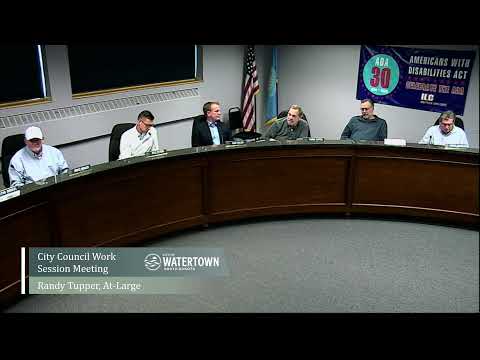
City of Watertown council members and staff used a work session to review a consolidated list of council priority projects, hear status updates and ask staff for more detailed cost and operational information on several items.
Flood control: Staff reminded the council that an updated flood-control plan for the Big Sioux River is expected in June. A current estimate shown in the packet totals about $22.9 million; staff said the city’s share under present assumptions would be roughly 35% or about $8 million, with hoped-for state contributions to be determined.
Housing and economic development: Multiple council members emphasized that housing, childcare and broader economic development are central issues that affect the city’s ability to pay for other capital needs. Staff and Council discussed aligning several stakeholder groups — H2O50, the Watertown Development Company, municipal utilities and school officials — to produce actionable goals; staff identified this as largely an ongoing operational priority rather than a single capital line item.
Recreation, facilities and other capital items: Directors and staff briefed the council on a set of other projects in the packet: - Cattail Clubhouse (golf): rough cost range presented $3.5–$6.1 million; staff suggested a capital-improvement fee as one funding option. - Baseball stadium: council approved a short-term agreement with the school district; staff estimates ranged about $3.1–$4.8 million depending on scope and donor support. - Mace Arena/indoor recreation: staff has formed a committee to study uses and operating models; upgrades could be phased and could involve outside operators or partners. - Foundation Plaza ice option: staff said retrofitting the downtown plaza for ice would be significantly expensive now and that prior structural provisions had been removed in earlier design steps; an earlier planning-level figure cited in discussion was about $600,000 in the initial planning conversations, but staff cautioned costs and feasibility vary by approach. - Event center improvements: rooftop units and air-wall replacements were identified in the packet as maintenance and capital items; staff said the facility remains open under interim lease arrangements while longer-term management and potential capital requirements continue to be evaluated. - Sidewalk program, gravel and collector roads: engineering staff asked for direction on prioritization and whether lower‑cost surfacing options or phased approaches to gravel‑street upgrades should be advanced. - Old water-treatment plant (Lake Hopaska) and auditorium: staff noted both are aging city-owned assets with deferred maintenance (roof leaks cited) and asked whether council wants estimates for demolition, repair or reuse — staff offered to return figures for estimated demolition/repair costs.
Budgeting and process: Staff suggested the council might re-rank or re-affirm priorities after the meeting and consider separating ongoing policy/priorities (for example, economic development/housing) from single capital projects for budget planning. Multiple council members asked staff for multi-year spreadsheets showing fiscal scenarios, what could be reserved annually for particular projects, and how bonding or G.O. debt would affect property- and sales-tax capacity.
Ending: Council members agreed to more follow-up: a June update on flood control, further cost/operational analyses for the auditorium and old treatment plant, and more financial scenarios for major projects. Staff offered to circulate a revised priority list and run a supplemental vote if the council wanted to re-rank priorities after receiving the requested analyses.