Get Full Government Meeting Transcripts, Videos, & Alerts Forever!
Get email alerts on the Clg Grant topic
No spam. Unsubscribe anytime.
Historic Preservation Advisory Board approves 2025–26 CLG grant application amid questions on landmark program
Summary
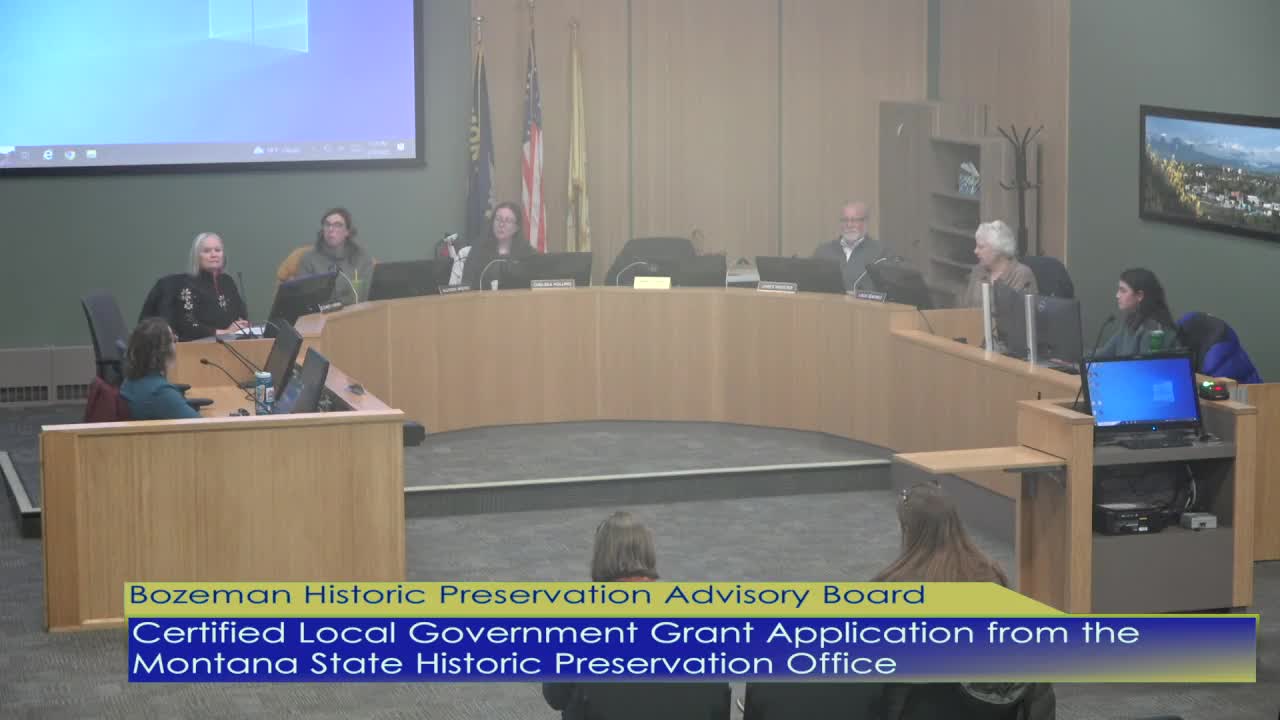
The Bozeman Historic Preservation Advisory Board on Feb. 19 unanimously approved the city’s application for the Montana State Historic Preservation Office certified local government grant for the 2025–26 cycle, a roughly $6,000 award for the city’s preservation program.
The Bozeman Historic Preservation Advisory Board on Feb. 19 unanimously approved the city’s application for the Montana State Historic Preservation Office (SHPO) certified local government (CLG) grant for the 2025–26 cycle, a roughly $6,000 annual award that will be placed into the city’s historic preservation program budget in the Community Development Department.
Board members voted to move the application forward after staff said the state-level freeze on some grants had been stayed by court action, allowing the city to proceed. “We were absolutely worried that it wasn't going to be able to go through with the executive order but with the judge blocking the freeze, we are proceeding as normal,” Sarah, a city preservation staff member, told the board.
The grant is routinely approved by the board; staff said Bozeman has accepted CLG funding annually since the mid-1990s and the award amounts are relatively small. Sarah told the board the CLG grant runs from April 1 and that the $6,000 would be absorbed into the historic preservation program’s line in the community development budget.
Public comment at the meeting focused on the city’s proposed local landmark program, not on the grant amount. Allison Sweeney, who identified herself as chair of the Better Bozeman Coalition and of the JAN Neighborhood, asked whether language in the grant application misrepresents the program’s intent and whether the local landmark program would be “honorary and voluntary, but not regulatory.” She asked on the record: “Are we misrepresenting the intent of this program in order to receive the grant?”
Sarah responded that the application’s description accurately reflects current intentions but that some details remain to be determined. She said the program is being framed as voluntary and honorary in terms of whether property owners must participate, but that the city must develop “standards” (as distinct from nonbinding guidelines) and that how those standards interact with zoning or enforcement mechanisms will be clarified in a forthcoming phase 1 report on the local landmark project. Sarah said that report is expected for board review in April.
Members of the public and board members also urged that training funded by the grant be extended to city planners who will apply any future standards. “I would argue that planners and staff who are making these decisions are the ones who need to have this training,” Allison Sweeney said.
The board made the formal motion to approve the CLG application for the 2025–26 cycle and recorded a unanimous roll-call vote. During the meeting, one board member raised the procedural question of whether public comment should have been heard before the vote; the chair and other members confirmed the vote outcome would not change and the board declined to revote.
Next steps: staff will submit the approved CLG application to SHPO and provide the board with the phase 1 landmark project report for review when it is released. That report will outline options for a local landmark program, including the distinction between voluntary/honorary recognition and any regulatory standards and how those might intersect with the city’s zoning code.