Get Full Government Meeting Transcripts, Videos, & Alerts Forever!
Get email alerts on the Economic Development topic
No spam. Unsubscribe anytime.
Watertown Development Company pitches real‑estate risk-taking, workforce and housing focus to council
Summary
The Watertown Development Company told the council it has been acting as a public‑private risk taker on downtown redevelopment and housing and urged closer, earlier communication with city leadership about projects and incentives.
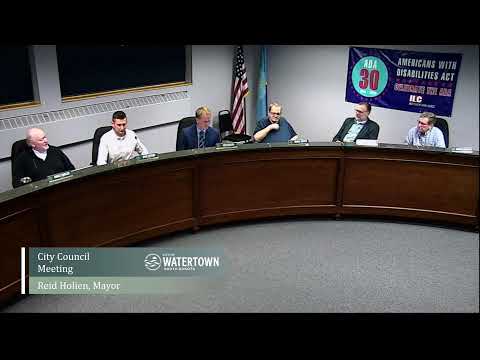
Steve Lehner, chairman of the Watertown Development Company (WDC) board, and Chris Clifton, WDC executive director, briefed the council on April 7, 2025 about the organization’s recent investments and priorities under its 2024–2028 Grow Watertown 2 plan.
WDC said it has taken on real‑estate and housing projects the private market would not, including renovating downtown retail properties at below‑market rents to fill vacancies and backing several downtown residential conversions. The organization manages roughly $32 million in assets and said its work has helped backfill vacant buildings and support job retention and expansion.
“We do this in a spirit of taking chances on opportunities that grow jobs, increase productivity, and elevate the quality of life here in Watertown,” Lehner told the council.
Clifton described WDC’s role as a risk‑taker that must now pivot from owning long‑term real property toward selling assets and incentivizing private landlords to invest at market rates. He said WDC currently is working nine prospective business expansion projects, seven of which are expansions of existing local firms, and is tracking both immediate recruitment prospects and longer‑term needs such as affordable and workforce housing and early‑childhood care.
Clifton and Lehner identified several local constraints: • Affordable housing supply — local construction costs and skilled labor availability have increased the per‑square‑foot cost of development, making the $175,000–$250,000 ownership market difficult to build. • Workforce scarcity — businesses report unfilled openings and a need for training and rapid upskilling; WDC supports targeted training and relocation assistance packages to meet employer needs. • Limited private developer capacity — WDC has invested to activate downtown properties, but long‑term sustainability requires private ownership and market rents to support ongoing renovation.
Lehner said WDC measures performance and requires performance commitments: investors and assisted projects sign expected job, payroll and investment targets; some agreements include clawback provisions if commitments are not met. He suggested the council and the mayor be more engaged early in economic development discussions and said WDC welcomes mayoral or council participation on WDC briefings or boards in an ex officio role to improve communication.
WDC reported fundraising and investment status: the organization raised roughly $4.1 million in its prior campaign, has raised about $3.2 million so far in the current Grow Watertown 2 campaign (a $4.2 million goal), and counts roughly half public and half private investors. Lehner told the council WDC would like more private investors and closer county cooperation on regional projects.
On housing, Clifton said WDC is completing research and encouraged a coordinated strategy that may include a local loan or incentive fund, targeted developer engagement and leveraging city‑owned land to reduce development costs. On workforce, WDC said it provides relocation and first‑time buyer matching funds in some deals and has proposed matching relocation grants in at least one prospect.
Why this matters: Watertown’s largest immediate economic development constraints — housing affordability, labor availability and site readiness — are central to whether existing employers can expand and whether new firms will locate in the city. WDC told council it will continue to play the role of investor and broker, but recommended earlier, more regular sharing of confidential prospect information with city leadership so the parties can align incentives quickly.
WDC did not request direct funding at the April 7 meeting; its representatives asked only for closer cooperation and more private investor participation. Councilmembers asked for measurable housing and workforce goals and pledged to consider ways the city can help reduce development costs and improve coordination.
The presentation closed with an offer to continue strategic planning cooperation with the council and with local partners.