Get Full Government Meeting Transcripts, Videos, & Alerts Forever!
Get email alerts on the K 12 Budget Cuts topic
No spam. Unsubscribe anytime.
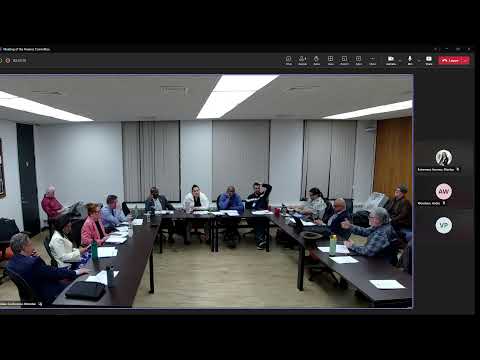
Bridgeport finance committee reviews $30 million in possible FY26 cuts, permanent and one-time options
Summary
The Bridgeport School District finance committee met at City Hall on Thursday, April 10, 2025, to review a slate of options intended to close about a $30 million FY2026 budget shortfall, considering a mix of permanent reductions (transportation, positions, program cancellations) and one‑time measures (staff concessions, reprogrammed software funds).
The Bridgeport School District finance committee met at City Hall on Thursday, April 10, 2025, to review a slate of options intended to close about a $30 million budget shortfall in the district's proposed fiscal 2026 plan. District staff presented a mix of permanent reductions and one‑time revenue or savings options; the committee asked for more specificity and moved the package to the full board for further consideration.
District staff and committee members said the list is intended to be a menu of options rather than final decisions. Presentations by district staff framed the work as a response to a legally required balanced budget and used both recurring and nonrecurring proposals to meet the target. The plan includes city and state revenue prospects, reductions in positions and programs, transportation changes, and tighter controls on outside spending.
The district highlighted several high‑value items the administration estimated would contribute to the $30 million goal. Those figures were presented by district staff as estimates for planning purposes only:
- City contribution: a $3,000,000 increase the mayor proposed for the district in FY26, described by staff as a permanent addition if the city council approves it. Staff said the council’s decision was expected in early May.
- One‑time staff concession: a 5‑day, district‑wide furlough/concession proposed as a one‑year measure estimated to save about $4,500,000 if every district employee agreed to it. Staff repeatedly described this as a one‑time, nonrecurring relief that would require a plan to restore pay in later years.
- Transportation/mileage changes: proposals to increase walking distance cutoffs for students so fewer bus runs would be required. Staff estimated raising elementary walking distance from 1.0 mile to 1.5 miles would save roughly $2.1 million annually; raising high‑school walking distance from 2.0 miles to 2.5 miles would save about $860,000 annually. Equivalent changes for charter‑school students (for whom the district currently pays transportation) were estimated to save about $970,000 (elementary) and additional amounts for high school charter students.
- Staffing reductions and reassignments: the presentation included multiple staff adjustments meant to reduce recurring expenses, including proposals to reassign assistant principals to classroom teaching slots (reducing use of contracted long‑term substitute services), eliminate additional central‑office positions (estimated at $585,000 in aggregate), consolidate teaching positions by maximizing class size and reassigning 31 teachers to fill vacancies (estimated savings about $1.4 million), and remove a further set of assistant principal positions. Separate line items showed estimated savings from eliminating additional social‑worker and counselor positions (presented as roughly $340,000 and $379,000, respectively).
- Program and contract changes: staff proposed canceling or postponing purchases of some curricula and relying on free state materials where appropriate, discontinuing some part‑time climate‑specialist positions ($100,000 estimate), cancelling selected arts/theater/fame positions ($406,000 estimate), and purchasing a one‑time Dynamics software license that could be reprogrammed as a nonrecurring offset (staff cited roughly $900,000 available from that one‑time item).
- Legal and contract controls: the district presented a plan to reduce outside counsel spending by routing routine questions through the city attorney and by adding internal authorization steps before outside counsel is retained. Staff cited roughly $300,000 of potential savings in outside legal fees relative to prior year spending levels, but committee members asked for an itemized billing history before approving a target.
- Other operational trims: audit of cell‑phone assignments and other device / gadget inventories (staff estimated about $50,000 in savings as a conservative figure), review of stipends and noncontractual payments, and scrutiny of special‑education nonmedical placements and processes to reduce avoidable cost growth.
Committee members repeatedly emphasized the human impact of many of the line items. Several board members asked for clarity about which positions would be eliminated, the seniority and bumping consequences under collective‑bargaining rules, and whether cuts would disproportionately affect particular schools. Members pressed staff for cost‑and‑benefit detail, including the expected one‑time vs. recurring nature of each item and the implementation timeline.
Members also discussed potential off‑ramps and restoration priorities if additional state revenue arrives. Staff and the board referenced a pending state special‑education reimbursement item (described by staff in the meeting as a “SB special education additional funding” line) that could provide up to about $1.8 million if included in the state budget; staff called that revenue uncertain and not counted toward the firm $30 million planning target.
Board members asked that the full list be posted publicly before the full board takes up the options, saying community members need the line‑by‑line detail to advocate and weigh tradeoffs. Staff responded that the committee's intent was to forward the options to the full board for deliberation and that further refinement — and additional ideas generated by board members — would be taken up before votes, if any, are scheduled.
Other fiscal context discussed at the meeting included the district’s internal service (reserve) fund balance (staff cited an available balance of about $5.0 million) and the administrator view that prudence requires some reserve rather than spending the entire balance to avoid cuts. Committee members were split on whether a portion of that fund should be used to temper cuts in immediate years; staff warned that some one‑time uses would not solve the district’s recurring shortfall.
What happens next: the committee did not adopt final cuts at the meeting. Committee members asked staff for more granular costing and the legal/contract implications (seniority, unemployment, sick‑leave payouts, and health‑insurance carryover costs) of any position eliminations. Staff said they would provide additional detail and present the options to the full board at the next meeting for deliberation. Staff and board members also discussed coordinated advocacy with legislators and planned public outreach in Hartford if state funding (the bill described in the meeting as SB 1511 / special‑education funding) is still under consideration.
Why it matters: the package mixes permanent structural changes (transportation mileage, position reassignments, program cancellations) with one‑time fixes (staff concessions and software reprogramming). Several committee members warned that reliance on one‑time measures would leave the district exposed to the same shortfall the following year unless recurring revenue or structural savings are achieved. Staff and board members framed the conversation as a legally required budget balancing exercise that they hoped to resolve with a combination of recovery from external revenues and targeted, minimally disruptive internal savings.
Ending note: the committee approved meeting minutes at the start of the session and then focused the rest of its time on the budget options. No final board action on any of the specific cuts occurred at this meeting; the committee directed staff to return to the full board with more detailed cost models and implementation notes.