Get Full Government Meeting Transcripts, Videos, & Alerts Forever!
Get email alerts on the Udc topic
No spam. Unsubscribe anytime.
Bozeman historic board hears wide-ranging UDC update, public raises concerns about NCOD boundary and transition standards
Summary
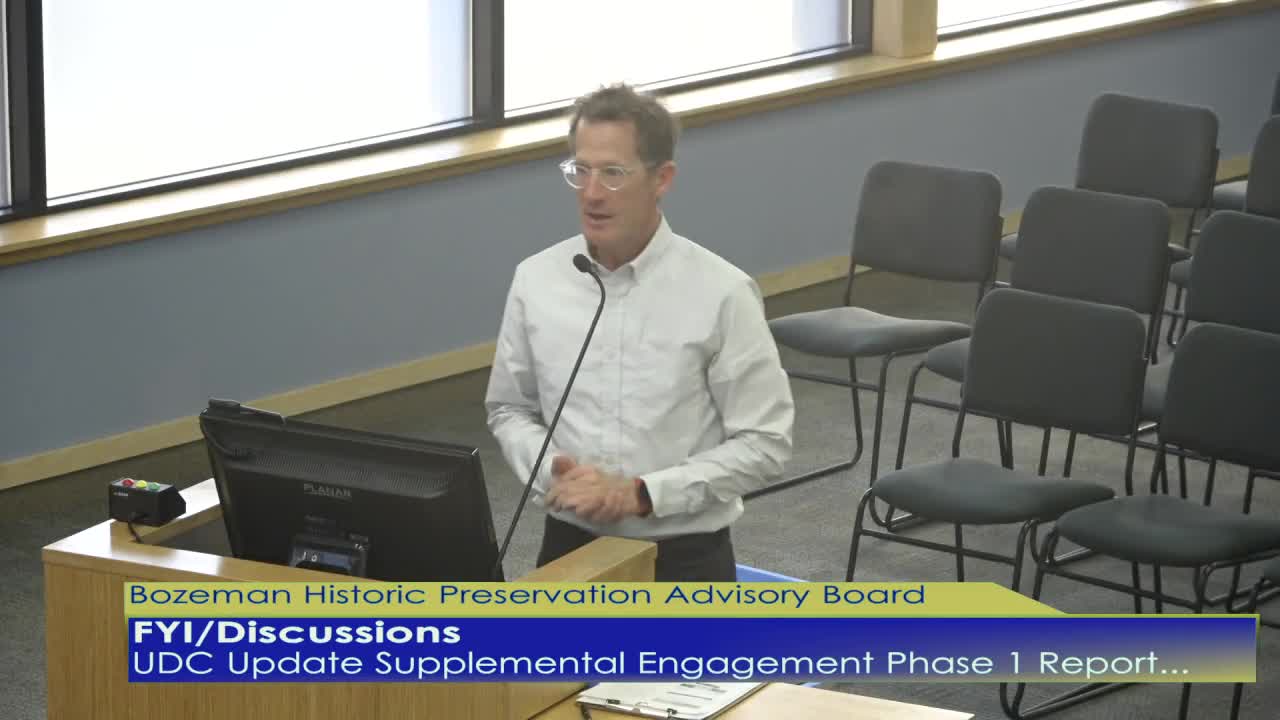
Tom Rogers, a planner with the Bozeman Community Development Department, briefed the Historic Preservation Board on the city’s multi-year rewrite of the Unified Development Code and answered questions about a proposed Neighborhood Conservation Overlay District boundary change and new zone-edge transition rules.
Tom Rogers, a planner with the Bozeman Community Development Department, briefed the Historic Preservation Board on the city’s multi-year rewrite of the Unified Development Code (UDC), saying the update responds both to the city’s revised growth policy and state law changes and will proceed in phases of public outreach and revision.
"I'm Tom Rogers from the Community Development Department. I've been tasked to, meet with you, provide an update for some ongoing efforts that we are doing to revise, and update our Unified Development Code or UDC," Rogers told the board, describing outreach that began with a 2023 draft and has entered a supplementary engagement phase.
Board members and public commenters used the session to press staff on two recurring concerns: (1) whether the Neighborhood Conservation Overlay District (NCOD) boundary shown in the public draft map is actually being moved and (2) how new zone-edge transition rules will moderate abrupt scale differences where higher-density commercial or multi-unit zones meet long-established single-family neighborhoods.
Why it matters: the UDC is the local ordinance that implements the city’s growth policy and sets what can be built where, including maximum heights, setbacks and transition rules. Changes to the UDC and the zoning map can directly affect property rights, neighborhood character and redevelopment pressure in older neighborhoods.
Key points of the presentation and discussion
- State-driven requirements: Rogers said portions of the draft respond to state law changes the city must implement. "Quite a few of our changes are to implement state law. We don't have a choice," he said, noting the work began in 2022 and that the draft posted in 2023 was refined after public comment.
- Draft zoning structure and next steps: Rogers summarized proposed residential district consolidations (a five-typology approach replacing multiple older categories), the creation of an intermediate RB district, and the ongoing mapping work that will be paired with text changes. He told the board the text amendment and linked zone map amendments will proceed together when the commission directs a formal adoption package.
- NCOD boundary: multiple public commenters and several board members raised alarms about a boundary shift along North Seventh Avenue that appears in the publicly posted draft map. A neighborhood commenter said many residents oppose moving the NCOD boundary from North Seventh to Fifth Avenue. City staff clarified that the NCOD boundary is being considered separately under the city’s landmark program and that "nothing's changed with the UDC" yet: "Now that we've been doing the landmark and the preservation policy, the NCOD boundary ... would be revised under that program, not the UDC. So nothing's changed with the UDC," a staff member said.
- Zone-edge transitions: the draft proposes more extensive transition standards than today, applying mitigation measures in more locations and with stronger site requirements where zoning districts meet. Rogers explained the city historically treats a street ROW plus front yards as a de facto transition in many places (a 60-foot ROW plus minimum front yards can translate to roughly an 80-foot mitigation distance) but said the proposed draft would apply transition requirements in more places and with more tools (setbacks, landscaping, screening) while asking the board for input on whether that is sufficient.
Public comment and board concerns
Residents asked for clearer, enforceable NCOD standards and an objective demolition policy; they said the public engagement process remains confusing because much outreach has relied on the 2023 draft and it is not clear when a revised draft will be posted.
"I am skeptical when city staff come up to the microphone and state we have a housing crisis without supplying any information, hard data," resident Daniel Carty said, urging clearer supporting data in outreach materials. Other speakers asked how transitions will work on narrow downtown streets and whether larger new buildings already permitted by zoning are displacing long-time residents.
Board members emphasized the need for broad review of the entire UDC, not only NCOD rules, and asked that advisory boards be given the opportunity to review the next revised draft before it returns to the commission. Several members expressed continued concern that current zoning districts (many dating to the 1970s) do not reflect existing neighborhood form and that transitions tied strictly to zoning boundaries can miss street-level context.
Votes at a glance
The board voted on routine business: it unanimously approved the minutes from Feb. 19 (motion by Elizabeth Darrow; second by Ashley Wilson). The minutes approval was the only formal recorded action during the UDC discussion segment.
What’s next
City staff said they are compiling phase 1 outreach results into a report for advisory boards; the consultants' phase 1 summary was expected to be presented to boards in April with the commission to receive it in May. Staff said a revised draft will follow feedback and that text and map amendments are planned to be packaged together when sent to the commission. Staff repeatedly urged continued public comment and board input during the supplementary engagement phase.
Ending: The discussion closed with board members asking staff to clarify the NCOD status on the publicly posted map, provide clearer comparison materials (current vs. proposed zoning and illustrative massing), and ensure advisory boards review the next formal draft before it advances to the commission.