Get Full Government Meeting Transcripts, Videos, & Alerts Forever!
Get email alerts on the Housing topic
No spam. Unsubscribe anytime.
Bozeman neighborhood reps press city on ADU incentives, financing and short‑term rental enforcement after Strong Towns webinar
Summary
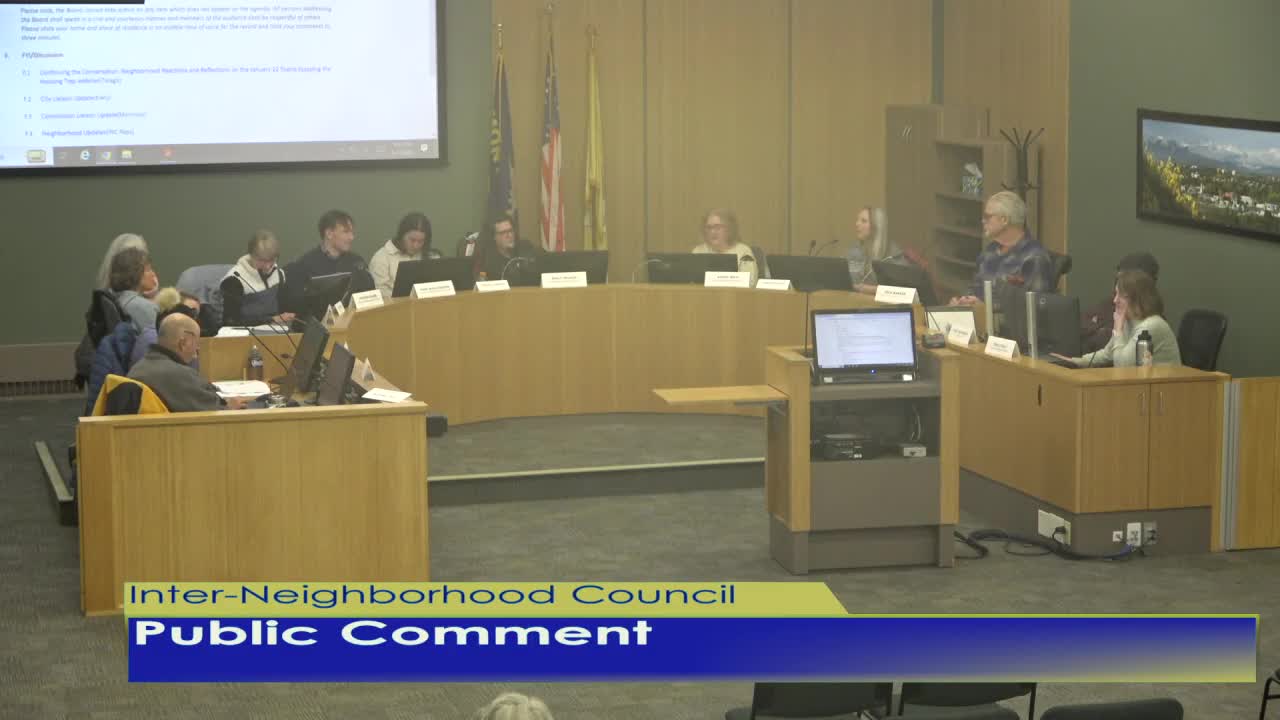
Neighborhood representatives, city staff and Bozeman’s deputy mayor spent the Feb. 13 Interneighborhood Council meeting debating how to convert owner‑occupied property into more housing and how the city should use new tools such as the recently adopted affordable housing ordinance.
Neighborhood representatives, city staff and Bozeman’s deputy mayor spent the Feb. 13 Interneighborhood Council meeting debating how to convert owner‑occupied property into more housing and how the city should use new tools such as the recently adopted affordable housing ordinance.
The discussion opened as an FYI about a Strong Towns webinar the group hosted for Bozeman; participants said the presentation highlighted low‑cost, locally led tools — including incentives for existing homeowners to create accessory dwelling units (ADUs) — and prompted questions about whether the city can help overcome financing and enforcement barriers.
Why it matters: Bozeman officials said the city seeks to increase units affordable to local workers while protecting neighborhood character. Council and commission members described tradeoffs between using limited public funds for small “invisible infill” ADUs versus subsidizing larger affordable projects, and they flagged legal and staffing limits that constrain what local government can require or enforce.
Deputy Mayor Joey Morrison said ADUs “and creating some sort of incentive package is still on our commission priority list,” but he cautioned that high land values and the cost of construction have made many ADUs financially unattractive. Morrison said an earlier local review found about 60% of new ADUs were being used as short‑term rentals rather than long‑term housing, producing “net 0 additional housing units” in that analysis.
Neighborhood representatives and residents pressed several policy ideas discussed during the webinar and in local follow‑up: a property‑tax credit for owners who rent below market rates (a proposal they said is under consideration in the state legislature), city‑run low‑interest loans or bond financing for small owner‑led projects, deed restrictions tied to public financing and stronger enforcement of short‑term rental rules.
“Allison Sweeney reported a code‑compliance response that enforcement is thin,” said one neighborhood rep; Sweeney told the meeting that after reporting an illegal short‑term rental she and a neighbor were told compliance staff could not verify occupancy claims and that “there is just no way to enforce that. We don't have the resources.”
City officials and staff provided clarifications and limits repeatedly raised during the discussion. Morrison said cash‑in‑lieu payments made under the city’s affordable housing ordinance must be placed into the city’s community housing fund and be used “in the general spirit” of producing affordable housing. He also reiterated a planning metric the city uses when assessing supply: over multi‑year horizons the city models needing roughly 1,000 housing units per year on average to keep pace with recent growth trends.
On financing, participants explored whether municipal tools could help homeowners get capital to add ADUs. Attendees suggested options including city‑backed loans, small locally focused bond programs, or cosigning loans to reduce barriers for owner‑builders. Morrison and other staff said some of those ideas require state law changes or carry tradeoffs: small funds can help only a few households at a time, while larger subsidies can more quickly produce hundreds of units but may shift the shape of growth.
Speakers also debated zoning and code tools. Several neighborhood groups reported work on local proposals to shape growth: a petition‑style downzoning effort in the Centennial Park area (a proposal to reduce allowable density on some parcels) and a separate Northeast historical/mixed‑use zoning concept (Niemu) that proponents say is intended to protect neighborhood character while allowing small‑scale activity. Community members asked for clearer, neighborhood‑level mechanisms to request or block specific zoning changes.
Public commenters urged attention to broader constraints as well. Daniel Carty, a Midtown resident, warned against treating large market‑rate “big box” developments as neutral economic products, saying they can “be detrimental to those communities and neighborhoods.” Other commenters raised water supply and public‑safety concerns, arguing the city must balance new housing with fire and water capacity.
What happened next: The group agreed to continue the conversation at future INC meetings and encouraged neighborhood reps to host local discussions and use the city’s engagement materials for the Unified Development Code update.
Ending note: Participants asked city staff for better data and more targeted outreach — for example, clearer answers about where cash‑in‑lieu funds are spent and whether the city can underwrite small owner‑led projects — and several representatives signaled plans to follow up with surveys and neighborhood meetings.