Get Full Government Meeting Transcripts, Videos, & Alerts Forever!
Get email alerts on the Special Education Certification topic
No spam. Unsubscribe anytime.
Finance committee refers expansion of state-run SPED certification program to full board
Summary
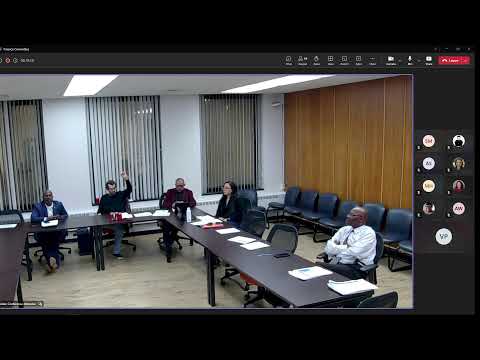
The Bridgeport Board of Education Finance Committee voted to refer to the full board a proposal to expand the district's participation in the State Department of Education's Advanced Alternative Route to Certification, a CREC-run program that cross-certifies current teachers into special education.
The Bridgeport Board of Education Finance Committee voted Thursday to refer to the full board a request to expand district participation in the Advanced Alternative Route to Certification, a state-run program that cross-certifies current teachers into special education.
Dr. Avery brought the item and described the district's past participation and interest in broadening it. "It's an upfront cost of about a hundred thousand dollars if we added an additional 10 participants to the program," Dr. Avery said, referring to the estimated district share to add 10 more candidates. He recommended the committee "embrace that concept again" and send it to the full board for possible action.
Michael Brosnan, who presented details to the committee, said the program is administered through the State Department of Education and run locally by the Capital Region Educational Cooperative (CREC). "This has proven to be a really successful program," Brosnan said, explaining CREC charges roughly $9,950 per candidate and that the district typically cross-endorses experienced general-education teachers into special education by paying the tuition and offering salary-step incentives.
Brosnan and committee members described how the program has fit local staffing needs: participants are usually mid-career teachers already employed by Bridgeport Public Schools who would begin serving as special-education teachers in fall 2025 while completing coursework that begins in June. Brosnan said a January survey produced 22 expressions of interest for the next cohort; he told the committee that at the time of the meeting four candidates had submitted full CREC applications and five slots remained from prior board approval.
Committee members pressed for details about costs and contract terms. Brosnan said the district pays the CREC tuition and covers an application fee; the MOU includes a two-step salary advancement as an incentive and a service commitment. He said participants agree to serve as special-education teachers and that the MOU/professional promissory note contains language for prorated repayment if a participant leaves before the commitment period ends. Committee members asked the staff to confirm whether the required commitment period is three years beyond the training year or three years inclusive of the training year; Brosnan said he would confirm the exact language with the superintendent.
Several members raised budget concerns. Committee members estimated additional personnel step costs and the total district outlay if the board approved up to 20 participants (rather than 10): Brosnan and members discussed an estimated per-candidate tuition near $9,950 and step-related pay increases that could add roughly $3,000 on average per participant for a two-step raise, producing different total estimates cited in committee discussion (figures cited during debate ranged from about $260,000 to $288,000 depending on step placements and whether step increases would have occurred anyway).
Given the timing, CREC's application deadline (March 31) and the program start in June, the committee directed staff to gather more precise cost and step-placement data and moved the proposal to the full board for discussion. A committee motion to refer the item to the full board was made, seconded and carried; one member said they intended to vote no but the motion carried on the committee voice vote.
The referral lets the full board consider whether to fund additional slots (beyond previously approved slots) and whether to authorize the district's share of tuition and incentive steps. Staff said applicants could submit while the board finalizes funding decisions, but warned that CREC would need to know by April in order to staff and schedule the summer coursework.
What happened next: the committee's referral sends the item to the full Bridgeport Board of Education meeting for formal action. Staff committed to return to committee and the board with a clearer cost breakdown, the MOU language about the required service term, and exact counts of applicants who have completed the CREC application by the March 31 deadline.
Why it matters: Finance committee members said the program offers a potential near-term way to increase the district's supply of certified special-education teachers by retraining experienced in-district teachers rather than recruiting from outside a tight statewide market. Committee members also said the proposal must be weighed against the district's broader, short-term budget constraints.
Ending note: Staff will return with a more detailed cost analysis and the exact MOU language about the service obligation; the full board will consider the referral at its next meeting.