Get Full Government Meeting Transcripts, Videos, & Alerts Forever!
Get email alerts on the Stormwater Management topic
No spam. Unsubscribe anytime.
Sustainability board recommends City Commission adopt 2025 stormwater facilities plan with equity, climate and reuse considerations
Summary
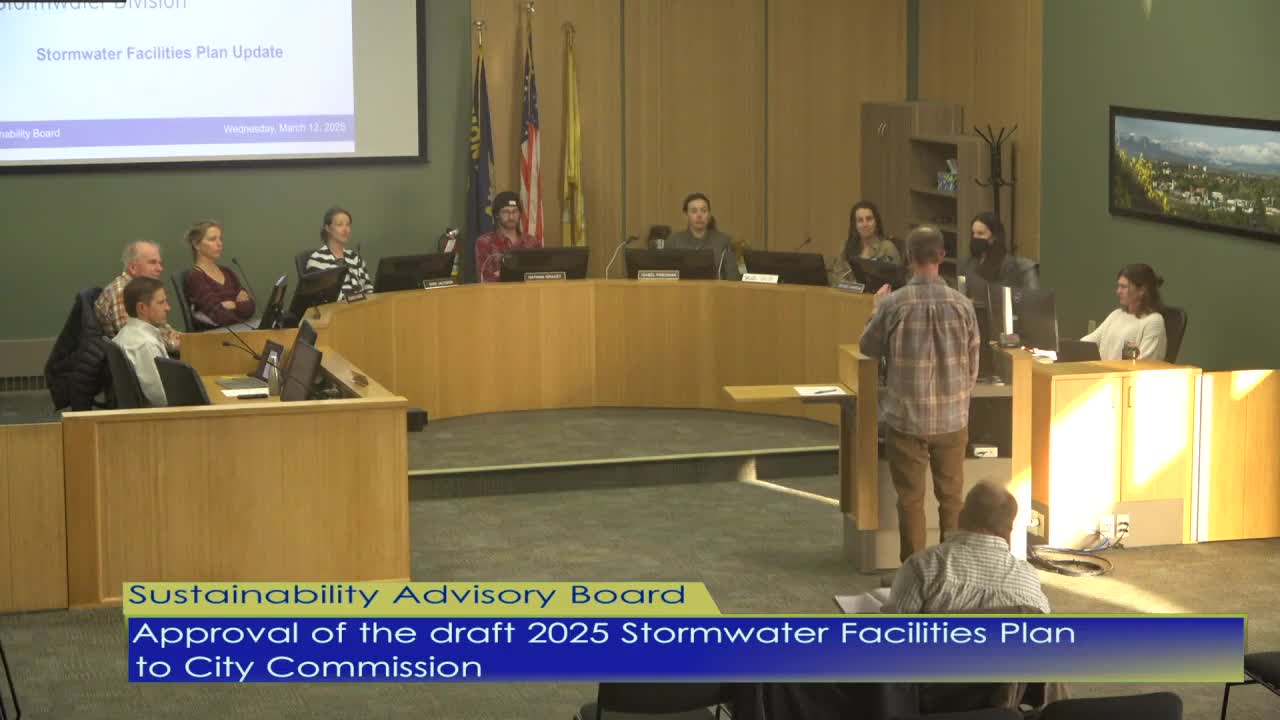
The Sustainability Advisory Board on March 12 voted to recommend that the Bozeman City Commission approve the draft 2025 Stormwater Facilities Plan while urging stronger emphasis on environmental justice, climate projections, and future water-reuse study.
The Sustainability Advisory Board on March 12 voted to recommend that the Bozeman City Commission approve the draft 2025 Stormwater Facilities Plan, while asking the commission to explicitly consider environmental justice in project prioritization, to incorporate forward-looking climate modeling where feasible, and to explore stormwater reuse in future plans (and to fund dataset development if necessary).
Adam Oliver, stormwater program manager for the City of Bozeman, presented the draft plan and described its scope: an asset inventory, condition assessment, operations and maintenance recommendations, capital improvement project prioritization, and regulatory compliance steps to meet the city’s MS4 permit. “We have replaced 5.6 miles of pipe since 2012,” Oliver said, and he summarized operations results, including mechanical separator and vacuum-truck removals: “We’ve picked up 478 tons of sediment from water quality treatment units,” he said.
The plan catalogs areas of the system that currently lack treatment and models options for projects that would add water-quality treatment and infiltration. Oliver described three common approaches for the downtown core and older neighborhoods: mechanical separators (to remove sediment and floatables), boulevard rain gardens with underground chambers, and larger two-part designs that combine pretreatment with buried infiltration chambers. He said the plan’s modeling helps size pipes and avoid creating future bottlenecks when installing capital projects.
Frank Greenhill, stormwater program specialist, said education and outreach were a prominent piece of public input and are addressed as part of the city’s annual stormwater management work. “We’re looking at growing our adopt-a-drain program,” Greenhill said, and he noted the city has already improved inspection forms and updated web materials.
Catherine Berry of the Gallatin Watershed Council testified in support of the plan and urged the city to emphasize co-benefits — such as nutrient filtering and habitat — where feasible. Online commenter Tyler Halligan also voiced support.
Board members pressed staff on several topics: whether the plan explicitly models climate-change-driven precipitation shifts (Oliver said the plan used recent periods of record and adjusted standards; he recommended selecting a higher design standard rather than relying on uncertain precipitation forecasts), whether grants could fund capital work (staff said grant opportunities are being pursued but much work will be covered by rates and local funding), how post-construction maintenance would be enforced (the plan calls for an enforcement response plan and inspection frequency), and whether developers are required to meet current design standards (Oliver said recent updates to design and construction standards require treatment in new development).
The plan prioritizes compliance gaps first, notably post-construction facility maintenance and an enforcement response plan; second, establishing levels of service and associated costs to inform a rate study; and third, replacing deferred infrastructure (including clay-pipe replacement). Oliver said modeling and outreach informed a top-13 project list of candidate capital upgrades.
The board passed the following motion: “Having considered the draft 2025 stormwater facilities plan, all public comments and information received, I move to recommend City Commission approval of the draft as submitted with additional consideration for the prioritization matrix for environmental justice, secondly forward-looking climate modeling, and thirdly water reuse in future plans; and if data is not available on these topics, we recommend the City Commission consider investments to build these datasets.” The vote was recorded as seven ayes and no nays; the motion passed.
Ending: The recommended plan will be forwarded to the Bozeman City Commission for consideration on April 15, with the Sustainability Advisory Board’s request that environmental justice, forward-looking climate analysis and water-reuse possibilities be explicitly considered as the Commission evaluates adoption and related capital programming.