Get Full Government Meeting Transcripts, Videos, & Alerts Forever!
Get email alerts on the Organics Composting topic
No spam. Unsubscribe anytime.
Bozeman plans city-run organics collection; program to launch this spring
Summary
City staff presented a year-round organics collection program offering weekly curbside pickup in 35- and 95-gallon totes, funded in part by an EPA solid-waste infrastructure grant; staff proposed an opt-in rollout, a $10 monthly introductory fee and partnerships with private processor Happy Trash Can.
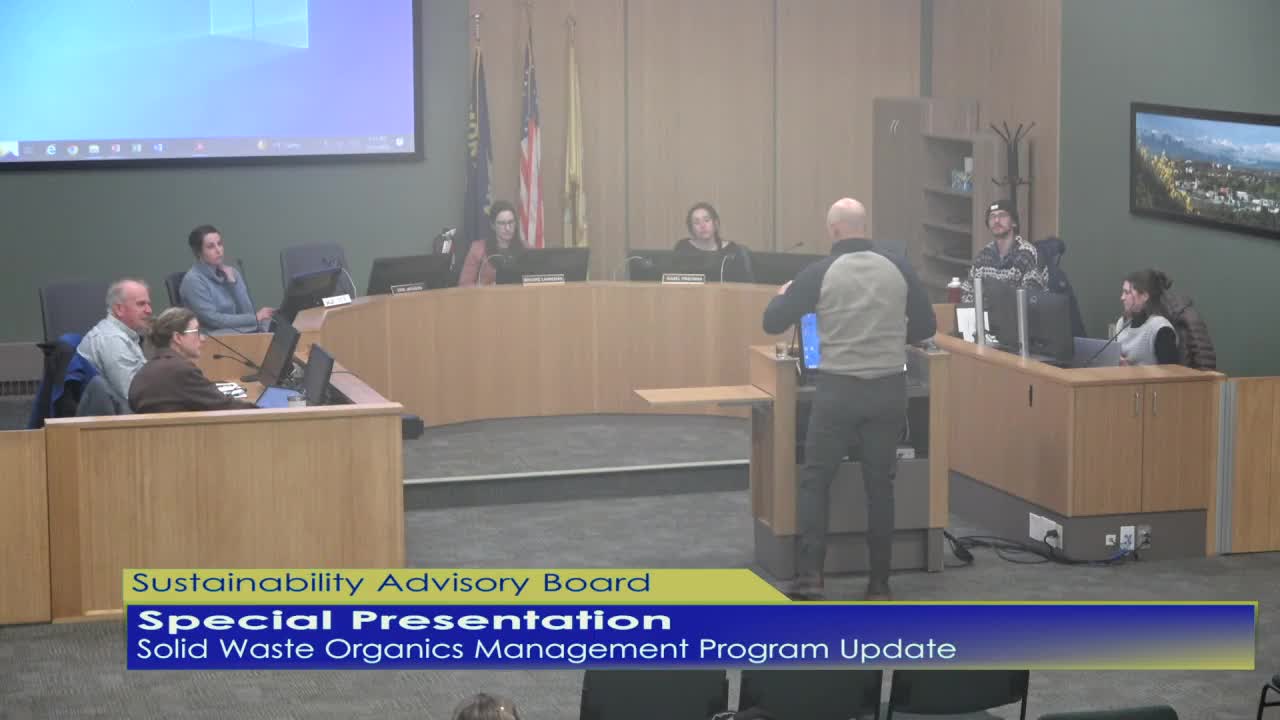
Nick Ross, Bozeman’s director of transportation and engineering, told the Sustainability Advisory Board that the city will launch a year-round solid-waste organics management program this spring that offers weekly curbside organics pickup to residential customers. “We’ll be offering a weekly service, so weekly collections, using either a 35 or a 95 gallon tote,” Ross said, and the city will partner with a local processor, Happy Trash Can, for processing and marketing the finished compost.
Nut graf: The city plans to use federal grant money to buy capital equipment and marketing, operate the service for a two-year grant reporting period and then continue the program if customers sign up. City staff said the program aims to cut landfill tonnage and the greenhouse-gas impacts of food and yard waste while providing residents a paid, year-round alternative to the seasonal yard-waste pickup now provided.
Ross told board members the program was launched by a City Commission directive in 2022 and shaped by a solid-waste rate study performed in 2023. He said the city secured an EPA solid-waste infrastructure grant that would pay for capital purchases including two new collection trucks and roughly 7,000 totes plus education and outreach materials. Under the grant, the city will operate the service for a minimum of two years and report results; staff said the trucks would remain city property after the grant requirements are met.
City staff described outreach and program design decisions informed by a customer survey of about 1,400 respondents (out of roughly 13,000 customers). The survey showed 62% of respondents already use recycling and 29% use the existing seasonal yard-waste pickup; staff said those results pushed them toward an initial opt-in model rather than bundling organics with other services. Staff said the city seeks to enroll about 7,000 households but can serve more.
Officials proposed a $10-per-month introductory fee for the first year of service, citing benchmarking of peer communities and costs that scale with participation. Staff said customers would get a choice of tote size, a kitchen pail and a supply of compostable liners; they also proposed options to pause service in winter months to ease uptake by customers who want only seasonal yard-waste pickup.
Happy Trash Can representatives were discussed as the contracted processor; staff said the processor will receive collected materials for turning into compost and may retain and market finished compost as part of its business model. Ross said the city will do the collections and pay the processor for processing by quantity. Ross and board members discussed the processor’s existing institutional and commercial customer base and how that fits with a city-run residential offering.
Board members and public commenters asked about education, facility capacity, bear-resistant containers, apartment and renter outreach, and whether the city or processor would provide buybacks or give-back compost to customers. Staff replied that the processor has space and is planning capacity investments, that additional bear-resistant totes funded by the grant will be available, and that education will roll out in phases, with basic customer notifications first and more detailed public education to follow. Staff said a tote procurement invitation for bids would be issued the week of the meeting, two new operator hires were near completion and trucks would be wrapped and put into service in March and April to match rollout timing.
A number of board members suggested additional outreach tactics: clearer use of the word “compost” rather than “organics,” Earth Day public tabling, targeted outreach to large apartment complexes and landlords, renter-specific materials, workshops or tours of the processor, and diagrams showing how diversion reduces household landfill costs. Staff said they would share updated creative materials with board staff and that direct mail, inserts with city utility bills, a web overhaul and social media would be used in the first phase of outreach.
Ending: Staff asked for board feedback on the outreach creative and the opt-in design and said they planned to start education and sign-ups in March with service billing beginning in April. The board did not take a formal vote on program adoption at the meeting; staff requested input on messaging and outreach details and will return with implementation updates.