
City Manager submits $365.6 million FY26 budget; council refers plan to Finance Committee
Get AI-powered insights, summaries, and transcripts
Sign Up Free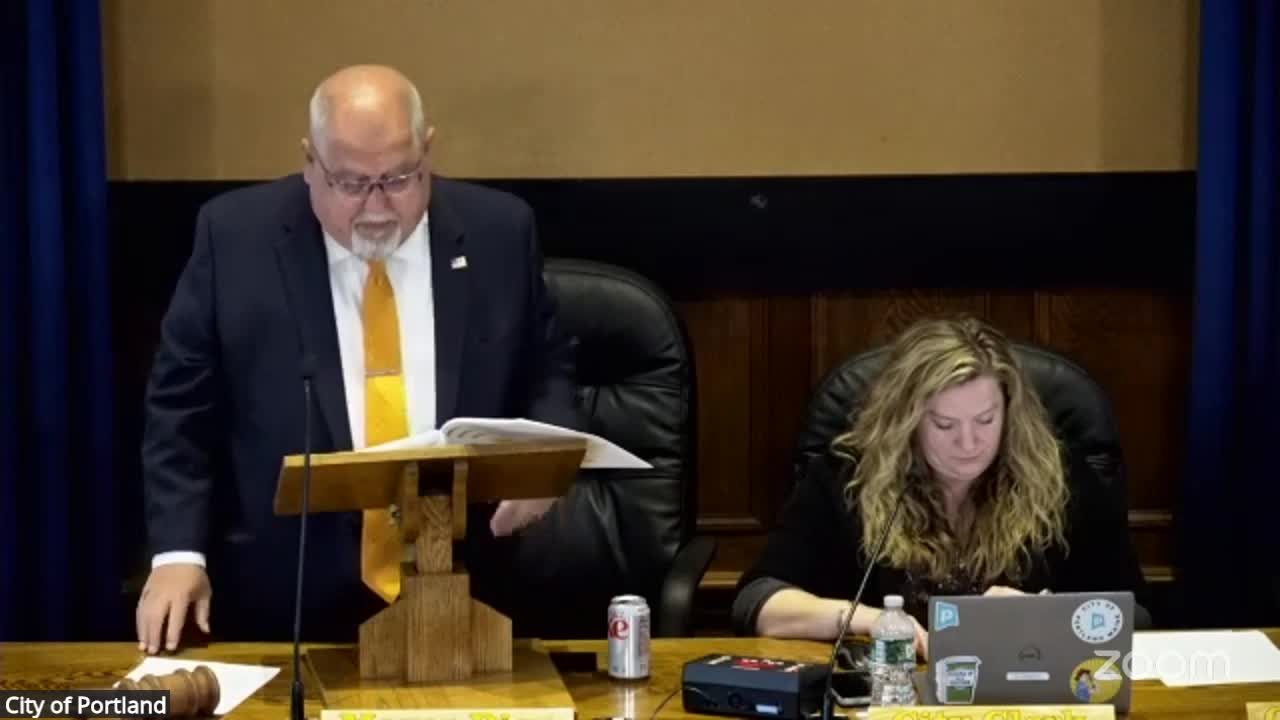
Summary
City Manager Daniel West submitted a $365.6 million recommended municipal budget and the City Council voted unanimously to refer the proposal to the Finance Committee for detailed review amid state funding uncertainty and proposals to use one-time funds and program changes to close a multimillion-dollar gap.
City Manager Daniel West submitted the City Manager's recommended fiscal year 2026 municipal budget — a $365,600,000 proposal — and the Portland City Council voted unanimously to refer the package to the Finance Committee for review.
The budget, delivered to the council as required by the city charter, was presented by Daniel West, City Manager. West told councilors the budget cycle was “extremely complex and very challenging,” citing rising health insurance costs as high as 20%, contractually required wage increases, and recent federal and state funding uncertainties that together produced a large budget gap.
West said the city began the process with an estimated $19 million shortfall that grew to about $29.5 million after the loss of a $3 million FEMA grant. Through departmental reductions, proposed fee and revenue increases and delaying hiring for some positions, staff reduced the remaining gap to about $8.8 million, which the recommended budget addresses in part using one-time funds and fund balance.
“We are still waiting for those uncertainties to play out, most relevantly in Augusta,” West said, referring to proposed state changes that could affect nearly $5.9 million in funding the city currently expects. He described general assistance as a state-mandated program with significant local cost and said Portland absorbs many clients from across Maine and beyond. West reported that from Feb. 24 to Feb. 25 the city recorded 975 intakes at homeless services, 484 of which were from other Maine towns and 203 from out of state.
To reduce reliance on fund balance, West proposed a set of policy options for the Finance Committee: reprogramming approximately $1.5 million in opioid settlement funds and consolidating family shelter services at an existing site (166 Riverside Street) after refit, which he said could save about $1.3 million. Taken together, those options could reduce the fund-balance draw by about $2 million.
Councilors reacted to the presentation by emphasizing the state-level uncertainty. Several councilors — including Councilor Sykes and Councilor Grant — stressed that labor costs and health insurance are the primary drivers of rising expenses and urged the council to consider structural changes if state funds are reduced. Councilor Sykes and others described ongoing work with the state delegation to seek a middle ground on proposed cuts or caps.
The council voted unanimously to refer the budget and appropriation resolve to the Finance Committee, which will begin consideration at its next meeting and continue with a schedule announced by staff.
The referral does not represent final approval; the Finance Committee will review line items, proposed policy options and potential reprogramming of restricted funding before a subsequent council vote.