Get Full Government Meeting Transcripts, Videos, & Alerts Forever!
Get email alerts on the Planning Commission Orientation topic
No spam. Unsubscribe anytime.
Watertown planning commission receives orientation on public‑hearing procedures; agrees to draft bylaws
Summary
At a Jan. 23 orientation, the City of Watertown Planning Commission heard guidance on public‑hearing procedure, ex parte contacts and findings of fact from Brian McGinnis and directed staff to prepare draft bylaws and timeline for an upcoming comprehensive land‑use amendment.
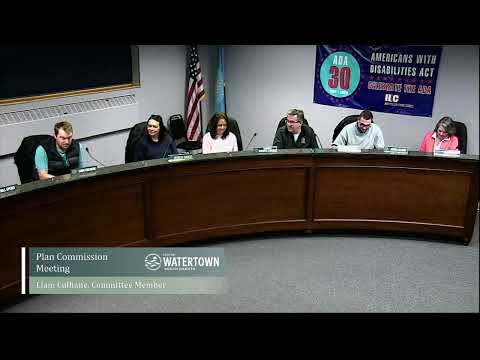
The City of Watertown Planning Commission on Jan. 23, 2025, held an orientation session led by Brian McGinnis, district 3 community development specialist, that reviewed public‑hearing procedure, ex parte communications, findings of fact and other meeting practices. Commissioners agreed to develop a set of formal bylaws and staff outlined a timetable for an upcoming comprehensive land‑use amendment.
McGinnis told commissioners that public perception matters nearly as much as actual impartiality, saying, "perception is almost the same as reality." He reviewed standard practices for public hearings: review meeting packets in advance, open and close the public hearing on the record, base decisions on facts and the city’s ordinances, and state findings of fact when required (for example, when voting on variances). He urged commissioners to avoid one‑on‑one, off‑the‑record contacts with applicants, and to disclose any necessary conversations on the record to limit perceived ex parte contacts.
McGinnis recommended practical steps to reduce risk and maintain fairness, including rotating seating and voting order, taking roll‑call votes on contentious matters, setting clear time limits for public comment by agreement or in bylaws, and avoiding technical redesigns during meetings by commissioners who are not credentialed in engineering or other specialized fields. He also warned that deferring decisions without a clear factual basis increases the risk of ex parte contacts and subsequent legal challenges.
Brandy, a community development staff member, reviewed staff roles and resources and told commissioners that meeting recordings are posted to the city’s YouTube page: "We have them recorded live and then stored on our YouTube page." She also said the community development division sits under the Public Works Department, that the public works director position is currently vacant, and that the division comprises six subunits that handle planning, zoning and building permits. Staff identified Carla as an additional staff contact for commissioners and distributed a reference handout with QR codes linking to applicable resources, including the city’s comprehensive land‑use plan.
On next steps, commissioners and staff agreed to prepare bylaws. A commissioner suggested scheduling a bylaws discussion two to three months out so the body could review a draft before formal adoption. Staff also summarized the timeline for the pending comprehensive land‑use (CL) amendment: if the planning commission forwards the item at its next available meeting, staff said the earliest city council first reading would be March 3, the second reading March 7, and adoption could occur April 11 (dates as stated by staff during the meeting).
The session also included routine procedural votes: the commission approved the meeting agenda and the Jan. 9 minutes and later took a motion to adjourn. Those votes were taken by voice/roll call and were recorded in the meeting transcript as passing; the transcript does not list numerical tallies.
Why it matters: Clear, consistent meeting procedures and well‑written bylaws help the planning commission apply the zoning ordinance and the comprehensive land‑use plan consistently, reduce legal and fairness risks for applicants and neighbors, and improve public confidence in decision‑making. The commission’s next work items include drafting bylaws and advancing the CL amendment through the adopted schedule provided by staff.