Get Full Government Meeting Transcripts, Videos, & Alerts Forever!
Get email alerts on the Parks Community Grant topic
No spam. Unsubscribe anytime.
Bozeman advisory board adopts Parkland Trust Community Grant Program to distribute about $220,000
Summary
The Urban Parks and Forestry Advisory Board on March 27 voted to adopt a formal Parkland Trust Community Grant Program to distribute about $220,000 in cash-in-lieu parkland funds, with the board approving the proposal unanimously in a recorded vote of 4-0.
Lede The Urban Parks and Forestry Advisory Board on March 27 voted to adopt a formal Parkland Trust Community Grant Program to distribute about $220,000 in cash-in-lieu parkland funds, with the board approving the proposal unanimously in a recorded vote of 4-0.
Nut graf The program, presented by Park Planning and Development Manager Addie, consolidates prior scoring categories, clarifies procedures for applicants and staff, and aims to align grant awards with themes in the city’s recently adopted PRAT plan. The board approved moving the program forward with changes discussed at the meeting; staff said the first application period would launch in spring and that grant awards would be reviewed by the board in June with funding recommendations expected in July.
Body Addie, identified in the meeting as the Park Planning and Development Manager, told the board the draft formalizes an on‑going but informal practice of allocating cash-in-lieu of parkland. “We have about $220,000 to disperse,” Addie said, and described plans to run a defined application period, simplify the application form and reduce criteria from eight to six so applicants do not repeat information.
The program will require staff to score the first two criteria (feasibility and appropriateness for park type), while the board will rank criteria three through six, Addie said. She described consolidating equity- and access-related criteria into a single item and said the impact criterion—how strongly a project advances PRAT plan themes—will be weighted most heavily.
To reduce one-on-one back-and-forth with applicants, Addie proposed a single in-person public workshop and a Zoom Q&A session (recorded and posted), plus FAQs and a draft grant contract on the program website. Addie said the city would aim to launch the application period by about April 1 and run it for roughly two months, with a likely deadline the Friday after Memorial Day (referred to in discussion as about May 30). Scoring would occur at the June board meeting and the board would receive funding recommendations in July.
Board members and staff sought clarifications on scoring and administration. One board member described the largest point category as “really broad,” and several board members recommended a rubric or descriptive ranges (for example, “exceeds/ meets/partially meets/does not meet”) to improve scoring consistency. Addie and staff agreed to provide internal scoring ranges and example language for reviewers prior to scoring.
The program documentation will collect, but not currently score, the applicant’s financial match and in‑kind contributions; Addie said those fields are “more just for tracking.” Staff told the board that some applicant groups may propose to perform maintenance themselves—an example given was a long-established user group that undertakes ongoing maintenance under a contract with the city—and that the application will allow applicants to indicate that intent. Addie also warned that cash-in-lieu funds have geographic constraints under state law and that staff will confirm where funds can be used before awards are finalized.
On distribution mechanics and timing, staff said disbursement will typically be by reimbursement or by city procurement (for example, paying a contractor directly) depending on the grantee. Because the city’s capital budget schedule means some funding becomes available only on July 1 of a fiscal year, staff and board discussed scenarios where grants are approved in one fiscal year but funds are disbursed after the start of the next fiscal year. Addie said the current allocation can be used now and the program will be refined to fit a repeatable annual cycle in future years.
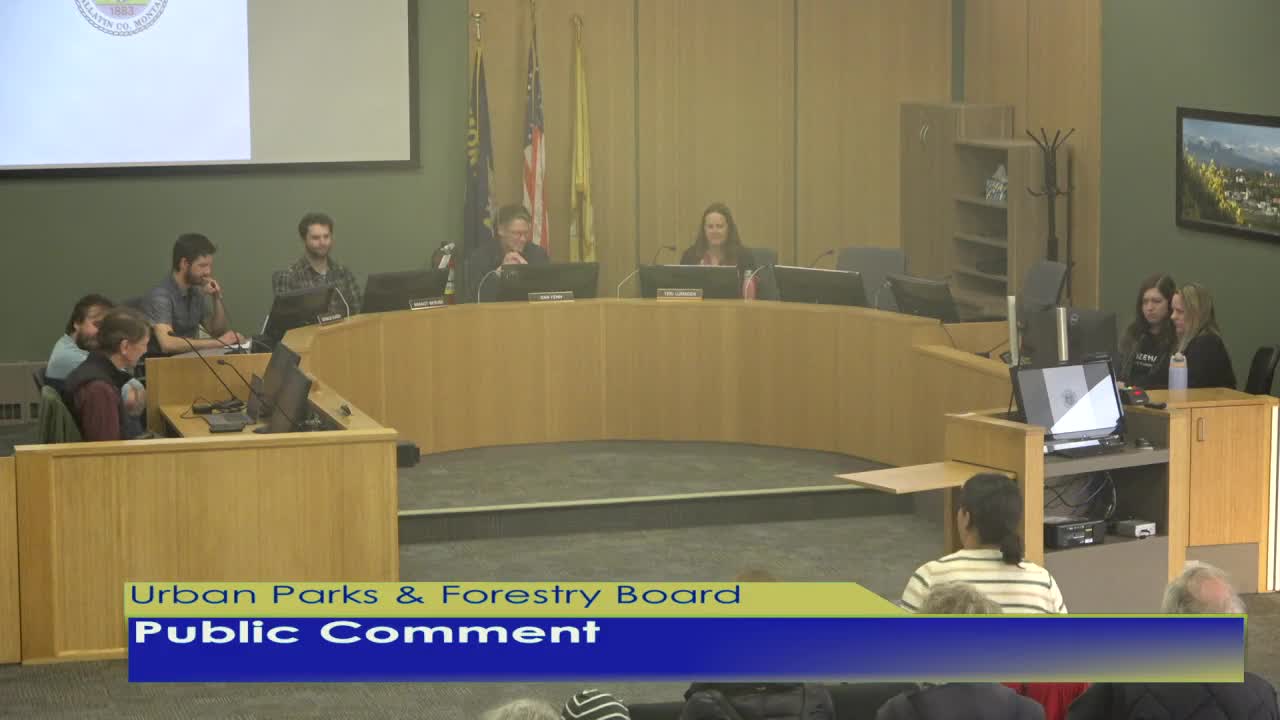
Public comment and outreach The board and staff discussed outreach plans: a press release, social media, outreach to HOAs, trail and watershed groups, the Valley Community Foundation, KGLT radio, and targeted on‑site signage (QR codes) in neighborhoods that are eligible to receive funding. Marcia Kaveny, a resident who spoke during public comment, recommended simplifying scoring with a checklist and urged clearer language about the PRAT plan objectives on the program website.
Formal action and vote The board’s final motion, recorded by the chair, was to approve the Community Grant Program with the changes discussed during the meeting. The vote record captured in the meeting transcript: board member Donald Overage — yes; Brent Groot — yes; Dan Finn — aye; Carrie Lumsden — yes. The chair announced the motion had been approved.
Ending Staff will post the final application package on the city website (including a draft grant contract and Q&A), hold the workshop sessions (in person and via Zoom), and return to the board in June with scored applications and to the board/commission with funding recommendations in July. Staff noted the program is intended to be refined as the city integrates the grant cycle into its regular fiscal planning so future cycles can be announced earlier in the year.