Get Full Government Meeting Transcripts, Videos, & Alerts Forever!
Get email alerts on the Land Use Zoning Variance topic
No spam. Unsubscribe anytime.
Norwalk Zoning Board of Appeals holds training on variance law, FOIA, conflicts and meeting procedure
Summary
City lawyers led an orientation for the Norwalk Zoning Board of Appeals explaining Connecticut case law on variances, meeting procedures including quorum and record rules, and obligations under FOIA, ADA and the Fair Housing Act. Law staff will circulate case summaries and confirm training credit.
Norwalk Zoning Board of Appeals members met for a training session where city attorneys reviewed state court standards for granting zoning variances, procedural rules for hearings and appeals, and legal constraints such as the Freedom of Information Act and conflict-of-interest rules.
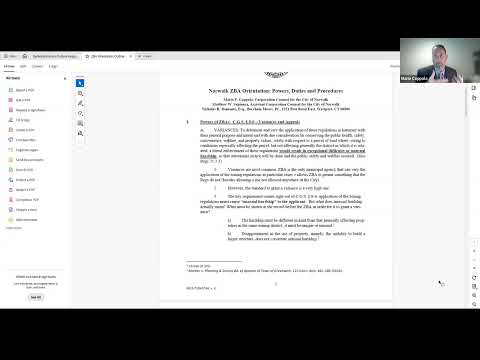
The orientation, led by Mario Capo, corporation counsel for the City of Norwalk, with Assistant Corporation Counsel Matt Saffanza and outside counsel Nicholas Bimonte of Birch and Moses, concentrated on the high legal bar for variances under Connecticut case law and best practices for documenting decisions. "The variance being requested is...the reason that there's a hardship for the variance being requested that affects the property uniquely and differently than others within the zoning district," Capo told board members, urging clear findings on the record when an application is contentious.
Why it matters: The panel heard that recent Connecticut precedent requires more than inconvenience or financial loss to justify most variances. Bimonte summarized the effect of the state Supreme Court’s decision, saying that in practice a board often must show that, without the variance, the property lacks a reasonable economic use. "You can't grant a variance unless there is 0 economic value to the property unless you grant that variance," Bimonte said, describing the strict standard that has emerged in case law and the limited exceptions such as reductions of nonconformity or reasonable accommodations under the Fair Housing Act and Americans with Disabilities Act.
Most important guidance - Hardship standard and exceptions: Attorneys reviewed the standard elements for a hardship-based variance, noted the Supreme Court’s ruling identified in the orientation (referred to in the materials as the E and F Associates decision), and identified one commonly recognized exception where a variance reduces an existing zoning nonconformity. The panel was repeatedly told to put reasons supporting a hardship on the record in contentious cases so a future court can review the basis for the decision. - Reasonable accommodations: Counsel said requests for variances tied to ADA or Fair Housing Act reasonable accommodations are legitimate grounds for relief but urged the board to consult the law department because some claims may be overstated. - Appeals and de novo review: When the board hears an appeal of a zoning enforcement officer’s decision, it conducts a de novo review and is not bound by the prior official’s determination. - Quorum and voting: Members were reminded that a concurring vote of four is required to grant a variance or to reverse a zoning enforcement officer on appeal; the ZBA should strive to have five members present for such decisions when possible. - Record and ex parte communications: All written reports and materials become part of the record. Counsel warned that ex parte communications or an email back-and-forth among a quorum can create an illegal, unnoticed meeting under the Connecticut Freedom of Information Act. Matt Saffanza said, "If you're using something as part of your judgment, then the applicant and the public should have a chance to know what that is." - Public hearing conduct and briefs: The board may set neutral time, place and manner limits, and members should allow opportunity for applicant rebuttal; counsel recommended asking for briefs when issues are complex but cautioned against refusing to accept materials outright. - Conflicts and recusal: Counsel reviewed conflict principles and the appearance-of-conflict standard. Capo advised that a member who has a conflict should recuse and leave the hearing rather than merely abstaining at the vote. The attorneys recommended consulting the law department confidentially when unsure. - FOIA cautions and site visits: The group was warned that exchanges by email, text or phone among a quorum can constitute an unposted meeting; site visits involving a quorum must be noticed. Counsel advised that clarifying a past, closed decision one-on-one is usually acceptable, but substantive deliberation with multiple members outside a public meeting should be avoided.
Board response and next steps: Members asked procedural questions about handling briefs and managing repetitive public commenters; the law staff recommended case-by-case consultation. Mario Capo and the law department agreed to circulate summaries and copies of the cases discussed (referred to during the meeting as the Verillo/Crillo decision and the E and F Associates decision) and to confirm whether the session counted toward the board members’ statutory training requirement.
The meeting concluded without formal changes to policy or binding decisions recorded on zoning matters during the session. A motion to adjourn was made and seconded near the end of the session; the transcript records the motion and second but does not provide a roll-call vote.
The orientation focused on legal standards and process: board members were urged to record clear reasons when granting or denying variances, to avoid ex parte communications, and to consult the law department on complex ADA or Fair Housing Act claims. Law staff said they will follow up with the case texts and with confirmation of training credit.