Get Full Government Meeting Transcripts, Videos, & Alerts Forever!
Get email alerts on the Stormwater Facilities Plan topic
No spam. Unsubscribe anytime.
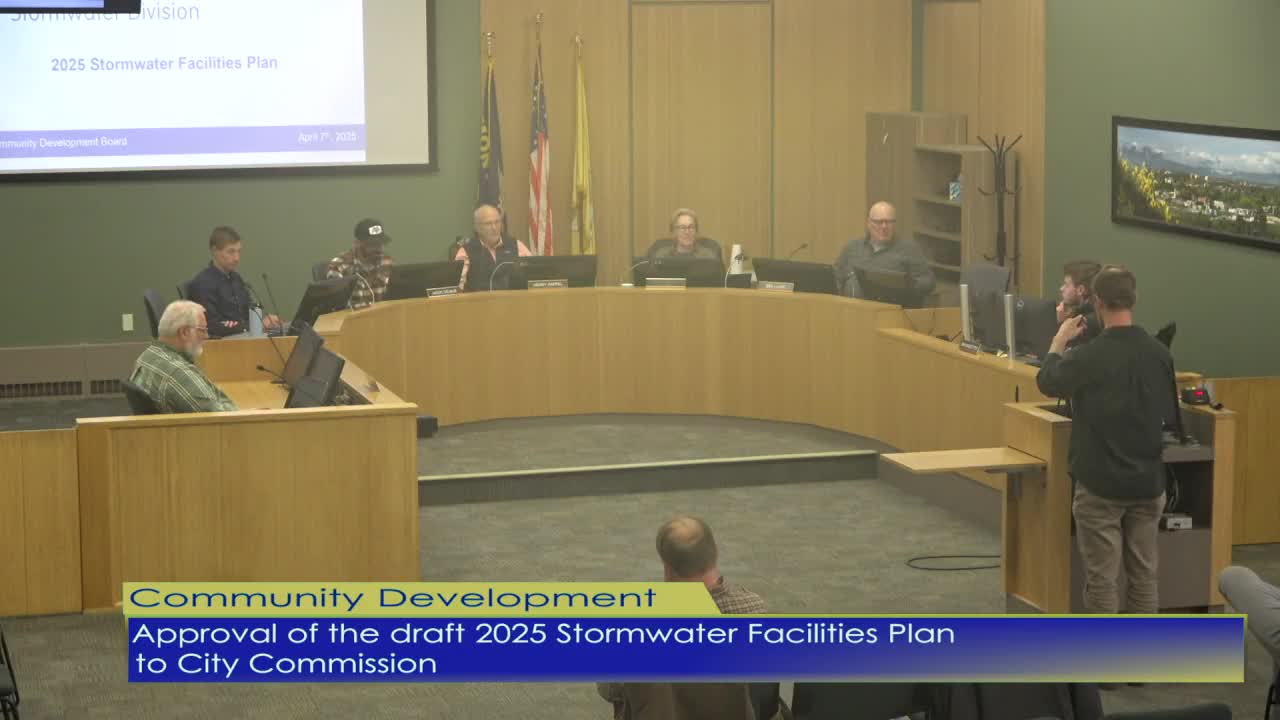
Bozeman board recommends city commission adopt 2025 stormwater facilities plan
Summary
The Bozeman Community Development Board voted 5-0 to recommend the City Commission adopt a draft 2025 Stormwater Facilities Plan after hearing staff presentations, technical questions about downtown pipe capacity, and public comments urging nature-based solutions and better ditch coordination.
The Bozeman Community Development Board voted unanimously Wednesday to recommend that the City Commission adopt the draft 2025 Stormwater Facilities Plan, a 20-year blueprint that updates stormwater design standards, prioritizes MS4 permit compliance, and outlines capital and funding recommendations.
The plan, presented by City of Bozeman staff including Adam Oliver and Sean Coats, aims “to improve waterway health, protect public safety, and comply with our MS4 permit,” Coats said, summarizing the plan’s primary drivers.
Board members and staff discussed key technical findings from the plan, including widespread stretches of undersized clay pipe in the downtown basin, options to line versus replace pipes, and alternatives that emphasize infiltration or bypass piping. Staff said prior work has included replacing roughly 5 miles of pipe and installing 29 water-quality capital projects; the draft plan recommends finalizing inspection and maintenance frequencies for post-construction facilities and conducting a needs-based funding assessment before setting new utility rates.
Why it matters: the plan guides how the city will address recurrent flooding, protect Bozeman Creek and other receiving waters, and implement a program to inspect and maintain roughly 1,300 mapped detention or retention features citywide. The board’s recommendation moves the document to the City Commission for final action, currently scheduled for the May 6 meeting.
Key technical points and staff responses
- Downtown pipes and lining: staff identified the alley north of Main Street as a critical downstream pipe that collects flows from above Main and outfalls to Bozeman Creek. Staff showed camera footage of clay pipe and portions that have been rehabilitated with a fiberglass liner. “There’s no more room. It’s at capacity,” staff said when describing how a design storm fills that critical pipe, and noted lining generally extends pipe life though it slightly reduces diameter while increasing hydraulic efficiency.
- Alternatives and regional treatment: the draft plan presents two broad alternatives in several basins: increase conveyance with upsized pipes or emphasize infiltration and distributed, nature-based solutions where soils and right-of-way allow. Staff said flow monitoring and additional watershed studies (recommended in the plan) would inform where regional treatment or larger conveyance is feasible.
- Post-construction facility program and private ponds: staff described an existing inventory of roughly 1,300 mapped post-construction facilities (about 100 city-owned, 800–900 HOA-owned, and the remainder on commercial lots) and estimated about 80 new features are added annually with development. Staff said the 2021 DEQ audit highlighted a need for more robust inspection and maintenance of private HOA ponds, and noted the city has enforcement authority but has rarely used it.
- Funding and level-of-service choices: the plan does not set new rates. Instead it recommends a needs-based assessment that would estimate costs for different levels of service and potential funding mechanisms (including a stormwater impact fee, which the city does not currently have). Staff gave one high-level cost example from the draft: “If you were to replace every clay pipe tomorrow, it would cost $37,000,000,” and cautioned that figure is a planning-level estimate, not a bid-ready amount.
Public comment and stakeholder concerns
Catherine Berry, speaking for the Gallatin Watershed Council and the Gallatin Water Collaborative, urged the city to prioritize native wetland and riparian vegetation in stormwater facilities and to include irrigators and fisheries professionals in planning for open channels. “Promoting and maintaining native vegetation in stormwater facilities…can help with nutrient infiltration, aid in flood resilience and create habitat,” Berry said.
Kevin Hagerty, secretary of the Mill Creek Ditch Company, asked for clearer city coordination with ditch operators and said his group had received an insurance notice limiting “forever chemicals” in ditches. “We would need better communication with the city about who can grant a ditch right,” Hagerty said.
Staff reply and follow-up
City staff said they tracked and responded to public comments during the drafting process and have incorporated state guidance (the state stormwater BMP manual) into local design standards. Staff also said city leadership has met with the Mill Creek Ditch Company and described progress on coordination. Staff noted state legislation under consideration could allow nutrient-offset projects that might fund naturalized, regional treatment systems.
Board action and next steps
Board Member Mark Eggie moved to recommend City Commission approval of the draft plan; Ben Lloyd seconded. The board approved the recommendation 5-0. The board’s formal recommendation forwards the draft plan to the Bozeman City Commission for consideration and possible adoption by resolution; the Commission review is scheduled for May 6, 2025, according to staff.
The plan itself recommends a priority sequence of actions over the next 20 years, led by (1) MS4 permit compliance and post-construction inspection/maintenance frequencies, (2) a needs-based assessment to identify sustainable funding, and (3) a focused approach to deferred maintenance and capital replacement in the oldest basins. Staff told the board that decisions about changing rate structures, credits, or pursuing impact fees would come later after the needs assessment.
Ending note
Board members praised the draft as a substantive update to city stormwater policy and recommended that staff return with any additional technical analyses and a clear plan for follow-up steps to the commission. The City Commission will receive the board’s recommendation at its May 6 meeting.