Get Full Government Meeting Transcripts, Videos, & Alerts Forever!
Get email alerts on the Unified Development Code topic
No spam. Unsubscribe anytime.
Bozeman officials outline Unified Development Code rewrite to simplify zoning, support housing
Summary
City planning staff presented a status update on a multi-year rewrite of Bozeman's Unified Development Code, proposing consolidated zoning districts, changes to parking rules and new usability features while pursuing compliance with the Montana Land Use Planning Act.
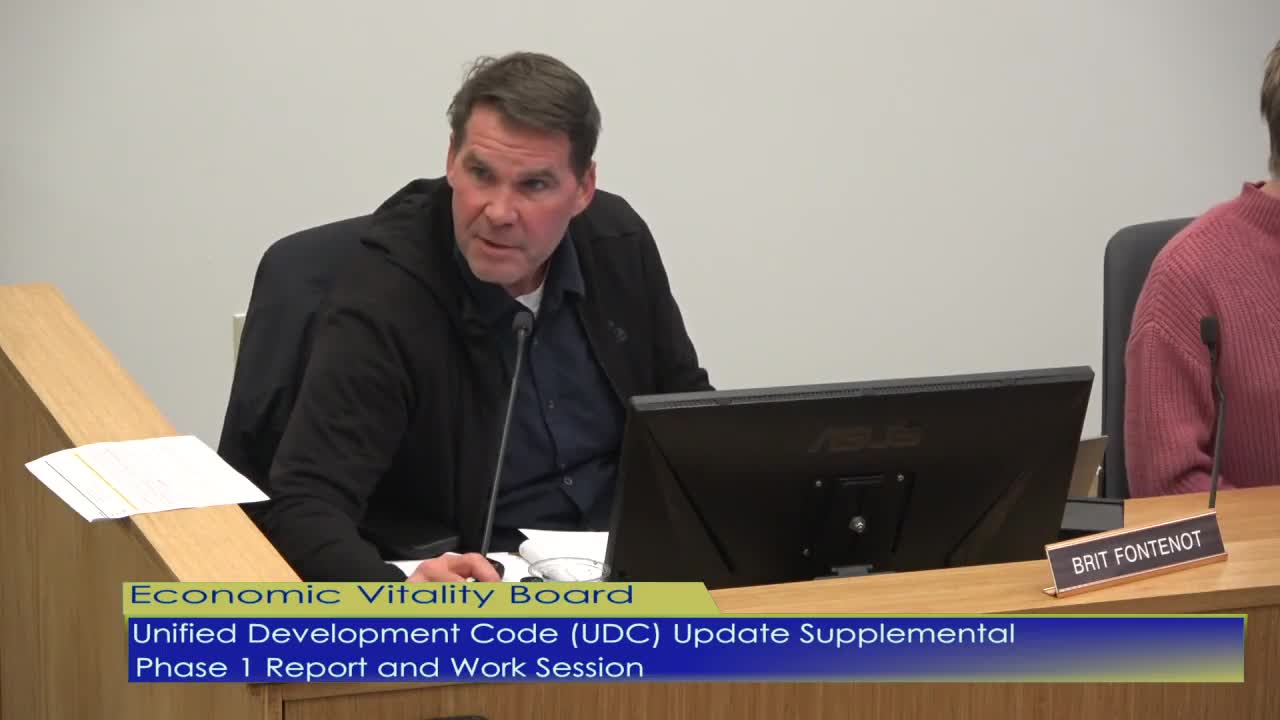
Chris Saunders, long-range planning manager in the Community Development Department, told the Bozeman Economic Vitality Board on April 2 that the city is midway through a supplemental engagement phase for a comprehensive rewrite of the Unified Development Code and will take revisions to the City Commission in May and June.
Saunders said the UDC — a single code that currently runs over 500 pages and covers zoning, subdivision and several technical standards — is being reorganized to improve usability and to implement goals in the city—s adopted plans. "The Unified Development Code is a single document in the municipal code that covers zoning, subdivision and then a whole lot of other related elements," Saunders said.
City staff emphasized two drivers for the update: better clarity and streamlined procedures for applicants, and legal compliance with recent state land-use law. Saunders identified the Montana Land Use Planning Act (MLUPA) as a key statutory driver and said the project timeline is tied to a compliance deadline the presentation referenced as May 17, 2026. He said the city is continuing public engagement through the Engage Bozeman platform, chat kits, open houses and a follow-up survey to refine draft language before formal public hearings.
Major proposed changes described in the presentation include consolidating residential districts (reducing district types from eight to five), creating a new B3C downtown historic-core district, folding smaller residential districts into a new RA category, and deleting two seldom-used commercial districts (residential office and urban mixed use). Saunders said some existing numeric standards such as lot area and floor area ratio have been removed in favor of other dimensional standards intended to reduce complexity.
On housing policy, Saunders said the draft implements legislative developments from 2023 requiring accessory dwelling units where housing is allowed and requiring duplexes where single-family housing is allowed. He noted that MLUPA requires jurisdictions to demonstrate support for at least five of 14 alternatives that encourage more housing "by how many front doors there are," not by price point.
The draft also reworks presentation and organization: each zoning district will use a consistent two-page layout (lot standards and building standards), keyed graphics to explain terms such as side-yard setback, and hyperlinks in the digital code to avoid repetition.
Parking and mobility changes were a frequent topic in board discussion. Saunders said the draft proposes eliminating or reducing minimum off-street parking in parts of Midtown, downtown (the new B3C), and in urban renewal/TIF districts to encourage shared public parking solutions in those areas. He described a shift to measuring nonresidential parking by gross floor area and adding stand-alone bicycle parking requirements with short- and long-term distinctions. "We're proposing to expand that concept to the city's urban renewal districts and TIF areas," Saunders said, noting those districts can fund shared structures such as the downtown Bridger Park parking garage.
Board members pressed staff on inclusion and neighborhood impacts. Board member Craig requested language that explicitly addresses mobility-impaired residents, asking that references to "walkable" be expanded to include people who use wheelchairs or scooters. "I—d like to request that wherever there—s walkable or walkability, it'd be extended to something like walkable and rollable or walking and rolling," Craig said. Saunders said related projects, such as the parks, recreation and active transportation plan, may be the best place to integrate accessibility language and committed to coordinate with other staff.
Members discussed whether more residential uses should be allowed in existing commercial B zones to increase housing near jobs and services. Saunders responded that map changes (zone map amendments) and where districts are applied are separate from the code text; some property owners have already asked for rezones but no parcel-level edits have been made while the draft process continues. He reiterated that zone map amendments may be initiated by property owners or the commission and that the commission will make the final decision.
Other questions covered energy and utilities (NorthWestern Energy is the utility provider and the city coordinates with the company), coordination with Gallatin County planning (the city coordinates with the county through the planning coordinating committee but each jurisdiction regulates its own land use), and potential legislative changes this session that could affect the final code (proposals mentioned included state-level parking rules and minimum building heights).
Saunders said engagement to date has included five open houses, six workshops, stakeholder meetings, and a September 2024 survey that drew roughly 500 responses; staff are compiling 74 pages of notes from recent workshops. He said the process will return to the City Commission in May-June for direction, then move to a revised draft and additional public review before hearings. Materials and draft documents are available on the city's Engage Bozeman webpage.
No formal actions or votes were taken during the Economic Vitality Board session; members offered feedback and staff will incorporate the board—s comments into the next drafting phase.
The city plans to present updated code language and a revised zoning map to the City Commission in May and June, then prepare for public hearings and a final adoption sequence after the legislature—s decisions are known. Staff encouraged board members and residents to review materials and submit input through Engage Bozeman.