Get Full Government Meeting Transcripts, Videos, & Alerts Forever!
Get email alerts on the Charter Review topic
No spam. Unsubscribe anytime.
Bozeman study commission adopts five goals for charter review, schedules March 6 to finalize timetable
Summary
The Bozeman Study Commission voted to adopt five goals guiding a two-year review of the city charter, agreed to add public education and outreach tasks, debated accuracy of meeting minutes, and set March 6 as the next meeting to finalize the review timetable.
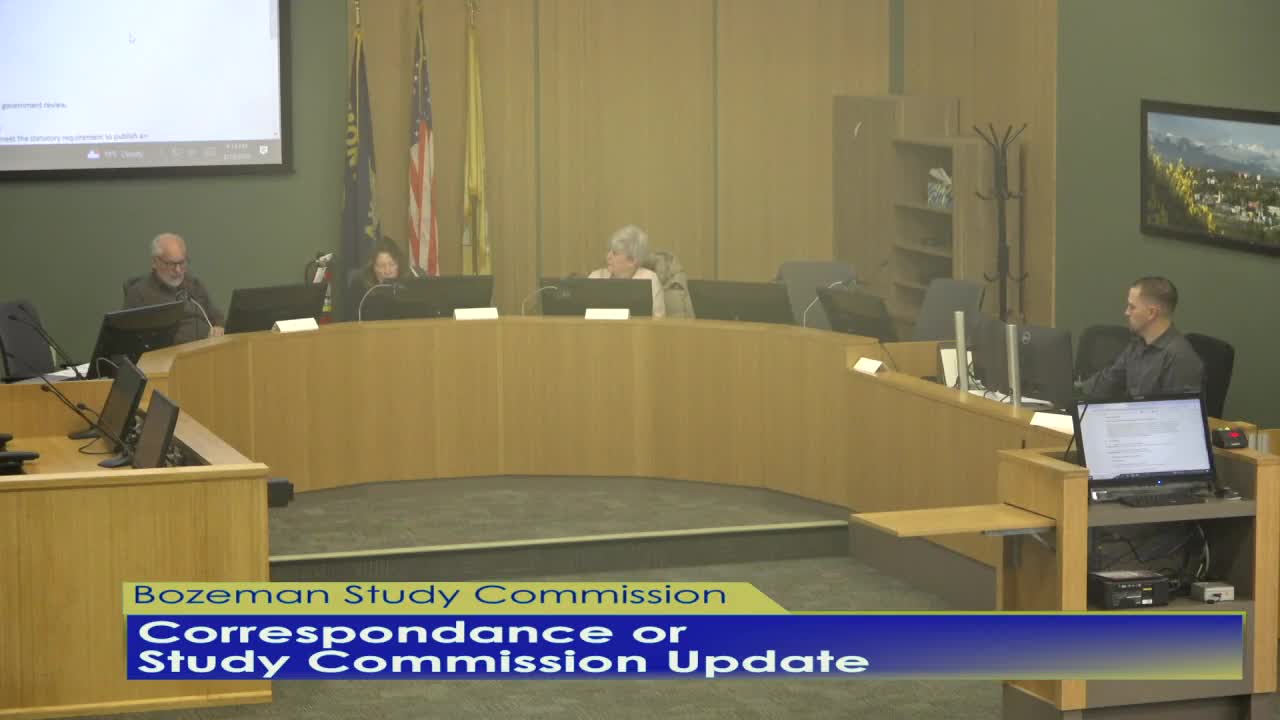
The Bozeman Study Commission on Feb. 19 adopted five goals to guide a two‑year review of the city charter and agreed to finalize a detailed timetable at a March 6 meeting.
The commission’s adopted goals include a requirement to “educate ourselves and the community on the City of Bozeman’s current structure, charter form and process of local government,” and a specific charge to “identify ways to educate all city voters on the study commission’s final report to encourage their participation in the November 2026 general election.” Commissioners voted to adopt the set of five goals as amended; the final motion carried unanimously.
Why it matters: The commission’s work could lead to proposed charter changes that would appear on a future ballot. The city attorney told members that under state law a city charter is defined as a document that sets a local government’s powers, structure, rights and duties; how the commission frames its work and how it educates voters will affect public understanding and any later vote.
Members and staff spent much of the meeting debating two procedural issues that shaped the outcome: (1) how oral public comments are summarized in the official minutes, and (2) whether the commission should describe the charter using the word “constitution” in its goals. On the minutes, commissioners voted 3‑1 to amend the previous meeting’s minutes to remove a summary of one commenter’s remarks and instead record only the commenter’s name and that the person spoke. On the charter language, the group discussed alternatives and ultimately approved language that emphasizes education about the charter without adopting a single phrasing that all members preferred.
Public comment and staff briefing shaped the discussion. Lisonbee Sweeney, chair of the Better Bozeman Coalition, urged the commission to “pull in lots of diverse resources” and to consider strengthening historic‑preservation language and neighborhood roles in a revised charter. Resident Mark Campanelli recommended exploring ward‑ or neighborhood‑based representation and said the city should rely more on local expertise before hiring outside consultants. At one point a public commenter, John Stelley, criticized the relevance of documents attached to the commission’s agenda; commissioners debated how that comment should be recorded in the minutes.
City Attorney Greg Sullivan gave members a statutory overview and quoted Montana law governing charters, saying a charter is “a written document defining the powers, structures, privileges, rights, and duties of the unit of local government and limitations thereon.” Sullivan also offered to present a 30‑ to 40‑minute briefing on state charter law, the Bozeman City Charter (adopted February 2006), and the nature of municipal self‑government at the March 6 meeting.
Commissioners agreed that the meeting on March 6 will include: (a) the city attorney’s legal briefing, (b) a final review and formal adoption of the timetable/chronology for the study commission’s work (the statute requires the commission publish a chronology), and (c) further work planning public outreach and education. Members and staff agreed to add a legal review step to the draft chronology so any tentative report or draft charter language can be reviewed by counsel before the second public hearing required by statute.
Votes and procedural actions recorded at the meeting included approval of claims and consent items (initial consent action recorded as carrying 4‑0; claims approval later recorded as unanimous), a 3‑1 vote to change how a public comment was summarized in the prior meeting’s minutes, unanimous passage of an added goal to educate voters about the commission’s final report, and unanimous final adoption of the five goals as amended. Commissioners directed staff to post the revised timetable and supporting documents and to include a communications/outreach plan with calendar dates and locations for public forums.
The commission closed the meeting by confirming March 6 as its next meeting, when members expect to adopt the timeline and begin the attorney‑led education segment. The group also committed to placing materials in the study commission repository so commissioners and the public can access draft documents in advance.