Get Full Government Meeting Transcripts, Videos, & Alerts Forever!
Get email alerts on the Impact Fees Water topic
No spam. Unsubscribe anytime.
Water impact fees fall after new irrigation conservation rules; commission adopts report and resolution
Summary
Bozeman commissioners accepted the 2025 water impact fee service area report and adopted a resolution making the revised schedule effective April 5, 2025. The report shows lower residential fees after a city irrigation conservation policy reduced peak outdoor demand in new development.
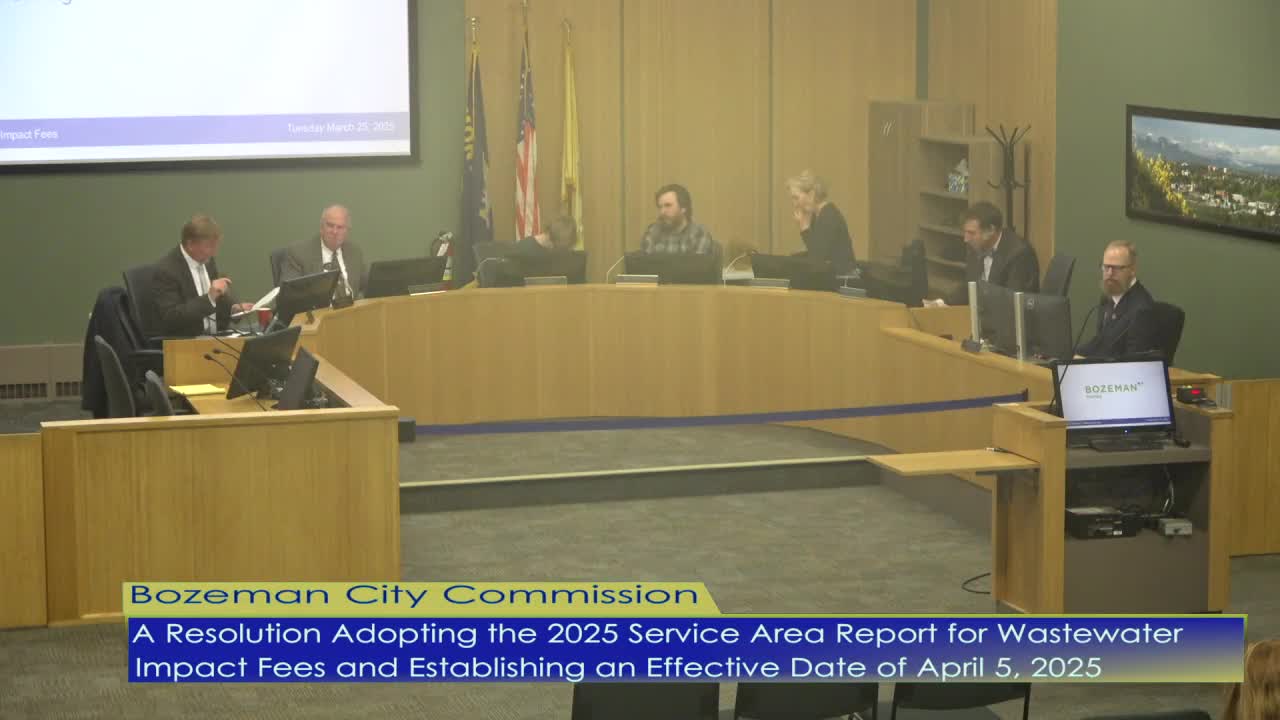
The Bozeman City Commission voted 5–0 March 25 to accept the 2025 Water Impact Fee Service Area Report and to adopt a resolution making the new fee schedule effective April 5, 2025.
Consultant Collin Maccowini and Community Development staff said the water study separates supply, storage, treatment and distribution costs and converts future demand into gallons per day per equivalent dwelling unit (EDU). McCawini told the commission the city’s 2024 irrigation conservation standards reduced peak outdoor water demand in new development and that change drives a sizable drop in residential impact fees.
McCawini said the study used a three‑year peak‑month average to estimate peak demand for an EDU and split that peak into indoor and outdoor components. He said the conservation measures lower peak outdoor gallons per day and therefore reduce the infrastructure sizing and unit cost that the fee must recover.
The city’s water CIP totals about $61 million including projects and remaining debt; staff applied a credit for the roughly $15 million currently in the water impact fee fund so the study does not double‑count funds already collected. After those credits and the conservation adjustments, the consultant estimated single‑family EDU fees near $2,600 (a reduction from previous levels), while some commercial fees would rise because of meter‑size and usage assumptions.
Deputy Mayor Morrison and other commissioners praised the conservation work and asked staff to monitor whether the assumed 44% reduction in peak outdoor demand materializes in practice. Staff said the city’s smart meters, irrigation audits and the new standards give reason to expect that the reduction is achievable but that staff will watch usage data and report back.
The commission accepted the service area report and then voted to adopt the implementing resolution with an April 5 effective date so staff can implement the revised fee schedule for new permits on that date.
Ending: Commissioners asked staff to track demand, especially for irrigation usage, and to revisit the fee study on schedule so the impact of conservation and inflation on future capital needs is visible.