Get Full Government Meeting Transcripts, Videos, & Alerts Forever!
Get email alerts on the Sidewalks Variance topic
No spam. Unsubscribe anytime.
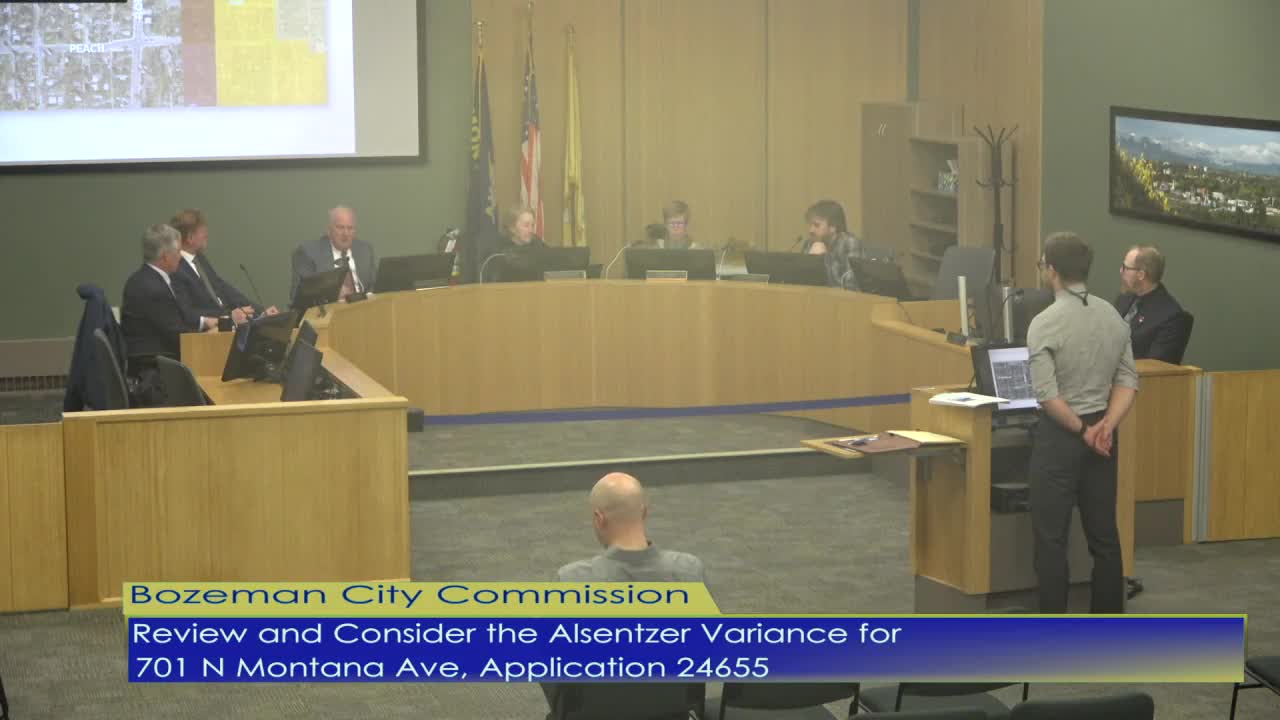
Commission denies variance to omit sidewalk at 701 N. Montana after neighbors and staff debate trees and connectivity
Summary
The City Commission denied a variance request March 11 that would have exempted a redevelopment at 701 North Montana Avenue from installing a five-foot sidewalk in the city right-of-way. Commissioners cited the transportation master plan, safety and the existing pattern of sidewalks; the denial passed unanimously.
The Bozeman City Commission on March 11 denied a variance request that would have allowed the owner of a redeveloped corner lot at 701 North Montana Avenue to avoid constructing a five-foot sidewalk in the city right-of-way adjacent to the property.
The issue: staff and the applicant agreed the redevelopment triggered the Unified Development Code requirement to install a city-standard sidewalk in the city right-of-way. The applicant sought a variance on two principal grounds: preservation of existing mature vegetation (a crabapple tree and an 8-foot hedge) that would need removal or root disturbance, and the applicant’s contention that the block currently lacks continuous sidewalk connectivity, making the installation a “sidewalk to nowhere.” The applicant described the site as a standard 50-by-132-foot lot but said the tree and hedgerow create a unique, locally important condition.
Staff recommendation and rationale: Associate Planner Zachary Moon presented the Development Review Committee’s report and recommended denial. Moon said the city’s Transportation Master Plan and Complete Streets policy call for sidewalks to be installed at redevelopment to build a continuous pedestrian network; his GIS analysis showed about 73% of the nearby frontage already has sidewalks. Moon also noted previously approved redevelopments in the immediate area had placed sidewalks when redevelopment occurred and that the sidewalk would lie entirely in the city right-of-way, not on private property.
Public comment: neighbors were split. John Barzness, a nearby resident who said he has lived in the neighborhood 44 years, urged the commission to require the sidewalk to provide safe east–west connectivity and noted the right-of-way is public property. The property owner (identified in the hearing as Guile/Guy Sensor) urged a compromise to preserve the crabapple and hedge and suggested an alternate alignment — a curb-adjacent sidewalk with a semicircular bypass around the tree — if a sidewalk must be installed.
Commission discussion and vote: commissioners questioned staff about the difference between minor improvements and full redevelopment (the latter generally triggers sidewalk installation), the city’s ability to allow alternative sidewalk alignments to save trees, and the improvements-agreement process (financial security held by the city until work is completed). Planner Moon and Director Nick Ross said the city is open to alternative alignments where justified and noted the city enforces completion through improvement agreements that can include bonds, letters of credit or cash security. Commissioner Majic moved to adopt staff findings and deny the variance; the motion was seconded and passed with all commissioners voting in the affirmative (Aye from Commissioner Majic, Commissioner Bodie, Deputy Mayor Morrison and Mayor Cunningham).
Why it matters: commissioners cited public safety, the city’s Complete Streets and Transportation Master Plan policies and the need to avoid inconsistent application of sidewalk rules when denying the variance. Staff and at least one commissioner said there are design options — including curb-adjacent sidewalks or jogged alignments — that can sometimes preserve trees while meeting pedestrian connectivity goals.
Outcome and next steps: denial of the variance requires installation of the sidewalk per the previously approved certificate of appropriateness for the redevelopment. Staff said an improvements agreement was already being finalized with the applicant to guarantee construction; if the property owner installs the sidewalk at their cost, the city will release the security once work is completed. Staff will work with the applicant on whether an alternative alignment (for example, a curb-adjacent sidewalk and a semicircular path around the crabapple) can meet code and preserve mature vegetation.
Ending: the commission denied the variance; staff will continue to work with the property owner on timing and final sidewalk alignment and the city manager said he would follow up on a separate public question about sidewalk status at Centennial Park.