Get Full Government Meeting Transcripts, Videos, & Alerts Forever!
Get email alerts on the Annexation Policy 5076 topic
No spam. Unsubscribe anytime.
Bozeman Commission adopts revised annexation policy, keeps flexibility on affordability requirements
Summary
The Commission unanimously adopted a rewritten annexation policy replacing Resolution 5,076, clarifying processes and reaffirming state-law limits on requiring affordable housing as a condition of landowner-initiated annexation.
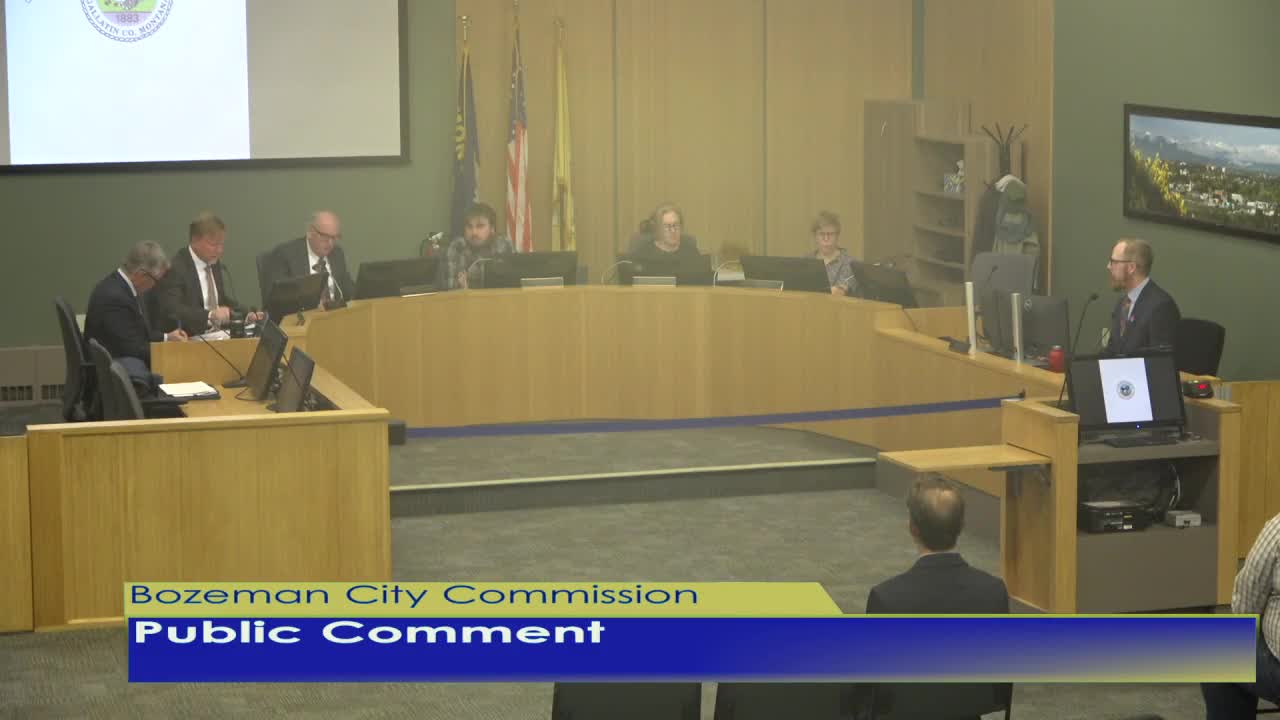
The Bozeman City Commission unanimously adopted a replacement annexation policy on Feb. 25 that updates wording, clarifies review procedures and retains local priorities while noting statutory limits on what the city can require when a landowner requests annexation.
City Manager Webb opened the action item by saying the revision “contains no substantive changes to the current annexation policy” but that staff placed it as an action item to allow fuller public discussion. Senior Planner Chris Saunders summarized the process for the commission: “Annexation is the legal process where property comes into the city. It's a delegation from the state to the city.” Saunders told commissioners the city received 43 annexation applications from 2020–24 and said the draft policy aims to improve clarity and coordinate zoning and services during annexation review.
During the discussion commissioners and staff focused on two recurring themes: contiguity and how the city can — or cannot — use annexation to require housing affordability. City Attorney Sullivan explained the city’s current legal limits and reminded commissioners that state law governs annexation methods. Sullivan said the 2021 state legislative action removed the municipality’s authority to require inclusionary zoning, and added that a bill introduced in the current session to reverse that 2021 change had been tabled in committee.
Multiple commissioners said they remain interested in using annexation selectively to encourage housing types that could support affordability. Commissioner Magick and others said the commission can be “choosy” about which petitions to accept and the zoning the city applies, but staff and the attorney cautioned that mandatory affordability as a condition of landowner-initiated annexation is legally constrained under current state law. Staff noted that a landowner may voluntarily opt into incentives in the city’s affordable-housing ordinance, but that opt-in differs from a city-imposed condition.
Saunders described common annexation motivations — failed septic systems or owners wanting to develop under city standards — and said the city’s policy prefers contiguous annexations while allowing case-by-case flexibility. He gave examples of large and unusual annexations in Bozeman’s history, including a multi-parcel “Riverside” annexation and a city-owned parcel annexed for infrastructure and communications uses.
The motion to adopt the replacement annexation policy passed unanimously. The resolution replaces Resolution 5,076 and will be used for landowner-initiated annexation petitions going forward.
Why it matters: The policy frames how the city evaluates petitions to expand municipal boundaries, how it coordinates zoning and public services, and clarifies the limits of local authority on affordability conditions in light of state law.