Get Full Government Meeting Transcripts, Videos, & Alerts Forever!
Get email alerts on the Academic Freedom topic
No spam. Unsubscribe anytime.
University of Montana debate exposes sharp split over academic freedom and trustees' oversight
Summary
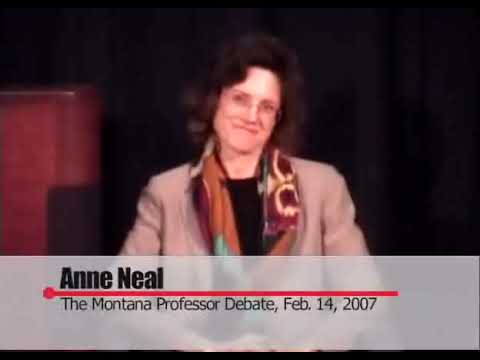
At a University of Montana event in Missoula, Roger Bowen of the American Association of University Professors and Anne Neal of the American Council of Trustees and Alumni traded sharply different views on whether external oversight and trustees should play a larger role in enforcing academic standards and curriculum.
University of Montana President George Denison moderated a debate in Missoula between Roger Bowen, general secretary of the American Association of University Professors, and Anne Neal, president of the American Council of Trustees and Alumni, on the relationship between academic freedom and institutional autonomy.
The debate focused on whether outside actors—trustees, alumni, legislators and advocacy groups—should do more to hold colleges accountable for curriculum, hiring and classroom practices. Bowen argued that faculty governance and peer review are the appropriate internal checks on academic conduct; Neal said external scrutiny and trustee action are needed when institutions fail to police ideological bias or weak scholarly standards.
Why it matters: The exchange highlighted familiar fault lines in U.S. higher education—shared governance versus trustee and public oversight, limits to professors’ classroom speech, and the growing share of contingent (non‑tenure‑track) faculty—which affect how colleges set curricula, hire and evaluate faculty, and justify public support.
Bowen framed the debate as a defense of longstanding professional norms. Citing the AAUP’s historical role dating to 1915 and its 1940 statement on academic freedom, Bowen said the academy must protect faculty decisionmaking about curriculum and personnel and use internal mechanisms such as peer review and, rarely, censure to enforce standards. “Academic freedom is precious and we think academic freedom is under fire, even under fire, from those who pretend to defend and protect it,” Bowen said, and he urged familiarity with the AAUP’s Red Book of policies. He warned that trustee or legislative intrusion into curricular decisions risks substituting political preferences for scholarly judgment.
Neal countered that trustees, alumni, parents and taxpayers have a legitimate role when institutions do not safeguard academic standards internally. She described ACTA’s work documenting course descriptions and student perceptions and argued that public pressure and trustee action have led to improvements at several institutions. “Trust but verify,” Neal said, summarizing ACTA’s view that outside stakeholders can press universities to ensure students receive broad, balanced general‑education instruction.
The two disputed several specific points: - Shared governance and presidential selection: Bowen said faculty must play a primary role in hiring and curricular decisions; Neal said trustees as fiduciaries should exercise oversight when faculty or administrations fail to assure quality and broader curricular coverage (for example, Western or U.S. history requirements at some institutions). - Limits of academic freedom: Bowen stressed the AAUP position that faculty should avoid introducing material unrelated to course subject; Neal argued the AAUP has shifted toward defending extramural political speech and that ACTA seeks clearer accountability when students report political advocacy in classes. - Evidence and surveys: Neal cited ACTA‑commissioned survey findings she described as showing substantial student reports of political content in classes (figures she cited include 49% reporting frequent political comments, 29% feeling they must agree with professors to get good grades, and other percentages describing one‑sided programming cited during her remarks). Bowen disputed ACTA’s characterization and emphasized peer review and internal processes as the main accountability tools. - Contingent faculty: Bowen highlighted AAUP research showing a large and rising share of contingent (non‑tenure‑track) instructors—he reported roughly two of three faculty are non‑tenure track—and said that trend weakens the protections academic freedom depends on.
Audience questions moved the discussion to related topics: whether “balance” means presenting every viewpoint (both panelists distinguished scholarly standards from false equivalence, saying that Holocaust denial or other claims without scholarly basis do not merit classroom parity), how adjunct/contingent employment affects academic freedom and institutional standards, and whether curricular requirements such as Western civilization are appropriate. Both panelists said they favored institutions and boards working collaboratively with faculty rather than imposing one‑sided mandates.
No formal actions or votes were taken. The event closed with panelists urging continued internal review and public discussion about how best to preserve both academic freedom and public confidence in higher education.