Get Full Government Meeting Transcripts, Videos, & Alerts Forever!
Get email alerts on the Homelessness Camping Regulation topic
No spam. Unsubscribe anytime.
Coos Bay council narrows public camping zones, enacts ordinance amending chapter 8.45
Summary
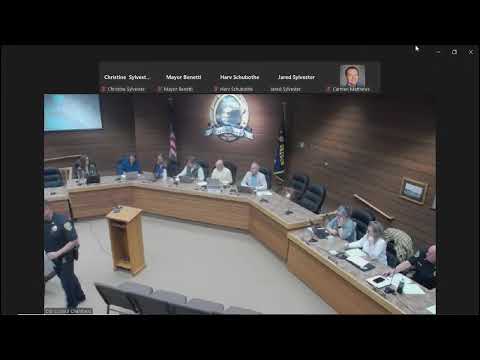
After a public hearing and staff briefing, the Coos Bay City Council voted unanimously to adopt Ordinance No. 585, which reduces the areas where public camping is allowed under the city's time, place and manner rules tied to state law House Bill 3115.
The Coos Bay City Council voted unanimously to enact Ordinance No. 585 amending Coos Bay Municipal Code chapter 8.45 to reduce the areas designated as allowable for camping in public rights-of-way.
City staff presented the ordinance and maps at a public hearing, explaining the changes are intended to clarify where camping is permitted and to make enforcement easier for police and outreach staff. The ordinance moves several areas — including a section of South Empire (On Ackerman) — from "allowable" to "not allowable," and refines the Eastside designation to a single corridor along Sixth Avenue from Avenue F through Avenue H.
The change comes after state developments, including House Bill 3115 and earlier state and federal rulings on public camping that require municipalities to apply a "time, place and manner" standard when regulating camping in public spaces. City staff said the municipal code remains constrained by ORS and related case law and that the local ordinance is intended to apply that framework in Coos Bay.
Staff member Nicole summarized past actions dating to 2021 and said the revision is intended to reduce confusion in areas with overlapping designations and to remove camping allowances from residential blocks. Police leadership discussed the state law context and confirmed that the ordinance uses a reasonableness standard (not a numeric formula) to identify permitted areas.
During the public hearing, one resident asked whether recreational vehicles (RVs) would be allowed to park and whether sidewalk camping that blocks pedestrian traffic would continue to be enforceable; staff and the chief confirmed existing parking and obstruction rules still apply. Council members discussed visibility and pedestrian safety on Sixth Avenue, noting that the corridor retained as allowable is more open and visible than other residential streets.
The ordinance also codifies the local schedule for when camping is permitted on allowed public spaces (the council and staff referred to a permitted overnight window commonly implemented under the city's regulations: camping may occur in allowed locations during overnight hours and must not constitute an obstruction of pedestrian or vehicular travel; staff referenced an 8 p.m. to 6 a.m. window during discussion). The council noted the code is a living document and encouraged future review by council or committee if conditions change.
At roll call, Councilor Kilmer, Councilor Stevens, Councilor Cribbons, Councilor Niebuhrghal, Councilor Matthews and Mayor Joe Benetti voted aye; the ordinance was declared duly enacted.
The council and staff emphasized that the ordinance does not eliminate camping citywide (state law still recognizes the right to rest in public spaces unless appropriately restricted under time, place and manner) and that enforcement will continue to rely on coordination between police and outreach services.
Looking ahead, council members suggested periodic review of the ordinance's maps and enforcement impacts and invited staff to return with amendments if the city sees overcrowding or new public-safety concerns in allowable areas.