Get Full Government Meeting Transcripts, Videos, & Alerts Forever!
Get email alerts on the West Side Market Transition topic
No spam. Unsubscribe anytime.
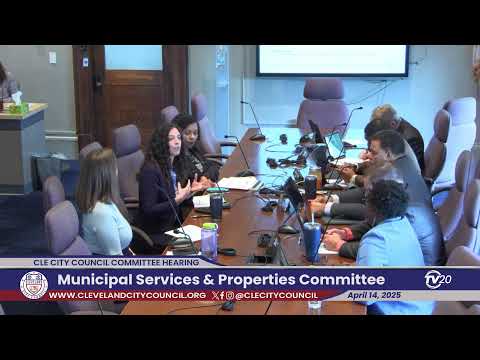
City hears one-year update from Cleveland Public Market Corporation on West Side Market operations, capital plan and financing
Summary
Cleveland Public Market Corporation told the Municipal Service and Properties Committee on April 14 that one year after nonprofit management began the West Side Market is seeing increased foot traffic and programming while advancing a $68–70 million rehabilitation plan that pairs $23 million in city capital with tax credits and philanthropic support.
The Municipal Service and Properties Committee received a comprehensive update on April 14, 2025, from Cleveland Public Market Corporation (CPMC) and the city’s major projects office on one year of nonprofit management at West Side Market and the capital program to renovate and stabilize the market.
Jessica Trevisano, senior adviser for major projects in Mayor Bibb’s administration, said the city continues to own the market while CPMC leases and manages day-to-day operations and the capital repairs set out in the West Side Market Master Plan. Trevisano said the city has committed $23,000,000 toward capital improvements; CPMC and administration representatives described that funding as catalytic because nonprofit management unlocked tax-credit and philanthropic sources not available to a municipal operator.
CPMC Executive Director Rosemary Mudry and Tiffany Allen White, CPMC’s director of operations, described operational changes over the past year: a roughly 80% year‑to‑date increase in door-counter foot traffic compared with the same period in 2024; continued food-access programs (including a Produce Perks partnership that provided about $75,000 in free produce to nearly 600 families); 91 vending opportunities in the year that included 62 unique businesses (a majority Cleveland‑based and majority minority‑owned); paid internships; merchant demonstrations; and continuation of a composting partnership with Rust Belt Riders. Mudry said the market is home to more than 60 small businesses that employ over 250 people; Trevisano said 45% of shoppers live in City of Cleveland ZIP codes and 25% of shoppers have household incomes under $50,000.
CPMC outlined a multi‑stage capital plan estimated at roughly $68–70 million. Stage 1 financing sources described to the committee include city capital support, Federal Historic Tax Credits, New Markets Tax Credits, a Port Authority sales tax exemption, state capital grants, philanthropic commitments (named philanthropic supporters included the Gund Foundation, Connor Foundation and lead gifts from KeyBank), Department of Development Brownfield funds, and Cuyahoga County capital support. Mudry said the first stage will fund soft costs and the East Arcade renovation (to become a produce arcade) and that the project will sequence work to minimize merchant disruption. Mudry described subsequent stages to include a full basement renovation (new coolers, HVAC and freight access), North Arcade conversion for hot/prepared foods, a teaching kitchen, mezzanine seating, ADA upgrades and courtyard activation.
Council members pressed CPMC on vendor relations, leases, and how long‑tenured merchants have been treated in the transition. CPMC said merchant leases had been year‑to‑year historically; during the transition some merchants had month‑to‑month arrangements but most merchants have since been returned to annual leases. Mudry said two merchants were not offered renewed leases after an evaluation that referenced a multi‑year record of complaints and noncompliance; CPMC and administration staff said they had attempted outreach but concluded those two merchants were not appropriate for renewal. Council members asked for transparent, written criteria for vendor performance; officials said lease rules and market policies (including transparency on pricing, attendance and customer service) are incorporated in leases and that merchants had merchant-selected representation on CPMC’s board.
Council members also asked about parking revenue, which CPMC projects to increase (2025 budget projection shown in CPMC materials: roughly $498,000 in parking revenue for 2025) while actual parking revenue for 2024 reported to committee was $161,000. CPMC said the market uses a gateless, camera-enforced system with a kiosk and QR payment; during market hours the first 90 minutes are free. Officials said enforcement was phased in to allow longtime customers to adjust and said an attendant is present during market hours.
CPMC officials described capital fundraising progress: Mudry said CPMC was closing tax-credit financing for the first stage and that the nonprofit had assembled a combination of tax credits and philanthropic commitments that substantially increase total project resources beyond the city’s $23,000,000. Trevisano said roughly $50,000,000 of the stage‑1 sources were paired to allow project close; Mudry said about $18,000,000 remained to be raised for later work. Committee members asked for documentation of past and projected operating subsidies; administration reported the 2025 operational subsidy to CPMC was just over $750,000 and said subsidies will likely continue during construction while additional revenue streams and programmatic income are developed.
Other topics discussed included composting and food‑rescue opportunities (CPMC said it is tracking compost collection through Rust Belt Riders and has merchant relationships that sometimes redistribute unsold product), adjustments to janitorial contracts to ensure living‑wage and unionized cleaning staff, and a community benefits agreement that will include small‑business contracting goals, community outreach, union labor commitments and enhanced customer access.
Council members asked for follow-up materials, including: (1) a parking revenue report for 2024; (2) documentation of projected financing sources and status of tax‑credit closings; and (3) summary data on merchant lease status and the criteria used in lease-renewal decisions. CPMC and administration said they will provide the requested materials to the committee.