Get Full Government Meeting Transcripts, Videos, & Alerts Forever!
Get email alerts on the State Budget topic
No spam. Unsubscribe anytime.
Ohio House passes $60 billion biennial budget, approves $600 million stadium bond; fights over school funding and Medicaid trigger
Summary
The Ohio House approved House Bill 96, the two-year operating budget, by a 60-39 vote after hours of debate over property tax relief, school funding formulas, a proposed Cleveland Browns stadium bond and a Medicaid expansion trigger.
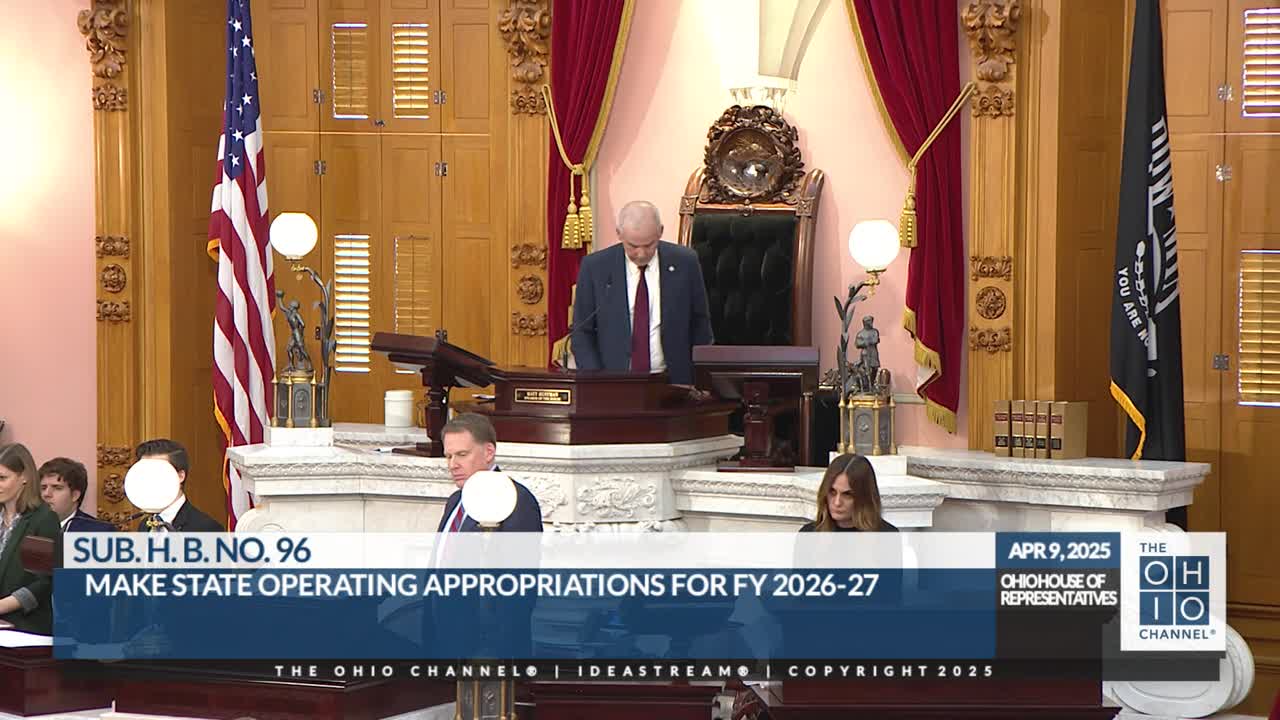
The Ohio House of Representatives passed House Bill 96, the biennial operating budget for fiscal 2026–27, by a 60-39 vote after hours of floor debate on April 9, 2025. The bill includes roughly $60 billion in appropriations, a mechanism the majority says will return excess local school carryover funds to taxpayers and authority for up to $600 million in state bonds to support a proposed stadium development in the Brook Park/Cleveland area.
The budget's backers said it raises state support for schools, expands child-care funding and delivers the largest property-tax relief package in state history; opponents said it abandons the phase-in of the fair school-funding formula, risks core public services and embeds a trigger that could terminate Medicaid expansion if federal matching rates fall.
Representative Stewart, chairman of the House Finance Committee, opened debate by outlining the bill’s headline items and numbers. “We're going to spend $20,200,000,000 on public schools over the biennium,” Stewart said, and he described a package he said would return up to $4.2 billion in property-tax relief and authorize a $600 million state bond to leverage more than $1.2 billion in private investment for a Cleveland-area stadium project. Stewart also described additions for childcare, higher education and hospital funding and said the stadium bond would be repaid from new tax revenue generated on-site.
Ranking Member Representative Sweeney opposed the bill on principle, arguing it abandons the fair school-funding formula that she said was designed to calculate costs “to educate a child in Ohio.” “This proposal abandons the fair school funding plan,” Sweeney said, adding that the carryover/redistribution mechanism would force many districts to return funds voters authorized and could prompt more levy campaigns. She also criticized a proposed Medicaid-related trigger, saying an automatic termination if federal matching falls even slightly would risk coverage for nearly 800,000 people and shift costs to state budgets and local hospitals.
Budget supporters and critics sparred over the stadium provision. Representative Brennan moved unsuccessfully to strip the bill’s authority for public loans or subsidies for professional sports facilities and warned of infrastructure costs and uncertain local support. Supporters including Representative Davila called the Browns project “a generational opportunity” and said private investment and an owner escrow would protect taxpayers. The House approved an amendment offered by Representative Stewart that increased the Browns owners’ required escrow deposit from $38.5 million to $50 million; the amendment passed 55-15, with the clerk recording “With 55 affirmative votes and 15 negative votes, the amendment is agreed to.”
Other amendments and procedural moves on education and property-tax language were debated and decided on the floor. Representative Glassburn proposed an amendment to restore more elements of the fair school-funding formula and to raise a higher carryover threshold; the House voted 64-34 to lay that amendment on the table. Representative Ferguson proposed removing language that would allow loans for professional sports facilities; the motion to table the amendment was tied and the amendment ultimately failed on the floor.
Key provisions recorded during the debate include: - Property-tax relief: A mechanism limiting school district carryover balances and directing excess to reduce next-year property-tax levies; backers described the change as enabling up to $4.2 billion in relief. - School funding: The bill increases state aid overall but does not continue the final phase-in of the previously enacted fair school-funding formula; supporters said no district will receive less than current-year funding, opponents said the flat approach ignores inflation and long-term needs. - Medicaid: The bill contains language tied to the expansion population and a trigger provision critics said could terminate expansion if federal funds decline; opponents warned that the trigger would remove the Legislature’s discretion to act later with full information. - Stadium financing: Authority to issue up to $600 million in bonds is included; an amendment that raises the owners’ escrow to $50 million passed 55-15. Sponsors said the escrow plus projected new local taxes would repay bonds without GRF outlays. - Child care and family supports: The budget creates/expands a child-care choice voucher program with an additional $100 million over the biennium, according to Stewart and other supporters.
Floor votes listed in the transcript include the passage of the Stewart escrow amendment (hf0004-1) and the final passage of the bill. The clerk recorded: “With 60 affirmative votes and 39 negative votes, the bill is passed and entitled.” The transcript also records multiple failed or tabled amendments and procedural votes, including a 64-34 vote laying the Glassburn amendment on the table and a tied vote on an amendment to bar loans for sports facilities.
The House passed the bill; the transcript records the House vote and the clerk’s certification that the bill “is passed and entitled.” The measure will proceed according to constitutional and chamber rules to the next step for enactment.
Votes at a glance: 1) Passage of House Bill 96 (biennial operating budget) — Outcome: approved; tally: 60 yes, 39 no. 2) Amendment hf0004-1 (increase Browns owners’ escrow from $38.5M to $50M) — Mover: Representative Stewart; Outcome: approved; tally: 55 yes, 15 no. 3) Motion to lay Glassburn amendment (restore fair school-funding elements / raise carryover threshold) on the table — Mover: Representative John; Outcome: laid on table; tally: 64 yes, 34 no. 4) Amendment to prohibit loans for professional sports facilities — Mover: Representative Ferguson; Outcome: failed (tie vote reported; final on-floor result recorded as failing). 5) Motion to lay Troy amendment (homestead/other tax-relief pilot) on the table — Mover: Representative John; Outcome: laid on table; tally: 63 yes, 33 no.
The legislative record in the transcript shows sustained, substantive debate across the chamber on trade-offs among tax relief, school finance, health-care coverage and economic development. Lawmakers on both sides invoked constituency concerns — property-tax burden, school budgets, rural hospital viability and caregiver and childcare access — as they weighed votes.
The bill’s passage in the House completes the chamber-level action recorded in the transcript; further procedural steps required for enactment are not captured in the meeting record.