
DOJ outlines Internet Crimes Against Children work and proposes regional organized‑crime response teams
Get AI-powered insights, summaries, and transcripts
Subscribe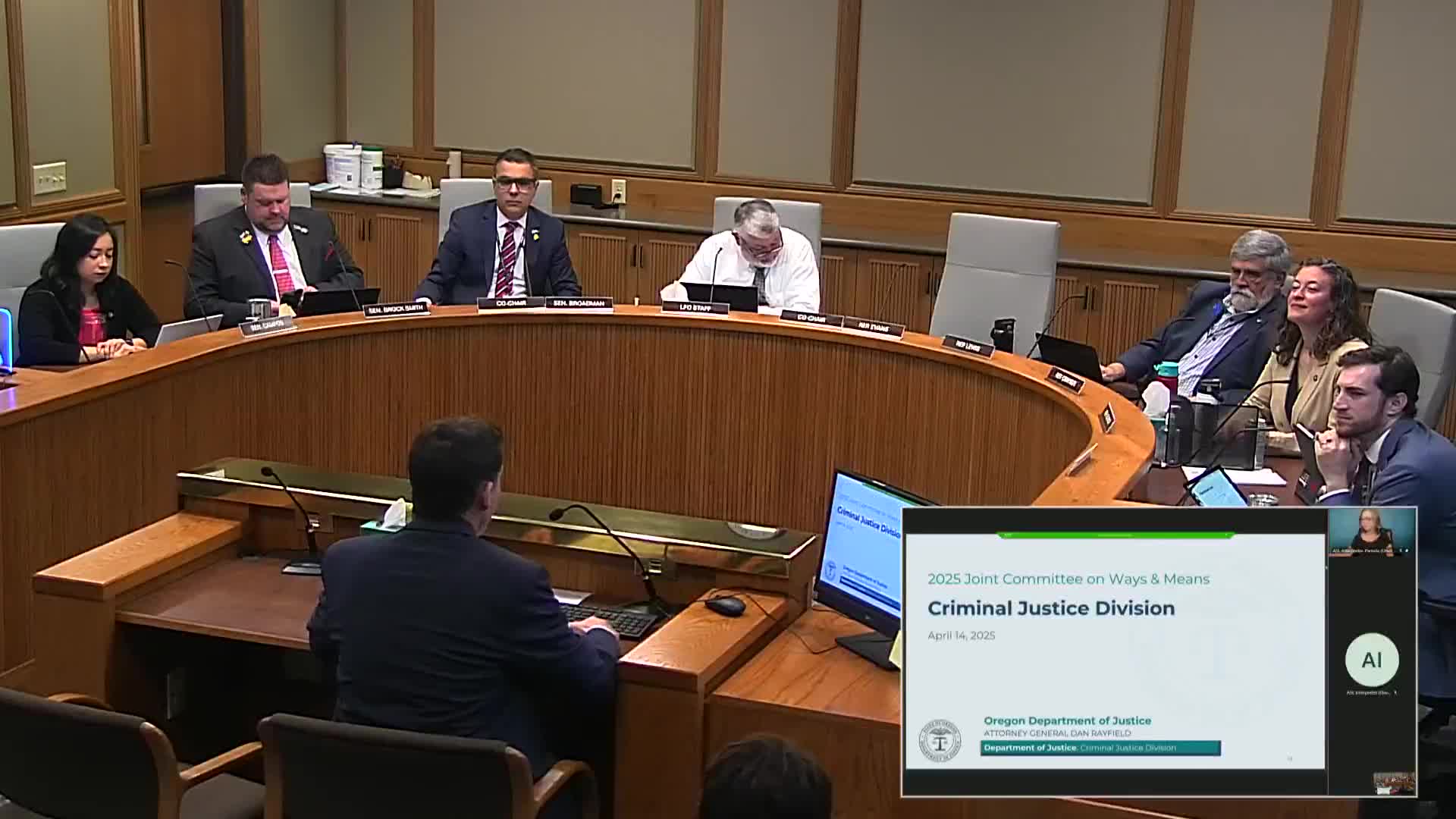
Summary
The Department of Justice told the Senate Committee on Public Safety about expanded Internet Crimes Against Children staffing, the elimination of investigation backlogs, and a policy proposal to create regional organized‑crime response teams and a law‑clerk pipeline to support district attorney offices across Oregon.
The Department of Justice described increases in investigative staffing for Internet Crimes Against Children (ICAC), recent workload patterns, and a multi‑part request to expand regional capacity to address organized crime during Monday’s informational hearing on House Bill 5014.
Michael Slauson, Assistant Attorney General and chief counsel of the Criminal Justice Division, told the committee the division has 95 employees and described programs that support district attorneys and local law enforcement, including the District Attorney Assistance Program, the Internet Crimes Against Children Task Force and the Organized Crime section.
“We are 1 of 61 task forces in the country,” Slauson said of the ICAC program. He said ICAC staffing increased dramatically in recent biennia and that the division received nearly 10,000 cyber tips in 2024. Slauson explained that improved filtering at the National Center for Missing and Exploited Children changed the composition of tips, so referrals for visual exploitation decreased while tips related to online solicitation, sextortion and adult‑solicitation increased and require more investigative resources.
Slauson described a recent policy option package that would create four regional organized‑crime response teams. Each team would include a prosecutor, multiple special agents, an analyst, and supporting administrative and management staff. The regional teams are modeled on federal strike forces: prosecution‑led, multi‑agency, and intelligence‑driven. The proposed teams would be located in regions identified by the division to improve collaboration and prosecutorial continuity on multi‑jurisdictional investigations such as auto‑theft rings, human trafficking and organized retail theft.
Slauson also presented a separate pipeline proposal to recruit and deploy law clerks to county DA offices. Under that concept the Department of Justice would hire and train law‑certified clerks, deploy them to county offices during summer terms, and thereby provide short‑term capacity for lower‑level, high‑volume offenses while building a recruitment pipeline for criminal litigation in Oregon.
Slauson cited outcomes from a 2023 Legislature–funded Organized Retail Crime unit: the unit responded to 71 requests in 13 counties, supported 21 cases, produced about 70 arrests and recovered approximately $640,000 in property. He also described a multi‑state case involving stolen SNAP/EBT purchases and resale of baby formula; the state criminal case has 19 defendants and the federal case had 17, Slauson said, and the investigation involved more than a dozen law enforcement partners.
The division’s analytical unit (ACES) and fusion‑center functions were described as force multipliers that provide short‑turnaround analytical support, deconfliction of operations, strategic analysis and statewide information sharing. Slauson said ACES had responded to roughly 9,000 requests for assistance this biennium and issued more than 2,000 intelligence bulletins.
Committee members asked about federal‑state coordination, wiretap support, and the division’s role when DOJ acts temporarily as a district attorney. Slauson said DOJ often provides prosecution, investigatory and analytic support to smaller counties and can assume the DA role when a vacancy arises.
No formal action on the policy option packages occurred during the informational hearing; Slauson said the division will provide additional briefings and performance data as requested by the committee.