Get Full Government Meeting Transcripts, Videos, & Alerts Forever!
Get email alerts on the Transportation Highway43 topic
No spam. Unsubscribe anytime.
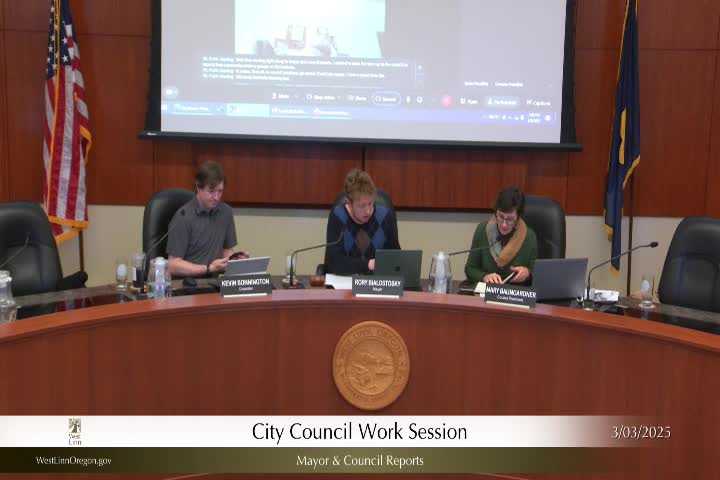
West Linn council discusses ODOT jurisdictional-transfer process as option for Highway 43 repairs
Summary
Mayor introduced the Oregon Department of Transportation’s Jurisdictional Transfer Advisory Committee process and presented Tigard’s recent application as an example. Councilors and staff said the mechanism could bring significant funding but noted uncertainties about legislative approval and long‑term maintenance responsibilities.
Mayor Bialystoski told the West Linn City Council on March 3 that the Oregon Department of Transportation’s Jurisdictional Transfer Advisory Committee accepts applications every even‑numbered year and can recommend legislative funding to bring a state highway to a state of good repair.
The discussion centered on whether West Linn should consider pursuing a transfer of Highway 43 from ODOT to the city as a way to secure substantial repair funding. The mayor showed the council the City of Tigard’s application to the committee and its supporting materials, including a committee recommendation of $50,000,000 to the legislature for Tigard’s transfer request.
Why it matters: A successful transfer can unlock state funding for major repairs and give a city more control over future improvements and design choices. Councilors said local control could allow West Linn to pursue traffic calming, bicycle lanes and safety improvements that they said are difficult and costly to achieve through ODOT procurement.
City staff described the committee process and financial expectations. “This committee takes applications and, every even numbered year considers and makes recommendations to the legislature for funding,” Mayor Bialystoski said while introducing the committee’s website and Tigard’s application. He explained the local match expectation: “The local government’s required to put a 20% match for whatever funding you’re requesting to bring the road up to the state of good repair,” and noted that Tigard used maintenance credits over a 20‑year horizon in lieu of an up‑front cash contribution.
City Manager John Williams cautioned that previous ODOT discussions allowed cities to take over a highway “basically in its current condition.” He said the scale of repairs now under consideration is larger: “I think if tens of millions of dollars are potentially in play in the legislature for these, then it’s a much more significant conversation than it used to be.”
Councilors asked practical questions about timing and next steps. Councilor Groner and others noted a current regional transportation timeline that would open applications in September and close in November 2025. Mayor Bialystoski said he plans to monitor the legislative transportation package and attend related meetings; he also plans to accompany Reid Wagner, Executive Director of the Locks Authority, to Washington, D.C., next week for related outreach.
No formal direction or vote was taken. Councilors expressed interest in further study and agreed to continue conversations with staff and ODOT about whether West Linn should pursue an application, while acknowledging that legislative funding is uncertain.
Next steps: Staff and councilors will track the committee schedule and the state transportation package, continue conversations with ODOT staff and the city’s legislative contacts, and return to council for further direction if West Linn pursues an application.