Get Full Government Meeting Transcripts, Videos, & Alerts Forever!
Get email alerts on the Oppenlander Park topic
No spam. Unsubscribe anytime.
West Linn council declines May bond to buy Oppenlander; directs staff to pursue public‑private purchase
Summary
On Feb. 25 the West Linn City Council voted to not place a $10 million bond on the May ballot to buy Oppenlander Park and instead directed staff to evaluate and pursue a public‑private partnership to secure some park acreage.
WEST LINN, Ore. — The West Linn City Council voted Feb. 25 not to place a new bond measure on the May ballot to purchase Oppenlander Park and instead directed city staff to evaluate and pursue a public‑private partnership to acquire some of the field for use as a city park.
The motion, moved by Council President Baumgardner and carried by unanimous vote of those present, directs staff to seek a deal that would use existing voter‑approved resources or other funding sources to secure parkland while avoiding a full $10 million bond this spring.
Supporters of preserving the site urged the council to place a bond on the ballot. Linda Parker, a West Linn resident, told the council Friends of Oppenlander had canvassed the neighborhood and believed voters would back a new measure: “I feel very confident that we could carry this measure again,” she said. Stephanie Kendall, who said she grew up using the field, told the council she and her family “rode my pony in the park” and urged elected officials to listen to voters who previously approved protections for the site.
Representatives of Icon Construction, the developer that has offered a purchase plan, said they are willing to negotiate and consider alternative site layouts to preserve more open space. An Icon representative said the firm could explore changing its proposal to create fewer lots and preserve additional trees and fields, but that reducing lots would lower the revenue available to pay acquisition and development costs.
Several council members said they support preserving Oppenlander but are constrained by the city’s other capital needs. Mayor Bielanski warned that placing a $10 million bond on the May ballot could jeopardize funding for water, transportation and other critical infrastructure and noted the city’s long unfunded project list. “So given all of this, I am open to this idea of the city acquiring some of the property and improving it as a park,” Bielanski said, arguing a smaller, negotiated acquisition or partnership could better match the city’s financial capacity.
Members cited specific fiscal concerns raised during the meeting: a water master plan with multi‑million‑dollar pipe replacements, seismic and system needs, an estimated $20–30 million public‑works operation center, and $30 million in unfunded transportation projects. Dean, a Friends of Oppenlander organizer who spoke remotely, laid out bond‑planning details and figures his group had prepared for voters and urged the council to structure any referral so staff could prepare ballot language and financial contingencies if council chose to proceed.
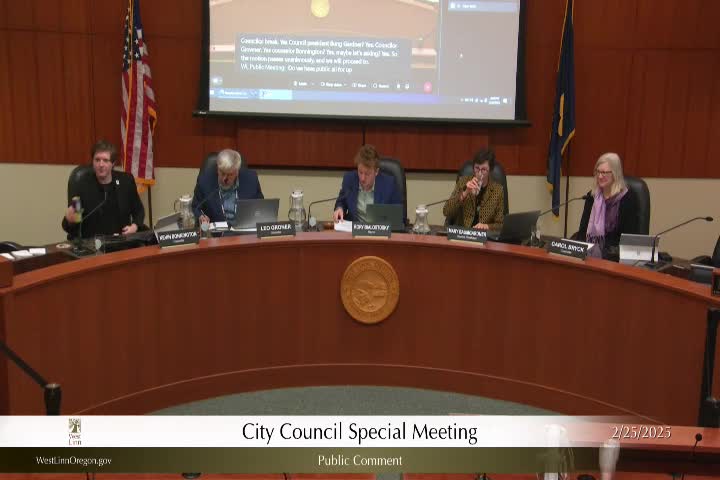
After public comment and council discussion, Council President Baumgardner moved “to not place a new bond measure to purchase Oppenlander on the May ballot for the reasons stated during this meeting and direct staff to evaluate and pursue a public‑private partnership for the city to purchase some of Oppenlander Field for use as a city park, utilizing existing voter‑approved resources or other funding sources.” The motion was seconded and passed by roll call.
The council also approved the meeting agenda at the start of the session by unanimous voice/roll call.
The decision does not end the city’s efforts to preserve the site: council members and speakers encouraged continued outreach to the school district and developers and said public pressure remains a tool to influence the seller’s timeline and price. Staff indicated they understood the direction and will return with options for negotiations, potential funding sources and a scope of land the city could reasonably acquire under a public‑private deal.
The council adjourned after confirming staff had direction to proceed.