Get Full Government Meeting Transcripts, Videos, & Alerts Forever!
Get email alerts on the Housing Production Strategy topic
No spam. Unsubscribe anytime.
Council hears housing-production strategy draft; construction excise tax draws split reaction
Summary
City staff and consultants presented a draft Housing Production Strategy on Feb. 18 that proposes 12 strategies to increase housing supply; the construction excise tax (CET) drew mixed reactions from developers, affordable-housing advocates and commissioners.
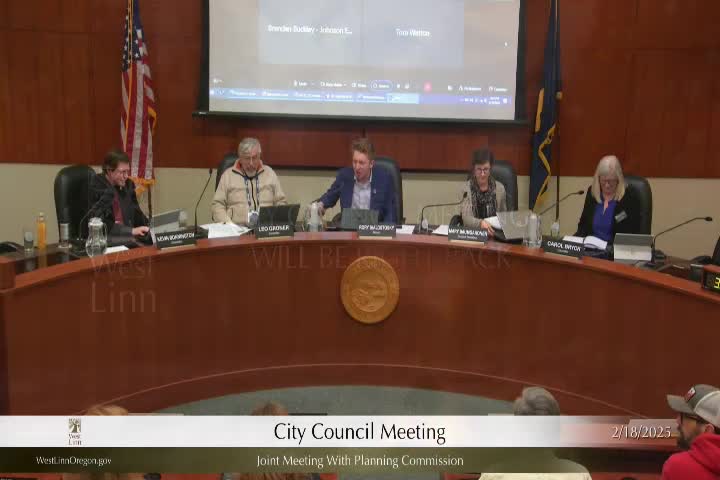
West Linn city staff and consultants presented a public-review draft of a Housing Production Strategy (HPS) on Feb. 18 and asked the Planning Commission and City Council for feedback on proposed actions to increase housing supply over the next six years.
Matt Hasty of MIG and Bridal Buckley of Johnson Economics walked commissioners and councilors through a 12-item strategy package that ranges from rezoning and code updates to tax abatement tools, public–private partnerships and financing options. The report also includes information the city is required to submit under the state’s administrative rules for housing production strategies, such as evaluating fair and equitable housing outcomes and monitoring plans.
The presentation gave particular attention to the construction excise tax (CET), a locally imposed tax on new construction that can finance affordable housing programs. Bridal Buckley explained how a 1.0% CET on permit value (the residential cap for Oregon is 1% under current rules) could generate, based on five-year average permitting activity, roughly $300,000 per year for West Linn if applied at 1% for both residential and commercial. Staff emphasized that residential CETs in Oregon are capped at 1% of permit value while commercial CETs are not capped.
Consultants and staff said adopting a CET requires an ordinance and administrative set-up but does not require voter approval. State rules require specific allocations of CET revenue, including use for development incentives in some instances, and the HPS includes options for exemptions and targeted uses such as backfilling SDC (system development charge) exemptions for affordable projects.
Reaction at the meeting reflected the split recorded in the project working group. Members with experience in affordable housing development supported CET as a revenue source that helps stack financing and leverage state and federal funds. Developers, including members of the Home Builders Association, warned a CET increases development costs and may be passed on to buyers in an already high-cost market. Planning Commissioner Tom Wotton said West Linn’s limited developable land and market conditions mean a CET could primarily increase costs for buyers rather than unlock significant new private development. Other commissioners urged pairing any CET with reductions or restructuring of SDCs to avoid double charges.
Councilors and Planning Commission members also discussed alternative or complementary measures the draft recommends: rezoning to allow more housing types, scaling SDCs by house size or deferring SDC payment until certificate of occupancy, multi-unit tax exemptions, tax increment financing tied to riverfront redevelopment, and creation of a local affordable-housing fund.
Consultants said the HPS is not final; it will be revised based on feedback and then proceed through additional work sessions, hearings and ultimately adoption steps. Staff said the city must demonstrate progress on the strategies under state monitoring; removing CET from the package now would require the city to identify other actions to meet state expectations. The council asked staff to return with additional analysis and outreach; several members suggested allowing the public and stakeholders to weigh in further before the city adopts any local tax or major incentive program.
No formal votes were taken on the HPS at the meeting; staff will prepare a revised draft that incorporates the commission and council feedback and will schedule public hearings for adoption.