Get Full Government Meeting Transcripts, Videos, & Alerts Forever!
Get email alerts on the Right Of Way Vacation Willamette Wetland topic
No spam. Unsubscribe anytime.
West Linn council continues public hearing on proposed vacation of rights-of-way through Willamette wetland
Summary
The City Council paused a decision on Ordinance 17-57, a petition to vacate portions of Fifth Street and Fourth Avenue that run through a locally-mapped wetland, leaving the record open for written comments and scheduling a March 17 deliberation.
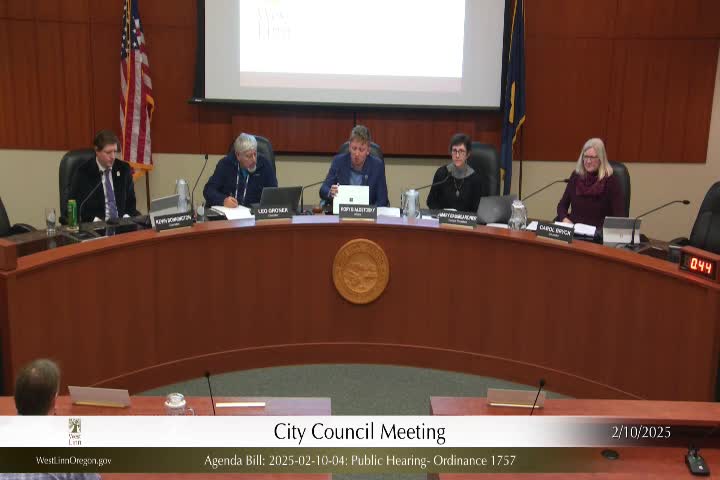
The West Linn City Council on Feb. 10 held a public hearing on Ordinance 17-57 — a petition to vacate portions of Fifth Street and Fourth Avenue in the Willamette neighborhood — and continued the matter to allow more written comment and applicant rebuttal.
Planning Manager Darren Wise told the council the petition, filed by SDG-2 LLC (filed as Revision Development LLC / E3 Design Concepts LLC), would vacate “just over 16,000 square feet” of Fifth Street right-of-way and “almost 12,000 square feet” of Fourth Avenue right-of-way. Wise said the affected strips are within the city’s local wetland inventory, floodplain and habitat conservation areas and that the city has no transportation or utility plans that require those rights-of-way.
“The rights of way are currently not used. They’re vacant. There’s no development within them,” Wise said during his staff presentation. He told the council the petition met the statutory signature requirement because the petitioner owns sufficient land in the affected area to provide the two-thirds owner consent the city uses for vacation petitions.
The applicant’s legal counsel, Garrett Stevenson, urged the council to decide on the narrow statutory question of whether the city needs the road easements for public use, not to treat the hearing as a full land‑use forum for an eventual development application. “What’s before the council tonight is a right of way vacation of just over 1 acre worth of roads that have been platted since 1908 and have never been used for transportation of any kind,” Stevenson said. He argued the statutory test focuses on whether the public interest will be prejudiced and that the city had no present need for those rights-of-way.
Neighborhood groups and dozens of residents urged more time, and several asked the council to withhold any action until the city and the Willamette Neighborhood Association (WNA) could review details. Kathy Halicki, president of the Willamette Neighborhood Association, asked the council for “a delay and or continuance on the decision of this item until staff can meet with the WNA members and educate us.” Multiple commenters raised questions about wetlands protection, the condition of an adjacent settling pond and the potential impacts of future development on wildlife, stormwater and neighborhood traffic.
Members of the public cited technical and regulatory concerns in written and oral comments filed with the record, including references to the city’s wetlands and habitat regulations and ORS 271.120, the state statute governing street vacations. Residents also provided petitions and letters; Friends of Willamette Wetlands and other neighborhood groups said they oppose changes that could facilitate development in the wetland area.
After hearing presentations and public testimony, the council voted to close oral testimony, leave the record open for additional written submissions and continue the hearing for deliberation. The council set deadlines that allow further written input from the public and a responsive filing by the applicant: written comments will be accepted through March 3 at 12:00 p.m., the applicant may file rebuttal and final written argument by March 10 at 12:00 p.m., and the council will hold deliberations and vote on March 17 at 6:00 p.m.
The council’s action preserves both the opportunity for more public input and the applicant’s right to respond; it does not decide the vacation petition. At the continuation the council will apply the statutory criteria that staff and counsel summarized — including whether the public interest would be prejudiced by vacating the easements — and may also consider the written materials submitted during the extended record period.
What’s next: The public may submit written comments by the March 3 deadline; the applicant has said it will respond in writing by March 10. The March 17 meeting will be limited to council deliberations and a formal vote; no additional oral public testimony is scheduled for that meeting.