Get Full Government Meeting Transcripts, Videos, & Alerts Forever!
Get email alerts on the Police Technology topic
No spam. Unsubscribe anytime.
Westland council pauses decision on license-plate cameras after public concerns
Summary
After a presentation from Flock Safety and an extended council Q&A, Westland councilors asked staff to gather more community input and policy options before deciding on automatic license-plate reader cameras.
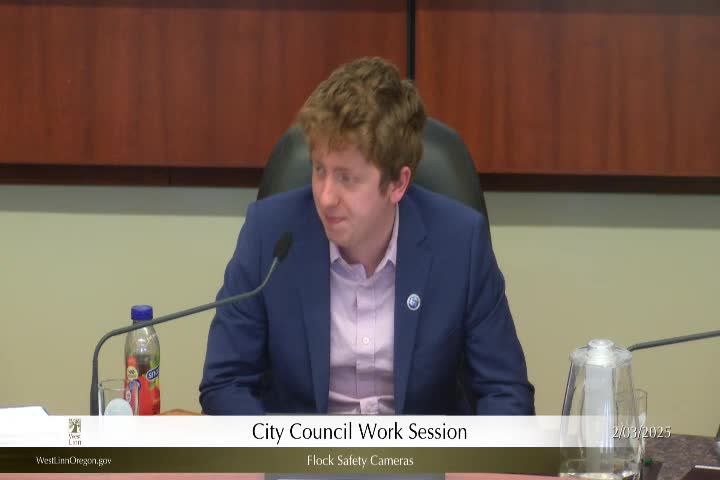
Westland City Councilors heard a presentation from Flock Safety on automatic license-plate reader (ALPR) cameras and directed staff to pause consideration and return with community engagement, policy options and a budget estimate.
The discussion followed a public comment in which a resident warned that ALPR systems indiscriminately collect movement data and risk privacy harms. Councilors then heard from Chief Mahuna and Flock representatives about how the cameras operate, data retention and auditing features.
Councilors said they saw potential public-safety benefits — including locating stolen vehicles and missing persons — but raised repeated concerns about privacy, data sharing, audit controls and public-records requests. After questions and answers, council accepted the police chief’s recommendation to pause and solicit more public input before moving forward.
Why this matters: The technology the city is considering could help detectives find stolen cars and assist in high-priority investigations, but residents and some council members said the city should adopt clear rules on access, retention, interagency sharing and auditing before agreeing to deploy it.
Flock representatives said their system captures still images of vehicle rears from fixed cameras, converts plate reads into searchable records, issues real-time “hot-list” alerts for plates in national databases and defaults to 30-day retention for images not preserved as evidence. Kristen McLeod, community engagement manager for Flock Safety, said the company does not offer facial recognition, encrypts data at rest and in transit, and provides an optional public transparency portal that agencies can publish to explain system use to residents.
Councilors pressed on safeguards. Councilor Groener asked how the system prevents improper searches; McLeod described a required “search reason” tied to a user ID and an audit trail. David Johnson, Flock’s regional account executive, and Ashley Hickman, Flock sales manager, described local Oregon deployments and said many departments share hot lists across jurisdictions.
Chief Mahuna described the department’s interest after a 2023 string of vehicle prowls that produced suspect images without plate reads and said the department is short on patrol staff; he framed ALPR as a force multiplier but said policy would be critical.
Privacy and records: Council members asked whether ALPR data would be subject to public-records requests and whether the city or vendor would control access. Flock representatives said the customer (the city) owns the data and Flock will not sell it; they also said customer agencies typically limit access in department policy and that most departments require a specific investigative purpose before searching plates. City Attorney Klein said staff would research public-records implications before any purchase.
Next steps: Councilors and staff agreed to pause immediate procurement and to gather more community feedback, review sample policies from other agencies, assess budget implications and return with recommended policy language and cost estimates. Staff also flagged a budget-calendar constraint: if the council decides to pursue a subscription-based deployment this year, the city would need to include funding in the upcoming budget process.
Ending: Councilors asked staff to schedule public forums and to provide policy examples from other Oregon agencies so the council can weigh privacy protections, sharing parameters and cost-benefit trade-offs before any formal decision.