Get Full Government Meeting Transcripts, Videos, & Alerts Forever!
Get email alerts on the School Food Waste Plastic Reduction topic
No spam. Unsubscribe anytime.
Fifth-graders urge district to ditch single-use plastics; district proposes student-teacher working group
Summary
SPE fifth graders presented cost, waste and health data to the Steamboat Springs School Board April 7 and urged a return to reusable dishes. District staff praised the research and proposed a working group to explore pilot options, costs and funding.
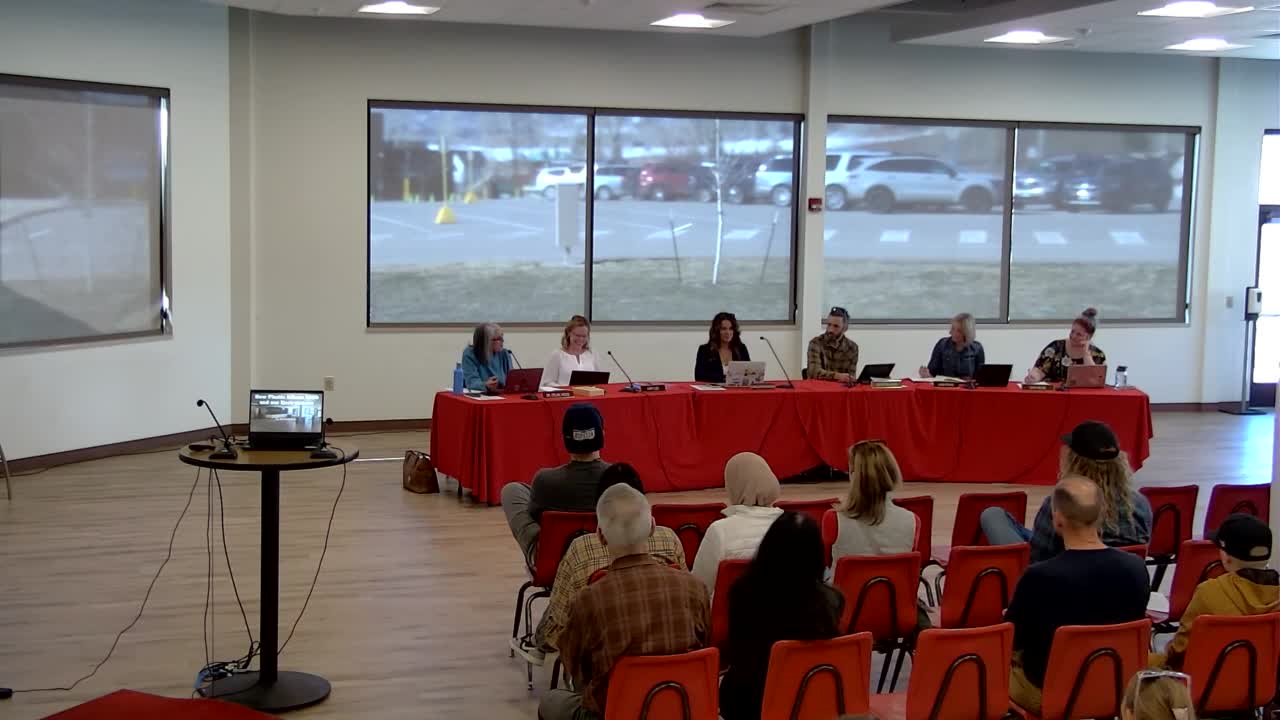
Steamboat Springs School Board heard a presentation April 7 from SPE fifth graders urging the district to stop single-use plastics in school cafeterias and return to reusable dishware, arguing the change would reduce waste, cut costs and lower student exposure to plastic-related chemicals.
The students told the board that single-use items cost their school about $0.27 per student per day, estimating $103.68 per day and roughly $18,662.40 per year for SPE alone, and presented additional figures for dishwasher operating costs and prior district experience with reusable serviceware. They cited a prior district change to reusable kitchenware that a local paper reported reduced lunch waste by about 70% and reduced the number of 30-gallon trash bags used daily.
The presentation warned that plastics can create toxic landfill leachate and listed chemicals that can leach from plastic into food; the students recommended ceramic plates, metal utensils and an investment in dishwashers as a long-term cost-saving and environmental measure.
The district response came from Stephanie Juno, director of finance and operations, who praised the students’ work and proposed an immediate next step: "putting together a working group with at least 2 students and 1 of the teachers that worked on this that would work alongside myself and Max Hopper, the director of nutritional services, to come up with viable solutions that we can implement as soon as next school year." Juno said the group would review food-safety and federal/state meal-component requirements, calculate district-specific costs, source and price reusable dishware, and explore funding opportunities the students cited.
Board members asked whether dishwashers remain at each school and about staffing. Juno confirmed the district has dishwashers at every school but said the shift to reusable serviceware would likely require additional full-time-equivalent (FTE) staffing to operate dishwashers, and suggested piloting the change at one school before districtwide rollout. Board members also noted past district grants: the students reported a prior Colorado Department of Public Health and Environment grant of $3,900 had been used to buy reusable plates for multiple schools; Juno said the district would explore similar external funding sources the students had identified.
The board did not take formal action on the presentation but the superintendent’s office and finance staff invited students, teachers and families to sign up for the working group. The board and staff emphasized that any realistic plan must address food-safety rules, meal-program delivery logistics and the initial capital cost of dishwasher and dishware procurement.
The school board thanked the students and parents for the presentation and for bringing researched recommendations to the district.
Ending: District staff said they will collect names from interested students and teachers and begin the working-group planning and cost analysis ahead of decisions for the 2025–26 school year.