Get Full Government Meeting Transcripts, Videos, & Alerts Forever!
Get email alerts on the State Legislation topic
No spam. Unsubscribe anytime.
Lake County staff warn ‘factor of the unknown’ in Springfield as multiple local bills advance
Summary
At the April 1 Lake County Legislative Committee meeting, county legislative staff reported uncertainty in the Illinois spring session that could affect transit, pensions and several county-backed bills, while outlining steps to monitor and work with state legislators on property tax and producer-responsibility proposals.
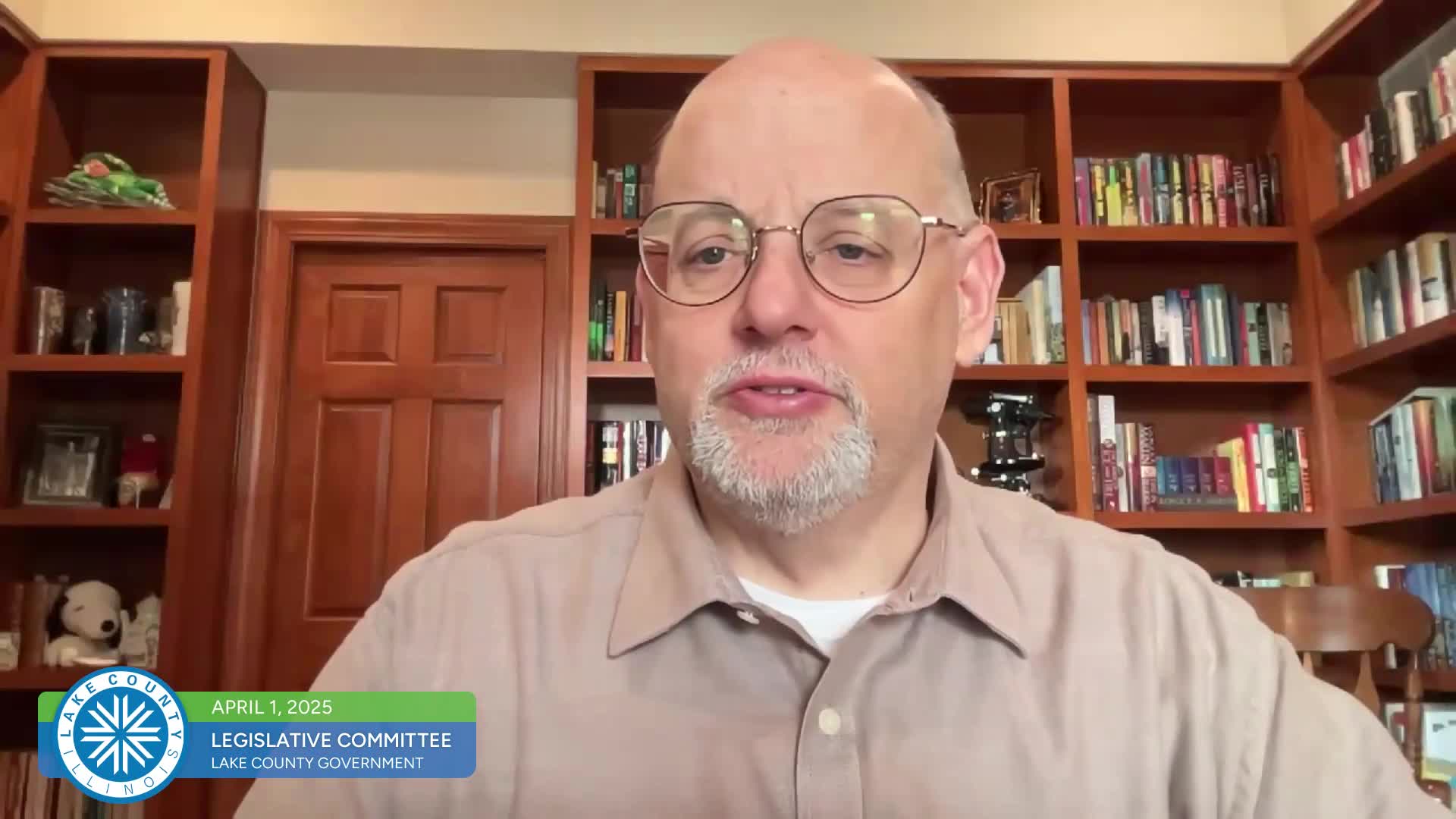
Lake County Legislative Committee members on April 1 heard a state-legislative update stressing uncertainty in Springfield this spring and progress — and resistance — on several bills the county is tracking.
Derek, a Lake County legislative staff member, told the committee that “there is 1 overarching factor in Springfield today … and that's the factor of the unknown,” pointing to unsettled decisions on transit funding, pension tier reforms and weak revenue collections that could force budget reductions for fiscal 2026 if April receipts fall short.
The update covered several items the county is watching closely. Staff said transit funding for northeastern Illinois remains unresolved; requests of between $800 million and $1.5 billion have been made, but “no identifiable revenue source has been pegged,” Derek said. He also flagged workgroups examining pensions and said Illinois revenue collections have trailed historic levels month to month.
Mike, a Lake County legislative staff member, reviewed bills the county has sponsored or supported. He summarized three categories of county priorities:
- Property-tax proposals: Staff described a bill aimed at limiting venue changes for Property Tax Appeal Board (PTAB) hearings that would prevent counties from being forced to travel to Springfield for hearings. County staff said PTAB objects to the legislation and proposed its own internal rulemaking; the county will continue discussions with Senator Morrison and other legislators. Staff also discussed a bill carried by Representative Laura Faber Dias to clarify and reinforce an existing statutory requirement that township assessors share data electronically with a county chief assessment officer; several Lake County townships have not been complying, and a stakeholder meeting was scheduled to seek resolution.
- Enhanced Producer Responsibility (EPR) / solid-waste bills: The Solid Waste Agency-backed measures include an EPR bill for household hazardous waste and measures addressing food waste and anaerobic digestion. Mike said the household hazardous-waste bill cleared the House Energy and Environment Committee but faces strong opposition from the Chemical Industry Council of Illinois, the Illinois Manufacturers' Association and the Illinois Retail Merchants Association. He described a typical industry concern: that producers would be asked to fund a producer responsibility organization (PRO) to run collection and disposal programs, which industry resists as a cost issue. He also said a separate vehicle to advance anaerobic-digestion provisions was grafted onto House Bill 1707 to keep momentum.
- Paint and batteries: Staff noted a paint-care (latex paint) EPR bill passed last year and is being implemented; details on effective dates and implementation were to be provided later.
Committee members asked clarifying questions about the bills’ scope and opposition. Member Jessica asked staff to summarize the EPR proposals; Mike explained that a PRO typically collects fees from producers and funds disposal networks, and that the complexity of household hazardous waste presents more stakeholder negotiation than single-product EPR efforts (for example, batteries).
Committee members also raised a new bill, the proposed State Public Defender Act (mentioned by members), which would create a state public defender office rather than selector processes tied to the judiciary. Staff said the bill was introduced in February, had moved out of a House committee on a partisan vote, and that the Illinois State Bar Association and bill sponsors remain involved in ongoing discussions.
Why this matters: County staff said the combination of unsettled state revenue, high-profile policy fights and strong stakeholder opposition on some bills means Lake County’s agenda could face delays or changes before May 31, when committee deadlines and May revenue numbers will clarify the path forward.
Committee direction and next steps: Staff said they will continue to meet with sponsors and stakeholders, monitor the April revenue reports, participate in the scheduled stakeholder meeting on the township-assessor data bill and report back to the committee. No formal county votes on state bills were taken at the April 1 meeting.
Ending: The committee did approve routine minutes at the start of the meeting (motion passed; no roll call recorded). Staff said they will continue outreach to legislators and stakeholders and return with updates at future meetings.