Get Full Government Meeting Transcripts, Videos, & Alerts Forever!
Get email alerts on the Budget Policy topic
No spam. Unsubscribe anytime.
Lake County committee adopts updates to budget development, planning and execution policies
Summary
The Financial & Administrative Committee approved revisions to three finance policies—budget development (3.5), FY26 budget planning (3.5/2026) and budget execution (3.6)—including changes to contingency budgeting, salary grade movement and a clarification that formal fee studies may set revenue for specific programs.
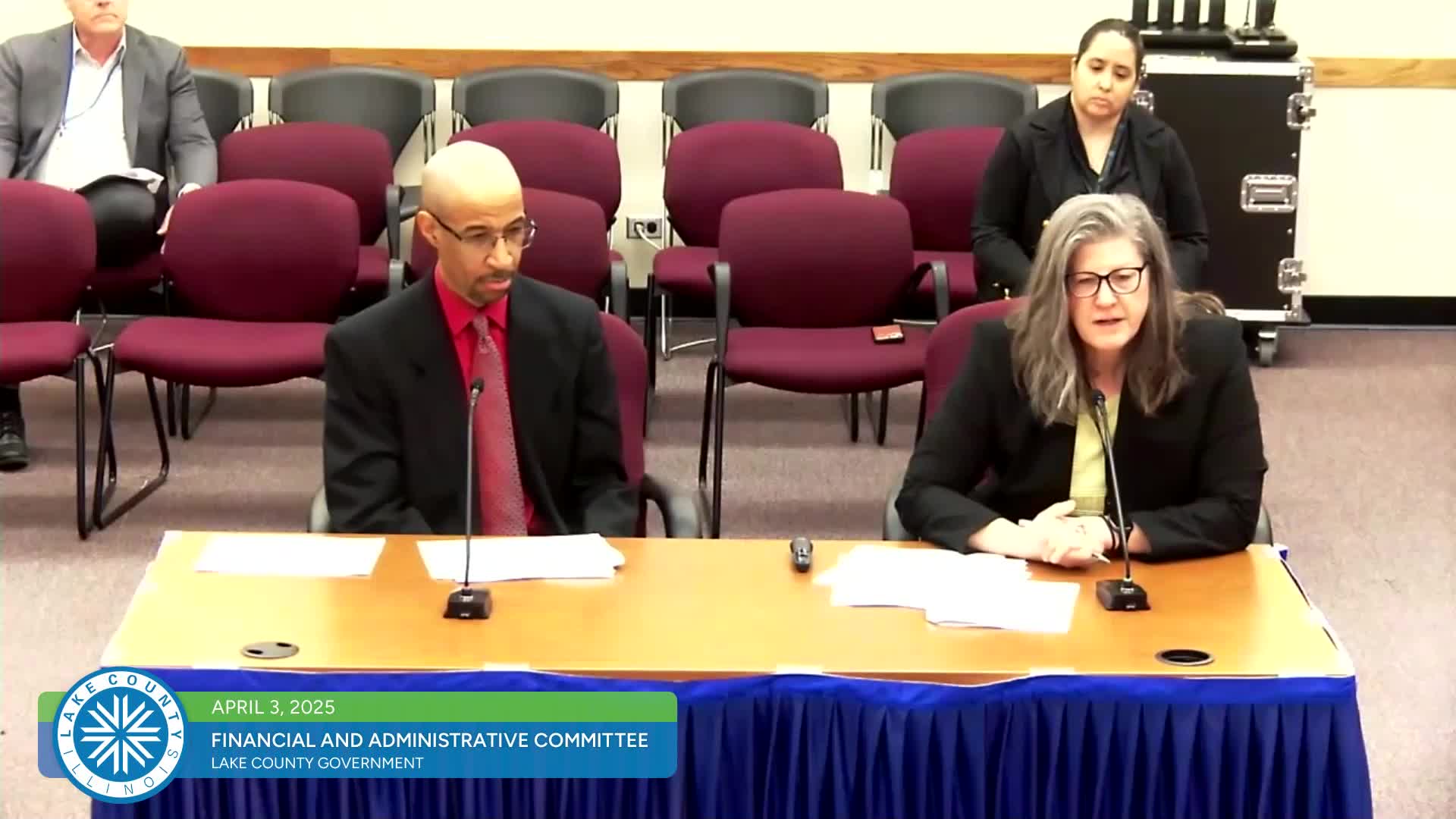
The Lake County Financial & Administrative Committee voted April 3 to approve updates to three finance policies that guide development, planning and execution of the county’s fiscal year 2026 budget.
Patrice Sutton, interim director of finance, presented the changes and highlighted three substantive edits: revised contingency budgeting guidance, a change to how salary grade movement is calculated, and a clarification that formal fee studies may determine revenue for specific items.
Sutton said the contingency budgeting split was adjusted “in accordance with how we've had to use it in the past,” raising the portion allocated to salaries and benefits to 70%, commodities to 10%, and contractuals to 20%. She also told the committee that salary grade movement language was altered to align with the county board–approved nonunion wage increases rather than the previous half-of-annual-increase formula; that change was recommended by compensation consultants Baker Tilly to stop entry-level pay from drifting farther below market.
On fees, Sutton said the planning policy now explicitly allows a formal rate study—such as a public works rate study—to dictate revenue for the affected program, and staff and committee members discussed adding routine reporting on departmental fee analyses so the board can find that information in the budget book.
Committee members asked for clearer reporting and suggested adding examples or reporting locations so fee reviews are visible during budget hearings. The committee voted in favor; the item passed on a voice vote.
The approved redlines also included administrative clarifications (for example, language about new program requests from board members routing through standing committees) and an edit in the nondiscrimination section noted by a member for punctuation correction. Sutton said departments will be asked to report fee-analysis activity in the budget-book narrative so the board can review those findings in October budget hearings.
Motion: Approve updates to finance policies 3.5 (budget development), FY26 planning policy and 3.6 (budget execution).
Outcome: Approved by voice vote.