Get Full Government Meeting Transcripts, Videos, & Alerts Forever!
Get email alerts on the Neighborhood Meeting Requirements topic
No spam. Unsubscribe anytime.
Committee debates and tables ordinance tightening neighborhood‑meeting triggers for revised development plans
Summary
After over an hour of debate on whether to require neighborhood meetings for revised detailed district development plans within three years of a zoning change — and whether to set the trigger at 10% or 25% — the Planning & Zoning Committee voted to table the ordinance for further review.
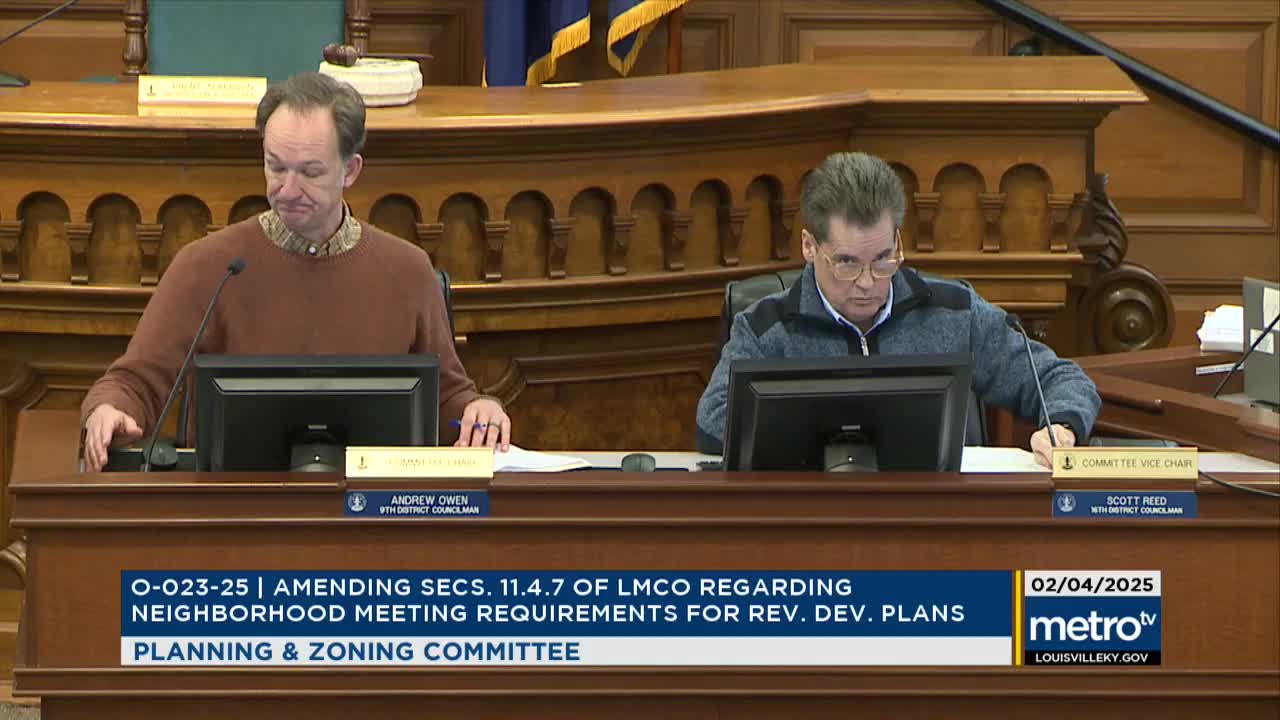
The Planning & Zoning Committee on Feb. 4 extensively debated an ordinance (24 LDC‑0009) that would require developers to hold neighborhood meetings before submitting a revised detailed district development plan within three years of an approved zoning change if the revision increases density or otherwise crosses set thresholds.
Joel Dock, legal staff in the Office of Planning, said the proposal responds to concerns about a perceived “bait and switch” where a project is presented one way at rezoning and revised quickly afterward. Dock explained the ordinance would require a neighborhood meeting for certain changes — including increases in density by a percentage threshold, changes of use affecting occupancy, increases in building footprint, and significant deviations in building or site design not caused by utilities or environmental constraints — if those changes occur within three years of a zoning approval.
Dock said the planning commission reduced an original 25% deviation threshold to 10% after public comment at the planning commission hearing. He and staff described the threshold as an across‑the‑board percentage intended to capture changes that are significant enough to warrant neighborhood notice while working within staff’s authority to approve minor revisions.
Council members expressed a range of views. Some members argued a 10% trigger is too low and could create unnecessary delays and cost for developers, while others said even an informational meeting restores trust and gives neighbors a formal opportunity to have concerns recorded. Several members raised concerns that the proposed neighborhood meeting would be informational only and would not bind developers, which they said risked appearing performative. Staff repeatedly clarified the proposed meeting would be informational and intended to notify neighbors and gather feedback prior to an application being filed; other public hearings and the planning‑commission process would still apply.
After extended comment from council members on both sides of the issue, Councilwoman Raymond moved to table the ordinance for further work; the motion was seconded and the committee voted to table the item until the next meeting.