Get Full Government Meeting Transcripts, Videos, & Alerts Forever!
Get email alerts on the Legislative Affairs topic
No spam. Unsubscribe anytime.
District 51 lobbyist briefs board on Colorado bills; board adopts positions later in the meeting
Summary
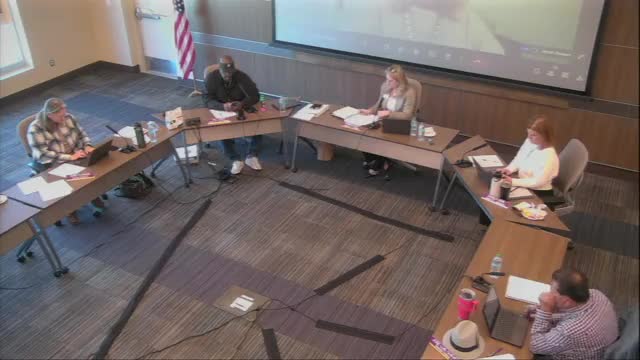
Contract lobbyist Amy Atwood told the Mesa County Valley School District No. 51 board on March 25 that a tight state budget is slowing bill movement and reviewed several education-related bills. She recommended positions the board later adopted, including opposing a ban on student seclusion and opposing a workers’ compensation change.
Amy Atwood, contract lobbyist for Mesa County Valley School District No. 51, briefed the board March 25 on the Colorado legislative session and several bills that could affect the district and local control. “May 7 is the last day,” Atwood said, referring to the statutory end of the legislative session, and warned that a tight state budget—“we went into the year… over a billion dollars in the hole”—is slowing appropriations and shaping which bills can move forward.
Atwood told the board there are just over 500 bills introduced this year and described seven measures with local-control or fiscal implications. She summarized each bill and recommended positions the board later voted to adopt. Key items she highlighted:
- House Bill 1135 (communication devices in schools): Atwood described it as bipartisan and a district-friendly measure that requires districts to adopt phone policies rather than imposing a blanket statewide ban. She recommended support.
- House Bill 1178 (ban on student seclusion): Atwood said this bill would prohibit any use of student seclusion as written and would inadvertently ban “sensory rooms” and other state-compliant supports. She said the bill “as written… just isn’t… good for districts” and recommended opposition.
- House Bill 1192 (financial literacy and FAFSA): The bill would require a financial-literacy course for graduation and require students to submit a FAFSA for state financial aid unless they qualify for an exception. Atwood said many districts already teach financial literacy and noted objections from school associations about local-control and feasibility. She recommended opposition.
- House Bill 1210 (K–12 data reporting study): Atwood described this bill as a review of required reporting to the Colorado Department of Education (CDE) to identify duplicative or outdated reports; she recommended support.
- House Bill 1278 (Education Accountability System): Atwood said the bill incorporates about 30 recommendations from the Education Accountability Task Force and carries a multiyear fiscal note; she advised monitoring because the bill will likely be pared back before funding is attached.
- Senate/House bill referenced as “1300” (workers’ compensation changes): Atwood said it would (1) give injured workers more control over choice of primary treating physician and (2) shift the burden of proof to employers to show an injury did not occur. She described the bill as expensive, likely to raise district costs, and recommended opposition.
- Senate Bill 153 (expanded school-level financial reporting): Atwood said this bill would require school-level financial reporting down to expenditures for marketing, recruitment, contractors and private donations, an expansion from last year’s charter-targeted proposal; she recommended opposition as overly burdensome and invasive to private donations.
Atwood also briefed the board on the state budget process, saying committees were negotiating and that the School Finance Act might be handled in tandem with the budget this year. She said the joint budget committee had discussed holding education funding flat or increasing it by $150 million but cautioned uncertainty until the committee finishes negotiations.
The board discussed the bills and later voted to adopt the positions Atwood recommended (support, oppose or monitor as she listed). Board members asked about federal FAFSA workload and about operational impacts of data-reporting bills; Atwood cited examples from other states and urged monitoring and engagement as the session neared its deadline.