Get Full Government Meeting Transcripts, Videos, & Alerts Forever!
Get email alerts on the Land Use Development topic
No spam. Unsubscribe anytime.
Apple Valley negotiates seven development agreements; mayor says developers will fund key infrastructure
Summary
The mayor said the town has seven development agreements (DAs) in negotiation or final stages, reduced a major project’s home count and secured developer commitments for a concrete million‑gallon tank, pipeline segments and road improvements while changing zoning rules to preserve a rural character.
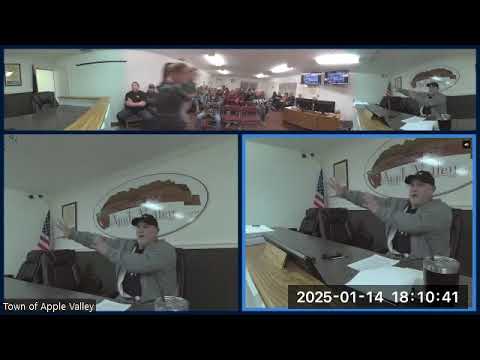
Mayor, Town of Apple Valley, told residents the town is negotiating or finalizing seven development agreements intended to manage previously approved growth and secure infrastructure contributions from developers.
“These are our DAs that we're going through right now. We have 7, d a DA is a development agreement with the developers,” the mayor said, describing the agreements as a way to “slow it down and do it responsibly.”
He identified one large project by the name used in the meeting — Quota Roca — as an 84‑cabin proposal with a lodge, spa and restaurant plus about 19 five‑acre home sites; he said the developer agreed to pay for a new concrete million‑gallon tank, a 12‑inch pipeline to the west end of town, highway turn lanes and Cinder Hill Road work. The mayor said another developer, identified as Travis Holmes, agreed to reduce an overall project count from about 3,500 homes to roughly 1,300 homes, including around 400 cabins and short‑term rentals, and to fund paving and other improvements for Gooseberry Road and related development areas.
The mayor said the DA negotiations also stopped a proposed disconnect that would have removed some parcels from the town and shifted development outside town limits. He said most future subdivisions will now be restricted to one‑acre minimum lots or larger and that the town eliminated half‑acre minimum zoning.
He described other code changes and enforcement steps taken this year: a civil code enforcement plan that routes fines to the town, an accessory‑building rule that allows larger barns and shops without requiring a larger primary residence, and a 300‑foot rule limiting nuisance complaints to nearby properties unless public safety is at issue. The mayor also said the town had worked with residents and short‑term rental operators to bring lighting into compliance with the town’s night‑sky ordinance, largely through outreach rather than citations.
The mayor said the DA approach is intended to secure developer contributions for public infrastructure rather than leaving the town or taxpayers to pay for improvements. He tied the changes to an effort to qualify for a resort tax if the number of short‑term rentals reaches the state threshold, which he said remains several dozen units away.
The mayor asked residents to participate in future planning — including input on a proposed commercial zone theme — and emphasized he wants to preserve Apple Valley’s rural character while allowing negotiated growth.
He said the DA work is nearly complete but depends on water outcomes and other technical approvals before final signatures and implementation.