Get Full Government Meeting Transcripts, Videos, & Alerts Forever!
Get email alerts on the Water And Growth topic
No spam. Unsubscribe anytime.
Apple Valley mayor: town approved development agreements, pipeline work under way and USGS aquifer study will guide future growth
Summary
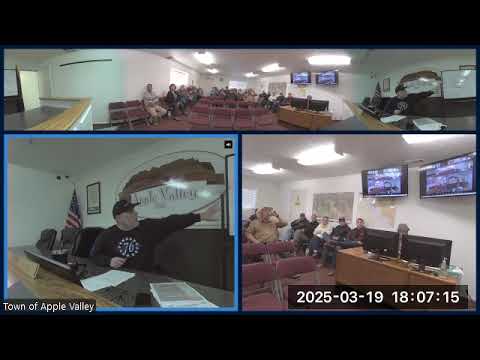
Mayor Mike Farrar told residents in an online meeting that the town has approved multiple development agreements that reduce projected homes from earlier zoning, denied a developer disconnect request to avoid losing local control, and outlined pipeline, tank and aquifer work to secure water for existing residents and limited future growth.
Mayor Mike Farrar told residents at an online town meeting that the Town of Apple Valley has approved multiple development agreements and is moving ahead on pipeline work, while a U.S. Geological Survey aquifer study and further well drilling will determine where additional growth can be supported.
The mayor said the council approved a package of development agreements (MDAs) that together reduced earlier projected dwelling units and increased open space, and that the council denied a developer request to “disconnect” properties back to the county — a move Farrar said would have cost the town local control and tax revenue and would likely have prompted litigation. "Zone changes are the only authority or power the town has to stop or control growth," Farrar said, adding that once land is rezoned the town cannot later prevent the density that zoning allows.
Why it matters: Apple Valley residents have pressed town leaders for clarity about where new residents’ water would come from as several large projects move forward. Farrar described a three-part approach: finish the pipeline and pump house that will link Cedar Point and Apple Valley proper; accept and integrate new wells and a donated tank tied to a developer’s work on the east side of Main Street; and evaluate springs and recharge options. He said an official USGS aquifer report is expected this summer and that the town will submit a water plan to the state Division of Drinking Water for approval before allowing further large-scale growth.
Most important details
- Development agreements and zoning: Farrar listed multiple MDAs and preapproved subdivisions around Gooseberry Mesa and Main Street (names discussed include West Temple, Crimson, Redstone, Solstice, Gooseberry Preserve and Gooseberry Springs Ranch). He said the new package reduced an earlier estimate of roughly 3,700–4,200 potential lots to about 1,400 homes and about 580 cabins (figures Farrar described as his estimate). One package item, Gooseberry Springs Ranch, was newly approved by the council as part of a negotiated deal with the developer identified in the meeting as Travis.
- Disconnect denied: Farrar said the town denied an application to disconnect some properties from the town and return them to county jurisdiction; the town attorney advised the council that the town would likely lose in court if it allowed the disconnect and would also lose control of water and tax revenue.
- Pipeline and pump house status: Farrar said the transmission pipeline to connect Apple Valley proper and Cedar Point is almost complete — "about a hundred feet of pipe left" — and that crews planned a tie-in at the RV park in the days after the meeting. He attributed the delay in turning water on to redesign and permitting for the pump house (including an easement dispute involving Rocky Mountain Power and a private property owner). Farrar said contractors expect water to be flowing by April, contingent on final pump house work and electrical hookups; an emergency generator will be installed and the conservancy has agreed to loan a portable generator if needed.
- Budget and funding: Farrar said the pipeline has come in under budget by a significant sum (he estimated $300,000–$500,000). He said the town applied for an additional grant (amounts discussed in the meeting were inconsistent in places; the transcript did not record a single confirmed figure) and that the Washington County Conservancy funded a USGS aquifer study.
- System upgrades and backup: The pipeline budget includes a supervisory control and data acquisition (SCADA) system Farrar described as a "state of the art" upgrade (he estimated roughly $100,000) to monitor wells, tanks and valves remotely. The Gregersen well received a new pump (Farrar cited about $13,000) and the town plans a substantial backup generator at the pump house (Farrar cited a price near $100,000); he said both Merritt and Gregersen wells have backup generators and stored diesel onsite.
- Million-gallon tank and developer work: Farrar said the developer (referred to in the meeting as Travis and at times associated with the name Cultoroca in the discussion) agreed to dedicate land and easements for a higher site for a million-gallon tank and to construct infrastructure (he described a 12-inch pipeline tied to that tank and turn-lane and paving work). Farrar said the developer will install wastewater treatment for the new developments rather than relying on septic, and that the town will take ownership of donated wells and infrastructure as provided in the development agreements.
- Aquifer findings and growth limits: Farrar summarized preliminary USGS findings saying Apple Valley proper currently draws on a smaller, shallower supply he called “Aquifer 1,” which the USGS concluded is effectively at capacity for large new growth; the town has limited remaining capacity for small additional connections. A second, deeper and larger supply he called “Aquifer 2” lies east of Main Street; Farrar said developer drilling into Aquifer 2 could provide a second source of water for future growth, but any plan to rely on Aquifer 2 will be submitted to and approved by the state. He warned that sustained drought (three or more years) could severely affect supplies across the region.
- Springs and water quality: Farrar said the town tested local springs and has shut one spring after a positive coliform result; he said the town will follow state direction on treatment if needed (chlorination was mentioned as a likely treatment option) and that springs are an additional source the town is exploring for backup and for Canaan-area residents.
- Water rights and priority: Farrar described water-rights priority (seniority by date of right) as a legal constraint: older water rights can take precedence in shortage, and he said donated water rights and well infrastructure from a developer will be transferred to the town under agreement terms.
Quotes and attribution
- "Zone changes are the only authority or power the town has to stop or control growth," Mayor Mike Farrar said when explaining why approved zoning sets the density the town can ultimately receive.
What the town decided or directed
- The council approved a package of development agreements and rezones already signed and reported to the town (Farrar described the package as reducing potential density compared with earlier zoning totals). - The council denied a disconnect application that would have returned properties to county jurisdiction; Farrar said legal advice indicated the town would likely lose if it had allowed the disconnect. - Farrar said staff will proceed with the pipeline tie-in and finishing the pump house; engineers will complete final designs for the donated million-gallon tank and associated 12-inch pipeline once developer funding and PID arrangements advance.
What remains unresolved or for future action
- The USGS aquifer report is pending (Farrar said a full written report is expected in summer and that the town will submit a water plan to the state Division of Drinking Water for approval). The town will not allow further large-scale growth until it has state sign-off on the water plan. - The pump house electrical work, final SCADA commissioning and full generator installation remained as tasks before water flows could be turned on for additional connections; Farrar estimated flow by April if those items complete on schedule.
Ending: Farrar closed by urging residents that town policy on growth and water will be guided by the USGS report and state review. He repeated that the council’s recent package of approvals reduced projected housing from earlier zoning estimates and said the town will protect existing residents’ water supply while coordinating with developers and the state on any future expansion.