Get Full Government Meeting Transcripts, Videos, & Alerts Forever!
Get email alerts on the Economic Development topic
No spam. Unsubscribe anytime.
York County economic-development committee and council discuss ED fund priorities; ag facility shortfall trimmed to about $800,000
Summary
Council and the county's economic development staff discussed a draft vision for economic development, survey results on priorities and whether the ag facility shortfall should be funded from the ED fund or other county funds after York 1 School District and private donations reduced the gap.
York County Council and Economic Development Director Mitch Miller discussed a draft vision and priorities for economic development at the April 8 workshop, and council debated how to fund a proposed agricultural facility after staff reported the shortfall had fallen to about $800,000.
Why it matters: decisions about the Economic Development (ED) fund and how the county invests in land, small-business programs and workforce initiatives affect the county's ability to attract higher-wage employers and support local firms.
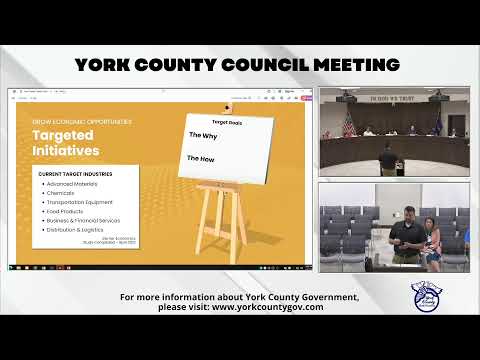
Mitch Miller, the county's economic development director, reviewed survey results council members returned and outlined a framework for an ED strategy: define "why" (the outcomes the county wants), then align incentives and programs to achieve those goals. Miller summarized the county's employment mix (manufacturing 12.7%, health care/social assistance 11.1%, retail 11.1%, finance/insurance 8.4%) and said council responses ranked workforce training and marketing ahead of tax incentives as priorities. "What if we focus on target really important to us. And then we go out and find developers, companies, whatever it may be, that really fits the mold of that," Miller said.
On the ED fund and a proposed agricultural facility, Kevin Madden told council he had spoken with York 1 School District, which had allocated interest income and some donor funds; as a result the funding shortfall for the ag facility had decreased. "The shortfall is now 800,000 instead of $8.80," Madden said. Council members then debated whether that remaining $800,000 should come from the Economic Development Fund or another county source. Councilmember Huckabee and others recommended not using the ED fund for that allocation; staff suggested the general capital fund (referred to in the meeting as account 1420) could be a potential source.
The Economic Development Committee had recommended focusing ED fund dollars on public-private partnerships, land and infrastructure investments and small-business programs; Miller said that aligns with many council members' survey responses that emphasized workforce development, higher-wage jobs and a strategic focus on corridors. He also presented corridor-level ideas (I-77 north/south, Carowinds area, the Catawba River corridors, western Highway 5/85 connections) and asked council members to describe desired outcomes for their districts.
Where council landed: members broadly supported using the ED fund to pursue targeted investments (land development, small-business programs and partnerships) rather than relying primarily on tax incentives. On the ag facility, several council members said they prefer using the capital fund or another source rather than spending ED fund dollars; staff said they will identify the appropriate funding source and include the allocation in the recommended budget where feasible.
Ending: Miller asked council members to continue providing input; staff will return with a recommended configuration for ED fund priorities and a funding plan for the ag facility when the manager presents the recommended FY26 budget April 21.