Get Full Government Meeting Transcripts, Videos, & Alerts Forever!
Get email alerts on the Rural Zoning topic
No spam. Unsubscribe anytime.
York County committee moves toward consolidating rural zones, narrows family-exemption rules and approves new rules for shipping containers
Summary
York County planning staff presented a draft package of changes to rural zoning rules March 31, telling the Planning & Zoning Committee the goal is to simplify redundant districts while protecting agricultural character and reducing spot-zoning concerns.
York County planning staff presented a draft package of changes to rural zoning rules March 31, telling the Planning & Zoning Committee the goal is to simplify redundant districts while protecting agricultural character and reducing the spot-zoning concerns that residents raised in surveys.
The presentation covered four linked topics: consolidation of the county—s agricultural and rural residential districts, minimum lot-size options (including a proposed move from a 5-acre to a 3-acre minimum in one district), revisions to the family-exemption process that allows property owners to subdivide parcels for family members, and several use-table and development standards (driveway spacing, setbacks and accessory storage containers). Staff described the changes as an interim step that would be followed by draft code text and another committee meeting before Planning Commission and full-council hearings.
Why it matters: Planning staff said current zoning categories do not align with how much land is actually farmed in those districts and that some provisions are being used in ways lawmakers did not intend. Staff showed GIS-based analysis that identified farming activity on roughly 15% of parcels in the primary agricultural (AGC) district and about 13% in a related AGC-1 district, with most parcels occupied by residences or vacant land. Committee members repeatedly raised concerns about —spot rezoning— and described the package as an opportunity to reduce surprise requests to rezone individual parcels from agricultural to denser rural residential districts.
Consolidation and lot-size direction
Staff presented three consolidation options: keep status quo; combine pairs of similar districts (the committee—s preferred Option 1); or add an intermediate —rural estate— district. After discussion the committee indicated a working consensus in favor of Option 1—consolidating AGC with AGC-1 and RUD with RUD-1—and asked staff to prepare text that preserves important distinctions (such as where manufactured housing would remain restricted).
On minimum lot size staff proposed reducing AGC—s current 5-acre minimum to 3 acres or adding a new intermediate district. Staff said a 3-acre minimum would have avoided several recent rezoning requests and would give owners more predictable subdivision options without resorting to spot rezonings. Several committee members supported lowering AGC to 3 acres or creating a 3-acre option; others urged caution and asked staff to model acreage totals and likely rezoning impacts before drafting ordinances.
Family-exemption rules
Committee review focused heavily on the county—s —family exemption— (rules that allow property owners to subdivide parcels to transfer lots to family members). Staff summarized the existing code and multiple changes adopted in 2019 that were designed to limit repeated subdivision abuses. Key existing limits staff described included a 10-acre minimum parent parcel, a 20-year ownership requirement for the grantor, limits on grantee eligibility and a requirement that grantees hold title for three years.
Committee discussion produced these policy directions for staff to draft into ordinance language: - Allow grantees to receive smaller lots (committee expressed support for a 1-acre minimum grantee lot in many cases), while requiring the grantor—s residual parcel to meet a minimum (the committee asked staff to draft options that would keep the grantor—s residual at the district minimum). - Retain measures to prevent quick —straw— transfers (for example, recording requirements and limits on who can receive successive exempt lots), and keep deeded access/easement and maintenance agreements as part of any exemption. - Limit the frequency and total number of exemptions per parcel: the committee favored a cap concept (examples discussed included one division every two years and a total cap such as six lifetime exemptions for a given parcel), but asked staff to return with specific regulatory text and examples.
Staff and several members emphasized the difference between family-exemption divisions (which can exempt certain requirements) and development-driven rezonings to a dense district (which remain subject to the standard rezoning public-notice process and council deliberation).
Permitted uses, manufactured homes and accessory units
Staff reviewed the draft consolidated use table and asked the committee whether uses such as assisted-living facilities, farmers markets, craft breweries/wineries and certain commercial/industrial uses should be allowed or conditional in the consolidated rural districts. Committee members generally supported allowing assisted-living uses in AGC as a special exception and asked staff to draft conditional-use requirements for farmers markets, breweries and land-use types that can generate truck traffic (landscape supply yards, larger hunting/fishing clubs and similar commercial uses).
On manufactured homes, the staff summary and committee discussion indicated a policy preference to allow manufactured homes in consolidated rural districts under conditions (for example, minimum lot size or standards to prevent manufactured-home parks in small-lot subdivisions). Committee members suggested size-based controls rather than absolute prohibitions so that larger lots could accommodate manufactured homes without creating dense manufactured-home subdivisions.
On accessory dwelling units (ADUs) staff reminded the group that most residential and agricultural zones allow an ADU in addition to a principal home under current code, and that AGC historically allowed situations with two primary homes on a parcel (often resolved by the 10-acre/2-home rule). Committee members asked staff to preserve clarity about how multiple dwellings will be treated in any revised AGC language to avoid future nonconforming splits.
Driveway spacing, setbacks and solar
Staff recommended reducing the county—s current arterial frontage requirement (350 feet) to 150 feet to better align with neighboring jurisdictions and SCDOT driveway-spacing practice. Committee members discussed safety trade-offs; several supported 150 feet as a compromise while emphasizing DOT spacing and shared-driveway alternatives where highway safety requires fewer curb cuts.
Staff also recommended restoring a 50-foot front-yard setback for agricultural structures (the code consolidation earlier had standardized a 100-foot front setback from the largest number). Committee members supported reverting to 50 feet for ag structures, saying the larger number created practical problems for working farms and accessory agricultural buildings.
Shipping containers: formal motion and vote
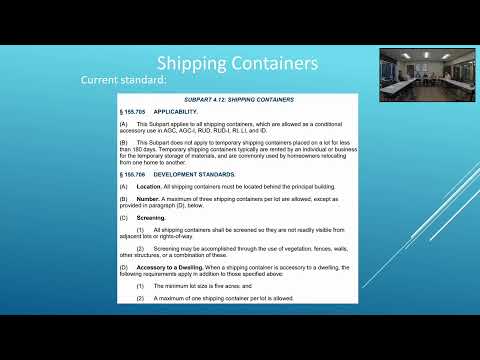
After a lengthy discussion of accessory storage containers and —shipping containers—, committee members proposed a sliding-scale approach: allow a baseline number of containers on rural residential parcels and then permit additional containers in proportion to acreage up to a cap. The motion members put forward and approved at the meeting set a formula roughly described on the record as permitting two containers on the first 1.5 acres and one additional container for each additional two acres, with an overall cap (discussion referenced a cap of 10 containers).
The committee voted in favor of that container rule as the meeting—s working direction; staff recorded the motion and the committee approved it during the session. Staff said it will convert that direction into draft code language and suggested screening, setback and maintenance conditions to reduce visual impacts.
Next steps and public input
Staff told the committee it will prepare draft text amendments based on the committee—s direction, return to the committee with a final staff report and recommended text in May, and then proceed to Planning Commission and council if the committee forwards a recommendation. Committee members asked for public meetings in multiple county locations (western and southern parts of the county were mentioned) to present proposed draft changes and gather public comments. Staff said the timing can be shifted to allow public input before or during Planning Commission/council hearings; the committee asked staff to propose a public-engagement schedule when the draft text is returned.
Ending
Committee members and staff said the package aims to simplify the code while protecting large farms and reducing unintended development pressure. Staff will return with drafted ordinance language, an updated use table and modeled acreage/residential-impact estimates before formal hearings.
Votes at a glance
- Motion: Modify shipping-container allowances to a sliding scale (2 containers for first 1.5 acres, then 1 additional per 2 acres, cap 10). Outcome: Approved by committee vote during the meeting. - Motion: Approve minutes of the February meeting. Outcome: Approved by committee vote during the meeting.