Get Full Government Meeting Transcripts, Videos, & Alerts Forever!
Get email alerts on the Right Of Way topic
No spam. Unsubscribe anytime.
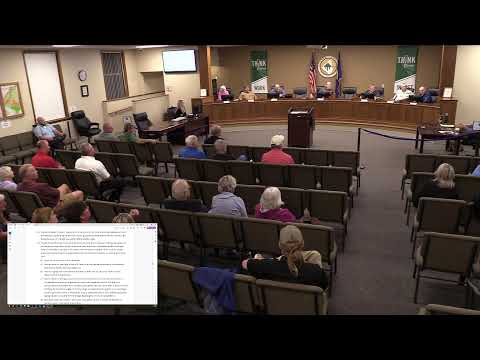
Oconee planning commission hears hours of testimony on 50-foot private road right-of-way; discussion tabled to next meeting
Summary
The Oconee County Planning Commission discussed whether to reduce or remove a 50-foot right-of-way requirement that applies to private drives and private roads. After hours of public comment and expert input from Roads & Bridges and the fire chief, commissioners voted to delay final action to the next meeting and to request further information.
The Oconee County Planning Commission on April 7 debated whether to keep a 50-foot right-of-way requirement for private drives and private roads and ultimately voted to delay action until its next meeting.
The proposal under discussion would change language in Chapter 26 (roads) and Chapter 32 (definitions/subdivision rules) that currently treats private drives and private roads as having a 50-foot right of way (20-foot travel surface plus 15 feet of additional width for utilities, sight lines and maintenance). Supporters said the rule is an overreach that restricts property owners; opponents warned it would reduce emergency access and invite piecemeal development.
Why it matters: the requirement affects how many dwellings a private access can serve, who pays to maintain shoulders and drainage, and whether utilities and emergency vehicles have room to operate. Commissioners and the public described a conflict between ordinances — one section referencing “lots,” another using “dwellings” — and cited real parcels in Oconee County whose ingress widths fall well under 50 feet, which can limit subdivision or family transfers without variances.
Discussion highlights
- Conflict in the ordinance: Commissioners and staff pointed out an internal inconsistency between Chapter 26 (which describes private drives/roads as serving up to 10 lots or dwellings and a 50-foot right of way) and the definitions in Chapter 32 (which elsewhere treats private drives as serving fewer lots). A “dwelling” in the county code is defined as a building or portion of a building with a separate kitchen or bathroom; that can make a single large lot contain multiple “dwellings.”
- Property-rights perspective: Commissioner Mickey Haney and multiple public speakers argued the 50-foot requirement can prevent ordinary family transfers (for example, a ranch house with a basement apartment plus a detached garage apartment can already count as three dwellings) or require a homeowner to seek a Board of Zoning Appeals (BZA) variance to add a family dwelling. Public commenters pressed that owners of large parcels should not have to surrender or plat additional right-of-way simply to enable family members to live on the land.
- Public-safety and emergency-access concerns: Oconee County Fire Chief Chris Smith told the commission that rights of way matter for operations. “Having those rights of way gives us access, not just the roadway for the truck to sit on,” he said, adding that trucks need room to deploy equipment, set dump tanks for water shuttle operations and allow other apparatus to pass. Chief Smith and the fire marshal referenced International Fire Code guidance (including a 20-foot minimum travel width and a vertical clearance of about 13.5 feet) while noting the IFC does not itself define private-road standards.
- Roads & Bridges perspective: Kyle Reed of Oconee County Roads and Bridges said the county does not typically maintain private roads but that, when subdivisions pursue county maintenance, the county requires the roadway and right-of-way to meet county standards. Reed noted the county has recently accepted easements from some subdivisions (for example, Waterside Crossing) where owners granted additional feet to reach a full 50-foot right of way so the county could assume maintenance.
- Examples and evidence: Planning staff presented slides with local parcel examples showing access widths of 23, 27, 34, 42 and 48 feet on properties of varying acreages; speakers debated whether plats and deeds already show 50-foot access in some cases. Public commenter Lucretia Morgan provided research and asked that it be included in the meeting record. Several residents from multi-generation families urged protecting both property rights and the county’s rural character.
Commission actions and procedural items
- Minutes: The commission approved the March 3 minutes by voice vote.
- Expert testimony: The commission voted to invite in-room experts to address technical questions; Roads & Bridges (Kyle Reed) and the Oconee County Fire Chief (Chris Smith) presented on access, maintenance and emergency operations.
- Public comment: Multiple citizens spoke for and against the change. Opponents said the proposal was previously considered in 2022 and rejected; some accused proponents of seeking advantageous rule changes for private development interests. Supporters framed the change as restoring property rights and avoiding unnecessary BZA appeals for family transfers.
- Direction and decision: Rather than amend ordinances at the meeting, the commission voted (unanimously) to delay further action until its next regularly scheduled meeting. Planning Director James Coley and the Planning & Economic Development Committee will present related items (redefining private driveways, front-setback changes and minor-subdivision procedures) at an upcoming meeting so commissioners can consider the issues together.
What was not decided
No ordinance amendments were adopted at the April 7 meeting. The commission did not remove or reduce the 50-foot requirement at this session; members asked for additional legal and technical analysis, clearer mapping of affected parcels, and explicit comparisons to the IFC and to neighboring counties’ standards before taking final action.
Ending
Commissioners said they will reconvene the discussion after staff compiles the requested clarifications and comparative research. The matter is scheduled to return at the commission’s next meeting for continued consideration.