Get Full Government Meeting Transcripts, Videos, & Alerts Forever!
Get email alerts on the Planning Zoning topic
No spam. Unsubscribe anytime.
Lexington County planning staff wins first-reading approval to remove special-exception step for some patio-home approvals
Summary
Lexington County planning commissioners moved on first reading an ordinance that would remove a Board of Zoning Appeals special-exception review for certain patio-home developments and reduce the BZA voting threshold from two‑thirds to a simple majority.
Lexington County planning commissioners moved on first reading an ordinance that would remove a Board of Zoning Appeals (BZA) special-exception review for so-called residential detached limited developments — commonly described in the meeting as patio-type homes — and would change the BZA vote requirement from a two‑thirds supermajority to a simple majority.
The measure, introduced as Ordinance 2506 and presented by Community Development staff, would eliminate the extra public-notice and special-exception step that now follows staff review for these limited patio-home developments. Council moved the ordinance to county council for full consideration after a unanimous committee vote to approve first reading by title.
Staff told council that the same design standards the BZA currently checks are already part of the Community Development review, so removing the special-exception step would principally remove an additional approval and the associated public-notice process. Staff said the change would “expedite the process for folks who are wanting to do that type of development,” and that the county has one patio-home application currently under review; staff said plans have been in review roughly six to seven months.
Council members pressed staff on several procedural details. Committee members noted the BZA currently has eight seats, with one vacancy and another member on extended medical leave; staff said average attendance is about six members per meeting. Several council members said the original supermajority requirement was added when the development type was new and an extra “safety valve” was deemed appropriate.
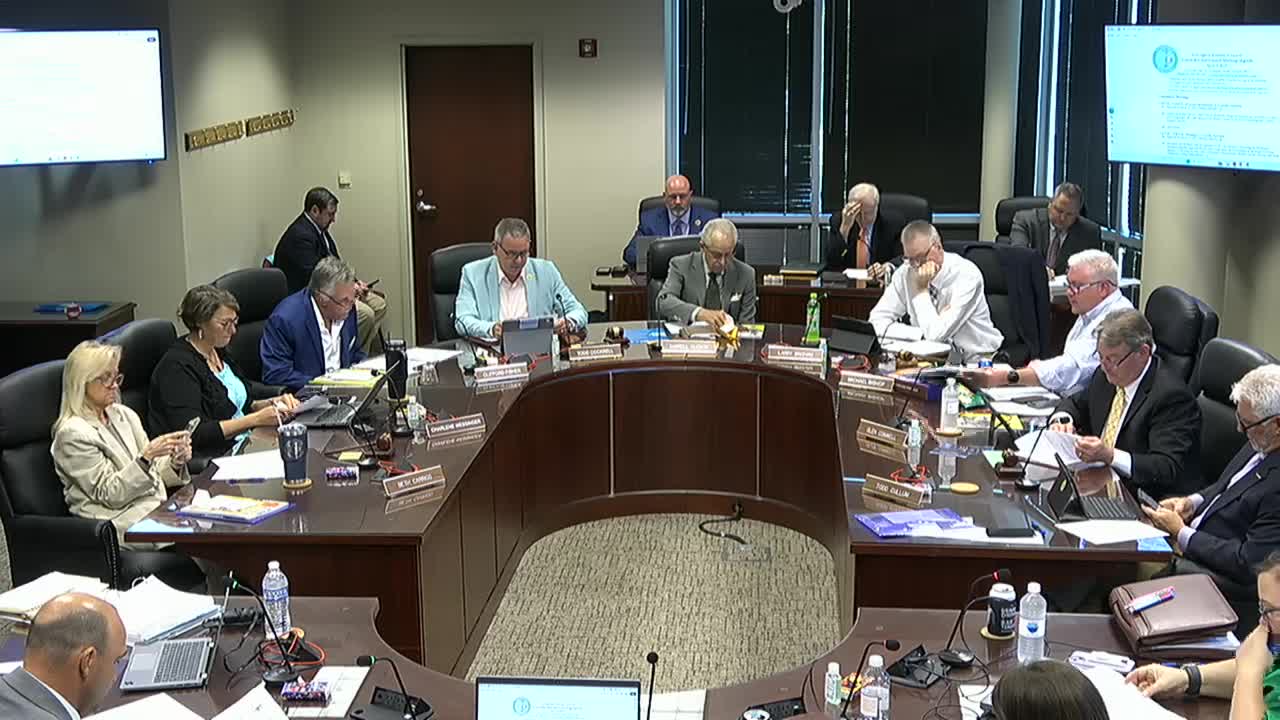
After discussion, Council member Todd Cullum moved to approve staff’s recommendation to advance Ordinance 2506 for first reading by title; the motion was seconded and passed without recorded opposition.
No final policy change was adopted at the committee level; the ordinance was advanced for full council consideration.
Requests for clarification and follow-up included confirming that the ordinance would not change design standards or acreage limits for patio developments (the presenter reiterated the 15‑acre limit remains unchanged) and that the change is procedural rather than substantive.
The committee recorded no formal dissent to forwarding the ordinance, and staff will present the same text at full council for additional consideration.