Get Full Government Meeting Transcripts, Videos, & Alerts Forever!
Get email alerts on the Food Pantry topic
No spam. Unsubscribe anytime.
Gilpin County residents sharply divided over proposed food pantry expansion and commercial kitchen
Summary
Public commenters at the Gilpin County Board of County Commissioners meeting on March 25 urged both caution and urgency on a planned new food pantry/annex, disputing project scope, rising cost estimates and the need for a commercial kitchen while some residents said voters mandated the project.
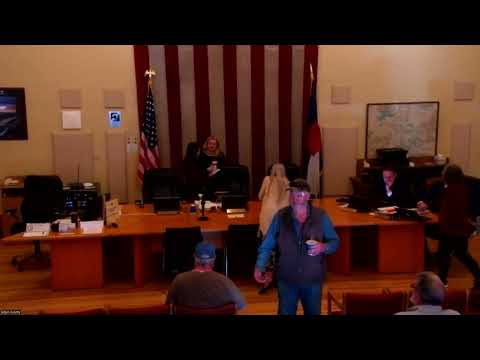
Dozens of Gilpin County residents told the Board of County Commissioners on March 25 that a planned replacement for the county food pantry should either be paused for more public review or built immediately and to a higher standard, with repeated debate centering on rising cost estimates and whether the project needs a commercial kitchen.
At a public-comment period before regular business, resident Dan Adler said he opposed what he described as an "expensive food pantry which includes office space and a commercial kitchen," adding, "as a county of under thousand people we can't afford another building to defer maintenance on" and urging the commissioners to prioritize existing building maintenance over new construction.
The dispute stems in part from shifting cost figures that residents said were disclosed only recently. "Last week we watched and listened while we learned that the funds proposed for the food pantry have grown from $1,100,000 to $3,300,000 over the last year and nine months," Bruce Perman said. Perman also said the board had since reduced the scope and that the current figure discussed publicly was about $2,465,000.
Other speakers questioned the need for a commercial kitchen inside the pantry. Jan Hedrick said the food pantry itself is "mandated by state law," but added, "the commercial kitchen is not mandated by state law," and asked whether the county needs to spend roughly $70,000 on kitchen space and equipment. Kathleen Balfour recalled language on the meeting agenda indicating the county would sign a contract for construction and said the indicated contract amount was $1,800,000 with a not-to-exceed price of $2,400,000.
Supporters of the project argued that the new pantry is necessary for emergency response and to serve growing needs. A speaker identified as Tell Gibbs said voters had made the pantry a central issue in recent elections and that "the voters decided by voting in the current board that the pan[d] food pantry needs to have a new home and meet the needs of the county." Cecilia Wilson said the county should "build it right the first time" to avoid future repairs and called a commercial kitchen a "wise investment." Several speakers described personal or county-level vulnerability to economic and emergency pressures and urged timely construction.
Residents also raised operational and regulatory questions about the commercial-kitchen proposal: who would manage rentals, what permits and licenses would be required, estimated staffing and maintenance costs, and how additional water use would affect local wells. Kathleen Balfour asked whether the kitchen would be stocked and whether rental fees were realistic, noting the Netherland commercial kitchen (reported by commenters to be in a rec center) charges a lower hourly rate than the county discussion suggested. Marie Morris and others specifically asked the commissioners to share any water-usage analyses; Morris said county water attorneys had not initially been aware the plan included offices and a commercial kitchen and warned of long-term impacts on the shared aquifer.
Other commenters focused on location and site utilities. Larry Sterling urged keeping the building in its existing footprint to avoid tree removal and the added cost of relocating utilities. Dan Adler urged the board to advance fire-mitigation measures, citing a private offer of donated land and a $25,000 donation toward cisterns and saying cisterns could reduce insurance cancellations and fire risk in parts of the county.
Commission business on the agenda included a later contract-signing item for the food pantry; several speakers specifically asked the board to postpone any binding decisions until the community had time to review revised cost figures. The board closed public comment for the morning and moved on to consent items; no final decision on the pantry construction contract appears in the transcript excerpt.
Questions raised during public comment that commissioners or staff would need to answer before final approval included a current, itemized project budget; the county's plan for managing or renting a commercial kitchen (including licensing, insurance and staffing); any water-use analyses tied to local wells; whether any grant or reserve funds would be applied and with what conditions; and the project's expected timeline and contingency not-to-exceed amounts.
For now, the project remains an agenda item under active public scrutiny: residents asked for more notice and broader community engagement, while others said delay risks higher construction costs and unmet needs.